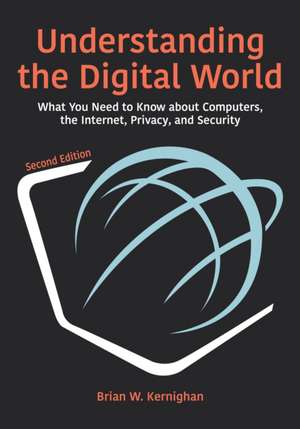
Understanding the Digital World
Autor Brian W Kernighanen Limba Engleză Paperback – 30 mar 2021
Notăm de la început că Understanding the Digital World este conceput ca un punct de intrare accesibil, nepresupunând cunoștințe tehnice prealabile sau o pregătire formală în informatică. Brian W Kernighan structurează materialul pentru a oferi o înțelegere fundamentală oricărui cititor curios să descopere mecanismele din spatele dispozitivelor pe care le folosim zilnic. Ne-a atras atenția rigoarea cu care autorul trece de la componentele fizice ale unui calculator la complexitatea rețelelor globale și a algoritmilor de învățare automată. Subliniem importanța noilor capitole dedicate limbajului Python și conceptelor de Big Data, care ancorează lucrarea în realitatea tehnologică actuală. Abordarea diferă de How Things Work de Charles F. Bowman prin faptul că este mai puțin un compendiu de tutoriale și mai mult o analiză aplicată a modului în care datele circulă și sunt stocate. În timp ce alte titluri se concentrează pe instrucțiuni, Brian W Kernighan pune accent pe limitările inerente ale computerelor și pe implicațiile etice ale monitorizării digitale. Structura narativă este susținută de ilustrații color și un glosar care clarifică jargonul tehnic, facilitând un ritm de lectură constant. Această ediție publicată de Princeton University Press reușește să demistifice nu doar laptopurile vizibile, ci și sistemele integrate în aparatura medicală sau rețelele electrice. Comparativ cu Living in a Digital World, lucrarea de față este mai mult orientată spre contextul socio-politic și securitatea informației, oferind o perspectivă critică asupra modului în care companiile și guvernele gestionează datele personale.
Preț: 271.84 lei
Preț vechi: 339.79 lei
-20%
Carte disponibilă
Livrare economică 07-21 noiembrie
Livrare express 24-30 octombrie pentru 60.65 lei
Specificații
ISBN-10: 0691219109
Pagini: 304
Dimensiuni: 180 x 253 x 22 mm
Greutate: 0.83 kg
Editura: Princeton University Press
V-ar putea interesa
-
 C Programming LanguageDennis Ritchie-20%Preț: 385.95 lei482.43 lei
 -
 The Go Programming LanguageAlan A. A. Donovan-20%Preț: 264.38 lei330.47 lei
 -
 The Practice of ProgrammingBrian Kernighan-20%Preț: 304.16 lei380.20 lei
 -
 Message to Our Folks: The Art Ensemble of ChicagoPaul SteinbeckPreț: 306.70 lei
 -
 Carcinogenesis by Ultraviolet LightHarold Francis BlumPreț: 457.65 lei
 -
 Education and Military Leadership. A Study of the ROTCJohn Wesley MaslandPreț: 397.76 lei
 -
 New England State PoliticsDuane LockardPreț: 450.70 lei
 -
 The Traditional Tunes of the Child Ballads, Volume 1Bertrand Harris Bronson-19%Preț: 508.94 lei628.32 lei
 -
 Rhythmic and Synthetic Processes in GrowthDorothea Rudnick-5%Preț: 365.80 lei385.05 lei
 -
 Geometric Integration TheoryHassler Whitney-19%Preț: 492.43 lei607.94 lei
 -
 Farm TroubleLauren SothPreț: 299.39 lei
 -
 Physiological AcousticsErnest Glen Wever-5%Preț: 675.31 lei710.86 lei
 -
 Introduction to Differential GeometryLuther Pfahler EisenhartPreț: 482.99 lei
 -
 Chemistry of PenicillinHans T. Clarke-23%Preț: 1331.29 lei1728.95 lei
 -
 StreamlinerJohn WallPreț: 352.86 lei
 -
 D Is for DigitalBrian W. Kernighan-20%Preț: 89.60 lei112.00 lei
 -
 Programmieren in C. ANSI C (2. A.)Brian W. Kernighan-20%Preț: 220.07 lei275.09 lei
De ce să citești această carte
Recomandăm această carte oricărei persoane care dorește să înțeleagă tehnologia dincolo de interfața grafică. Cititorul câștigă o viziune de ansamblu asupra modului în care funcționează Internetul, programarea și inteligența artificială, fără a fi intimidat de jargon. Este un ghid esențial pentru a naviga în siguranță într-o lume în care computerele sunt omniprezente, dar adesea invizibile.
Despre autor
Brian W Kernighan este o figură legendară în informatică, fiind co-autor al primului manual despre limbajul de programare C și contribuind semnificativ la dezvoltarea sistemului de operare Unix la Bell Labs. În prezent profesor la Universitatea Princeton, Kernighan are abilitatea rară de a explica concepte complexe în termeni clari. Experiența sa de zeci de ani în cercetare și educație oferă cărții o autoritate incontestabilă, transformând-o dintr-un simplu manual într-o resursă fundamentală pentru cultura digitală modernă.
Descriere scurtă
Computers are everywhere. Some are highly visible, in laptops, tablets, cell phones, and smart watches. But most are invisible, like those in appliances, cars, medical equipment, transportation systems, power grids, and weapons. We never see the myriad computers that quietly collect, share, and sometimes leak personal data about us. Governments and companies increasingly use computers to monitor what we do. Social networks and advertisers know more about us than we should be comfortable with. Criminals have all-too-easy access to our data. Do we truly understand the power of computers in our world? In this updated edition of Understanding the Digital World, Brian Kernighan explains how computer hardware, software, and networks work. Topics include how computers are built and how they compute; what programming is; how the Internet and web operate; and how all of these affect security, privacy, property, and other important social, political, and economic issues. Kernighan touches on fundamental ideas from computer science and some of the inherent limitations of computers, and new sections in the book explore Python programming, big data, machine learning, and much more. Numerous color illustrations, notes on sources for further exploration, and a glossary explaining technical terms and buzzwords are included. Understanding the Digital World is a must-read for readers of all backgrounds who want to know more about computers and communications.
Notă biografică
Cuprins
- Preface
- Introduction
- Part I: Hardware
- 1. What Is a Computer?
- 1.1 Logical Construction
- 1.1.1 Processor
- 1.1.2 Primary memory
- 1.1.3 Secondary storage
- 1.1.4 Et cetera
- 1.2 Physical Construction
- 1.3 Moore's Law
- 1.4 Summary
- 2. Bits, Bytes, and Representation of Information
- 2.1 Analog versus Digital
- 2.2 Analog-Digital Conversion
- 2.2.1 Digitizing images
- 2.2.2 Digitizing sound
- 2.2.3 Digitizing movies
- 2.2.4 Digitizing text
- 2.3 Bits, Bytes, and Binary
- 2.3.1 Bits
- 2.3.2 Powers of two and powers of ten
- 2.3.3 Binary numbers
- 2.3.4 Bytes
- 2.4 Summary
- 3. Inside the Processor
- 3.1 The Toy Computer
- 3.1.1 The first Toy program
- 3.1.2 The second Toy program
- 3.1.3 Branch instructions
- 3.1.4 Representation in memory
- 3.2 Real Processors
- 3.3 Caching
- 3.4 Other Kinds of Computers
- 3.5 Summary
- Wrap-up on Hardware
- Part II: Software
- 4. Algorithms
- 4.1 Linear Algorithms
- 4.2 Binary Search
- 4.3 Sorting
- 4.4 Hard Problems and Complexity
- 4.5 Summary
- 5. Programming and Programming Languages
- 5.1 Assembly Language
- 5.2 High-Level Languages
- 5.3 Software Development
- 5.3.1 Libraries, interfaces, and development kits
- 5.3.2 Bugs
- 5.4 Intellectual Property
- 5.4.1 Trade secret
- 5.4.2 Trademark
- 5.4.3 Copyright
- 5.4.4 Patent
- 5.4.5 Licenses
- 5.5 Standards
- 5.6 Open Source Software
- 5.7 Summary
- 6. Software Systems
- 6.1 Operating Systems
- 6.2 How an Operating System Works
- 6.2.1 System calls
- 6.2.2 Device drivers
- 6.3 Other Operating Systems
- 6.4 File Systems
- 6.4.1 Secondary storage file systems
- 6.4.2 Removing files
- 6.4.3 Other file systems
- 6.5 Applications
- 6.6 Layers of Software
- 6.7 Summary
- 7. Learning to Program
- 7.1 Programming Language Concepts
- 7.2 A First JavaScript Program
- 7.3 A Second JavaScript Program
- 7.4 Loops and Conditionals
- 7.5 JavaScript Libraries and Interfaces
- 7.6 How JavaScript Works
- 7.7 A First Python Program
- 7.8 A Second Python Program
- 7.9 Python Libraries and Interfaces
- 7.10 How Python Works
- 7.11 Summary
- Wrap-up on Software
- Part III: Communications
- 8. Networks
- 8.1 Telephones and Modems
- 8.2 Cable and DSL
- 8.3 Local Area Networks and Ethernet
- 8.4 Wireless
- 8.5 Cell Phones
- 8.6 Bandwidth
- 8.7 Compression
- 8.8 Error Detection and Correction
- 8.9 Summary
- 9. The Internet
- 9.1 An Internet Overview
- 9.2 Domain Names and Addresses
- 9.2.1 Domain Name System
- 9.2.2 IP addresses
- 9.2.3 Root servers
- 9.2.4 Registering your own domain
- 9.3 Routing
- 9.4 TCP/IP Protocols
- 9.4.1 IP, the Internet Protocol
- 9.4.2 TCP, the Transmission Control Protocol
- 9.5 Higher-Level Protocols
- 9.5.1 Telnet and SSH: remote login
- 9.5.2 SMTP: Simple Mail Transfer Protocol
- 9.5.3 File sharing and peer-to-peer protocols
- 9.6 Copyright on the Internet
- 9.7 The Internet of Things
- 9.8 Summary
- 10. The World Wide Web
- 10.1 How the Web Works
- 10.2 HTML
- 10.3 Cookies
- 10.4 Active Content in Web Pages
- 10.5 Active Content Elsewhere
- 10.6 Viruses, Worms and Trojan Horses
- 10.7 Web Security
- 10.7.1 Attacks on clients
- 10.7.2 Attacks on servers
- 10.7.3 Attacks on information in transit
- 10.8 Defending Yourself
- 10.9 Summary
- Part IV: Data
- 11. Data and Information
- 11.1 Search
- 11.2 Tracking
- 11.3 Social Networks
- 11.4 Data Mining and Aggregation
- 11.5 Cloud Computing
- 11.6 Summary
- 12. Artificial Intelligence and Machine Learning
- 12.1 Historical Background
- 12.2 Classical Machine Learning
- 12.3 Neural Networks and Deep Learning
- 12.4 Natural Language Processing
- 12.5 Summary
- 13. Privacy and Security
- 13.1 Cryptography
- 13.1.1 Secret-key cryptography
- 13.1.2 Public-key cryptography
- 13.2 Anonymity
- 13.2.1 Tor and the Tor Browser
- 13.2.2 Bitcoin
- 13.3 Summary
- 14. What Comes Next?
- Notes
- Glossary
- Index
- 13.1 Cryptography
- 11. Data and Information
- 8. Networks
- 4. Algorithms
- 3.1 The Toy Computer
- 1.1 Logical Construction
- 1. What Is a Computer?