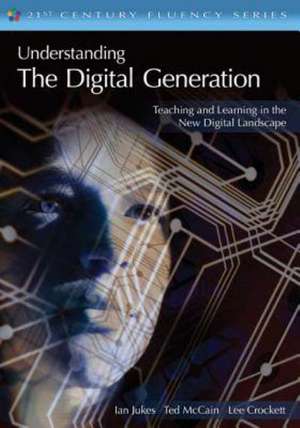
Understanding the Digital Generation: Teaching and Learning in the New Digital Landscape: The 21st Century Fluency Series
Autor Ian Jukes, Ted McCain, Lee Watanabe-Crocketten Limba Engleză Electronic book text – 9 apr 2012
- A comprehensive profile of digital learners' attributes
- An exploration of the concepts of "neuroplasticity" and the "hyperlinked mind"
- An approach to educational models that support traditional literacy skills alongside essential 21st-century fluencies
- An examination of appropriate methods of evaluation that encompass how digital generation students process new information
For staff developers leading study groups, this text provides powerful chapter-opening quotes, built-in questions, and additional tools to generate reflective dialogue and an open exchange of ideas.

Preț: 191.12 lei
Puncte Express: 287
Indisponibil temporar
Doresc să fiu notificat când acest titlu va fi disponibil:
Se trimite...
Specificații
ISBN-13: 9781452222547
ISBN-10: 1452222541
Pagini: 176
Dimensiuni: 178 x 254 mm
Ediția:1
Editura: SAGE Publications
Colecția Corwin
Seria The 21st Century Fluency Series
Locul publicării:Thousand Oaks, United States
Recenzii
"A highly
relevant
book
that gives
specific
reasons
for
educators
to
shift
to
meet
the
needs
of
digital
natives.
This
book
is
loaded
with
vignettes
and
cases
to
demonstrate
how
the
kids
of
today
think
and
learn,
with
strategies
to
help
educators
engage
today’s
tech-savvy
students."
“Jukes, McCain, and Crockett provide an excellent argument of why schools are not effectively preparing our students for the 21st-century global workforce. This shift of the paradigm where students move from consumers of knowledge to creators of their knowledge is paramount to students’ future successes.”
“In their new book, Jukes, McCain, and Crockett have broken new ground. While focusing on 21st-century skills, this group of authors has laid important groundwork for lifting our thinking into the 21st century. As they so aptly point out, we cannot correctly identify the skills for the 21st century with thinking still grounded in the 20th century. Jukes, McCain, and Crockett challenge our thinking first and then lead us to what is important for our students to be able to do in this new century. They are right on target for truly understanding the future of educating children.”
“Jukes, McCain, and Crockett have laid out an excellent road map for learning in the 21st century. Readers will have clearer understanding of this digital generation and why our classrooms continue to teach analog students in a digital world.”
“This book dramatically documents the need for educators to recognize that 21st-century learners do not learn like their predecessors. The included research and suggested strategies for change provide hope for the future. As a former Ohio school superintendent and staff development director, I believe this is a must-read for those truly interested in educational reform.”
"Understanding the Digital Generationis grounded in the recognition that today's students are very different from those in the past, and it outlines new approaches to schooling with technology that should be heard and acted upon now."
“This book explores critical questions that intrigue today’s educational leaders: How do I balance the best of the past with the opportunities and realities of the present? How do I balance all that I know with all that we are becoming? And how does all this create the best possible learning environment for our students? A great guide to the future!”
“The students populating today’s schools are fundamentally different from those of previous generations. If we are serious about educating them for life in the 21st century, we must acknowledge this difference and rebalance our approach. InUnderstanding the Digital Generation, Jukes, McCain, and Crockett fully deliver on their goal of providing a greater understanding of the digital generation and sparking ‘...deep thinking about how instruction should change to teach them effectively.’”
“Jukes, McCain, and Crockett offer up a highly readable, terribly important summary of the attributes of today's technologically enhanced children and explore the urgent implications for today’s schools. Get this book and read it. And then pass it along to your administrators!”
“A book that captures what real learning is all about. Thank you Ian, Ted, and Lee for sharing your knowledge and casting new insight on digital kids. A must-read for every teacher, teaching in this modern, high-tech, digital online world. This book equips teachers to meet these challenges and is the first of its kind to make a significant shift in focus from how teachers teach to how students learn.”
"The authors make a compelling case for the need to transform 20th-century classrooms into 21st-century learning environments to engage digital learners and prepare them to successfully collaborate, create, and compete in the mulitnational workplaces and communities of the new knowledge economy."
"While many assume that 21st-century education merely demands access to hardware and the Internet, our greatest limit is one of pedagogical vision. Jukes, McCain, and Crockett consistently push us to re-imagine the entire premise of learning and collaboration in the future. Best of all, they know how to guide us through a strategic process that ensures our students will remain intellectually agile in a future that extends far beyond the traditional schoolhouse."
"For academic advisors this book is a good resource to provide an understanding and appreciation for the digital generation of students. I recommend this book for academic advisors seeking to better improve their understanding and interactions with students of the digital generation."
Cuprins
The
21st
Century
Fluency
Project
Foreword
Introduction
Part I. Understanding the Digital Generation
1. The Need for Balance
2. The Problem of the Gap
3. What We Know About the Digital Generation
4. Learning Preferences of the Digital Generation
Part II. How Should Education Respond?
5. An Impending Tragedy
6. It’s Time to Catch Up
7. A Shift to Whole-Mind Instruction
8. Teachers Must Move Off the Stage
9. Teachers Must Let Students Access Information Natively
10. Teachers Must Let Students Collaborate
11. Teachers Must Teach Students Visually
12. Teachers Must Re-evaluate Evaluation
13. A Need for Balance and Leadership
Descriere
This
resource
examines
how
the
digital
landscape
is
transforming
teaching
and
learning,
why
informed
leadership
is
so
critical,
and
how
instruction
can
support
traditional
literacy
skills
alongside
21st-century
fluencies.