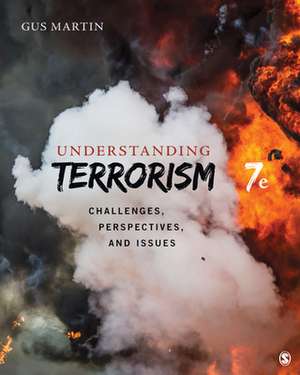
Understanding Terrorism: Challenges, Perspectives, and Issues
Autor Gus Martinen Limba Engleză Electronic book text – 30 iul 2020
Manualul Understanding Terrorism, ajuns la a 8-a ediție, reprezintă o resursă academică fundamentală pentru studenții și specialiștii în științe politice care doresc să descifreze complexitatea violenței politice contemporane. Observăm că această nouă ediție pune un accent sporit pe evoluția extremismului de dreapta în Occident și pe diversificarea tacticilor și armamentului utilizat de grupurile teroriste moderne. Structura volumului este riguros organizată în secțiuni care facilitează tranziția de la teorie la practică: începe cu o revizuire conceptuală și istorică, continuă cu definirea riguroasă a fenomenului prin prisma „matricei violenței politice” și culminează cu analiza cauzelor strategice ale terorismului.
Considerăm că abordarea lui Gus Martin este una dintre cele mai echilibrate din domeniu, reușind să integreze perspective din sociologie, istorie și securitate internațională. Volumul acoperă aceeași arie tematică precum Terrorism in Perspective de Sue Mahan, însă se diferențiază printr-o structură pedagogică mai densă, oferind instrumente de evaluare critică după fiecare capitol, cum ar fi liste de personalități și organizații proeminente. În contextul operei sale, această lucrare sintetizează expertiza autorului dezvoltată în proiecte precum The SAGE Encyclopedia of Terrorism, Second Edition, oferind însă un format de curs mult mai aplicat decât rigoarea lexicografică a enciclopediei.
Textul nu se limitează la o simplă descriere a evenimentelor, ci propune o metodologie de analiză a extremismului ca fundație a terorismului. Prin studii de caz concrete — de la ideologia Al-Qa’ida la „cazul Carlos” — autorul ghidează cititorul prin labirintul motivațiilor politice și psihologice, transformând o temă abstractă într-o disciplină de studiu sistematică și clară.
Preț: 516.96 lei
Preț vechi: 561.91 lei
-8%
Indisponibil temporar
Specificații
ISBN-10: 1544375859
Pagini: 592
Dimensiuni: 203 x 254 mm
Ediția:Seventh Edition
Editura: SAGE Publications
Colecția Sage Publications, Inc
Locul publicării:Thousand Oaks, United States
De ce să citești această carte
Recomandăm această ediție a 8-a oricărui student la relații internaționale sau securitate care are nevoie de un fundament teoretic solid, ancorat în realitățile curente. Cititorul câștigă o înțelegere profundă a modului în care s-au transformat amenințările globale, beneficiind de analizele unui expert care predă activ acest subiect. Este un instrument esențial pentru a distinge între diversele forme de violență politică și pentru a înțelege mecanismele de radicalizare modernă.
Despre autor
Gus Martin este profesor și vicepreședinte asociat la California State University, Dominguez Hills, unde susține cursuri specializate pe tema terorismului și extremismului. Cu o carieră academică începută la University of Pittsburgh, acesta a ocupat diverse funcții administrative și de conducere în cadrul facultăților de administrarea afacerilor și politici publice. Expertiza sa este vastă, fiind autorul unor lucrări de referință precum Terrorism and WMDs și Juvenile Justice. Lucrările sale sunt recunoscute pentru capacitatea de a face subiecte complexe de securitate accesibile mediului universitar prin rigoare metodologică și actualitate.
Recenzii
“Very well done and an excellent resource for students.”
“Very thorough, well thought out to benefit student knowledge and growth on the topic, and clear.”
Cuprins
About the Author
Acknowledgments
Introduction and Rationale
PART I. TERRORISM: A CONCEPTUAL REVIEW
CHAPTER 1. Terrorism: First Impressions
Opening Viewpoint: The Ideology of Al-Qa’ida
First Considerations
Conceptual Considerations: Understanding Political Violence
The Past as Prologue: Historical Perspectives on Terrorism
Terrorism and Criminal Skill: Three Cases From the Modern Era
Chapter Summary
Key Terms and Concepts
Prominent Persons and Organizations
Recommended Readings
CHAPTER 2. The Nature of the Beast: Defining Terrorism
Opening Viewpoint: Are “Hate Crimes” Acts of Terrorism?
Understanding Extremism: The Foundation of Terrorism
Defining Terrorism: An Ongoing Debate
A Definitional Problem: Perspectives on Terrorism
The Political Violence Matrix
Chapter Summary
Key Terms and Concepts
Prominent Persons and Organizations
Recommended Readings
CHAPTER 3. Beginnings: The Causes of Terrorism
Opening Viewpoint: The Case of Carlos
Political Violence as Strategic Choice
Political Violence as the Fruit of Injustice
Moral Justifications for Political Violence
Chapter Summary
Key Terms and Concepts
Prominent Persons and Organizations
Recommended Readings
PART II. TERRORIST ENVIRONMENTS AND TYPOLOGIES
CHAPTER 4. Terror From Above: Terrorism by the State
Opening Viewpoint: State Terrorism as Domestic and Foreign Policy
The State as Terrorist: A State Terrorism Paradigm
Violence Abroad: Terrorism as Foreign Policy
Violence at Home: Terrorism as Domestic Policy
The Problem of Accountability: Monitoring State Terrorism
Chapter Summary
Key Terms and Concepts
Prominent Persons and Organizations
Recommended Readings
CHAPTER 5. Terror From Below: Terrorism by Dissidents
Opening Viewpoint: The Tupamaros
The Rebel as Terrorist: A Dissident Terrorism Paradigm
Warring Against the State: Antistate Dissident Terrorism
Warring Against a People: Communal Terrorism
Operational Shifts: Dissidents and the New Terrorism
Chapter Summary
Key Terms and Concepts
Prominent Persons and Organizations
Recommended Readings
CHAPTER 6. Violence in the Name of the Faith: Religious Terrorism
Opening Viewpoint: The Journey of Abu Musab al-Zarqawi
Primary and Secondary Motives: The Idiosyncratic Quality of Religious Terrorism
Historical Cases in Point: Fighting, Dying, and Killing in the Name of the Faith
State-Sponsored Religious Terrorism in the Modern Era
Dissident Religious Terrorism in the Modern Era
The Future of Religious Terrorism
Chapter Summary
Key Terms and Concepts
Prominent Persons and Organizations
Recommended Readings
CHAPTER 7. Violent Ideologies: Terrorism From the Left and Right
Opening Viewpoint: Racist Skinheads as a Supportive Environment
Reactionaries and Radicals: The Classical Ideological Continuum
Left-Wing Ideologies and Activism
Class Struggle and National Liberation: The Terrorist Left
Right-Wing Activism and Extremism
Race and Order: The Terrorist Right
Violent Ideologies in the New Era of Terrorism
Chapter Summary
Key Terms and Concepts
Prominent Persons and Organizations
Recommended Readings
CHAPTER 8. Terrorist Spillovers: International Terrorism
Opening Viewpoint: Terrorism in the Age of Globalization
Defining International Terrorism
Globalized Revolution: Reasons for International Terrorism
Globalized Solidarity: International Terrorist Networks
The International Dimension of the New Terrorism
Postscript: The “Stateless Revolutionaries”
Chapter Summary
Key Terms and Concepts
Prominent Persons and Organizations
Recommended Readings
CHAPTER 9. Emerging Terrorist Environments: Gender-Selective Political Violence and Criminal Dissident Terrorism
Opening Viewpoint: ISIS Gender-Selective Terrorism
Culture and Conflict: Gender-Selected Victims of Terrorist Violence
Protecting the Enterprise: Criminal Dissident Terrorism
A Global Problem: Regional Cases of Criminal Dissident Terrorism
Chapter Summary
Key Terms and Concepts
Prominent Persons and Organizations
Recommended Readings
PART III. THE TERRORIST TRADE AND COUNTERTERRORISM
CHAPTER 10. Tools of the Trade: Tactics and Targets of Terrorists
Opening Viewpoint: Actionable Intelligence—Israel and the Hunt for the Engineer
The Purpose: Terrorist Objectives
The Means: Terrorist Methods
The Focus: Terrorist Targets
The Outcome: Is Terrorism Effective?
Chapter Summary
Key Terms and Concepts
Prominent Persons and Organizations
Recommended Readings
CHAPTER 11. The Information Battleground: Terrorist Violence and the Role of the Media
Opening Viewpoint: Media-Oriented Terror and Lebanon’s Hezbollah
Two Perspectives: The Media and Governments
Understanding the Role of the Media
A New Battleground: The War for the Information High Ground
The Public’s Right to Know: Regulating the Media
Chapter Summary
Key Terms and Concepts
Prominent Persons and Organizations
Recommended Readings
CHAPTER 12. The American Case: Terrorism in the United States
Opening Viewpoint: Lynching—Vigilante Communal Terrorism in the United States
An Introduction to the American Case
Background to Terrorism: Left-Wing Activism and Ideological Extremism in America
Left-Wing Terrorism in the United States
Background to Terrorism: Right-Wing Activism and Ideological Extremism in America
Right-Wing Terrorism in the United States
International Terrorism in the United States
Chapter Summary
Key Terms and Concepts
Prominent Persons and Organizations
Recommended Readings
CHAPTER 13. Counterterrorism: The Options
Opening Viewpoint: The Death of Osama bin Laden
Responding to Terror: The Scope of Options
Warlike Operations: Counterterrorism and the Use of Force
Operations Other Than War: Repressive Options
Operations Other Than War: Conciliatory Options
Applying the Rule of Law: Legalistic Options
Chapter Summary
Key Terms and Concepts
Prominent Persons and Organizations
Recommended Readings
PART IV. SECURING THE HOMELAND
CHAPTER 14. A New Era: Homeland Security
Opening Viewpoint: International Collaboration on Surveillance and Data Mining
Homeland Security in Perspective
The American Case: Homeland Security in the United States
Civil Liberties and Securing the Homeland
Chapter Summary
Key Terms and Concepts
Prominent Persons and Organizations
Recommended Readings
CHAPTER 15. What Next? The Future of Terrorism
Opening Viewpoint: Carnivore and the Dawn of Internet Surveillance
An Overview of Near-Term Projections
The Future of Terrorism: Terrorist Environments in the 21st Century
The Future of Terrorism: New Threats
Controlling Terrorism: Ending Terrorist Campaigns and New Challenges
Final Considerations
Chapter Summary
A Final Thought on Reform and Revolution
Key Terms and Concepts
Prominent Persons and Organizations
Recommended Readings
Appendix A: Map References
Appendix B: Prominent Persons and Organizations
Glossary of Terms
Notes
Index
Descriere
Understanding Terrorism: Challenges, Perspectives, and Issues offers a comprehensive, interdisciplinary exploration of domestic and international terrorism that helps readers develop the knowledge and skills needed to critically assess the underlying causes of modern terrorist violence.
The Seventh Edition includes new or expanded discussions of critical topics in terrorism, such as the evolution of right-wing extremism in Western countries, as well as analysis of recent events and updated terrorist tactics, weapons, and methods.