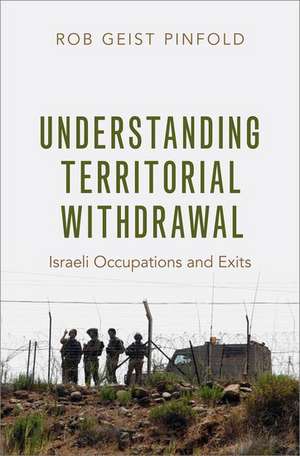
Understanding Territorial Withdrawal: Israeli Occupations and Exits
Autor Rob Geist Pinfolden Limba Engleză Hardback – 30 iun 2023
Preț: 409.09 lei
Preț vechi: 525.94 lei
-22%
Puncte Express: 614
Carte disponibilă
Livrare economică 05-10 noiembrie
Livrare prin curier în România Termenul estimat este afișat lângă disponibilitate.
Transport gratuit pentru acest produs Plată online sau ramburs, în funcție de opțiunile comenzii.
Retur gratuit în 14 zile Comandă securizată și suport în română.
Specificații
ISBN-13: 9780197658857
ISBN-10: 0197658857
Pagini: 344
Ilustrații: 10 b/w line drawings
Dimensiuni: 237 x 162 x 28 mm
Greutate: 0.6 kg
Editura: Oxford University Press
Colecția OUP USA
Locul publicării:New York, United States
ISBN-10: 0197658857
Pagini: 344
Ilustrații: 10 b/w line drawings
Dimensiuni: 237 x 162 x 28 mm
Greutate: 0.6 kg
Editura: Oxford University Press
Colecția OUP USA
Locul publicării:New York, United States
Recenzii
Understanding Territorial Withdrawal is a vital contribution to the literature on military occupations. Pinfold offers a careful, well-reasoned, and provocative analysis of why some military occupiers choose to withdraw while others only become further entrenched. This is a must-read for students of military occupation and intervention.
Why do some military occupations end while others persist? Pinfold's penetrating study offers unique insights into this important question. Drawing primarily on the experiences of Israeli military occupations, Understanding Territorial Withdrawal provides a much-needed analytical framework for appreciating the factors that inform these critical strategic choices.
With so much written on how Israel has held on to occupied territory, it is refreshing to have a book which also examines those cases in which it did withdraw. Understanding Territorial Withdrawal is rich and informative, demonstrating that it is the interplay between domestic and international political considerations that determines when an occupation ends.
Understanding Territorial Withdrawal is a welcome addition to existing debates over Israel's treatment of conquered territory. The book expertly weaves analysis of the domestic, bilateral, and international arenas. In so doing, it demonstrates how decisions about withdrawal are driven by the strategic and ideational benefits of holding onto conquered territory, compared to the costs imposed by bilateral violence and international opposition.
Pinfold's research into Israel's history of territorial occupation and withdrawal is a much-needed piece of scholarship. Not only does Understanding Territorial Withdrawal highlight the complexity of Israel's territorial strategies, but it also illustrates why Israel has exited from some territories, but not others. Further, the book demonstrates how Israel's experience can provide lessons for other states and occupied lands.
It will appeal especially to political scientists and historians interested in state security policy and Middle Eastern politics...Recommended. Advanced undergraduates through faculty.
Rob Geist Pinfold's Understanding Territorial Withdrawal: Israeli Occupations and Exits, is a timely contribution to the scholarly literature on territorial conflict and conflict resolution.
Understanding Territorial Withdrawal is a robust analysis of Israeli foreign and defense policy.
The author illustrates the ways in which politics in the occupying power affects the decision to withdraw or to remain. In comparisons with other countries, he demonstrates how occupation and exit are framed and contested domestically.
Understanding Territorial Withdrawal examines the politics of Israel's occupations and "exits" through case studies of the Sinai Peninsula, Lebanon, Gaza, the West Bank, and the Golan Heights. The comparative analysis considers each of these occupations individually and highlights the linkages between them.
Excellent book.
Why do some military occupations end while others persist? Pinfold's penetrating study offers unique insights into this important question. Drawing primarily on the experiences of Israeli military occupations, Understanding Territorial Withdrawal provides a much-needed analytical framework for appreciating the factors that inform these critical strategic choices.
With so much written on how Israel has held on to occupied territory, it is refreshing to have a book which also examines those cases in which it did withdraw. Understanding Territorial Withdrawal is rich and informative, demonstrating that it is the interplay between domestic and international political considerations that determines when an occupation ends.
Understanding Territorial Withdrawal is a welcome addition to existing debates over Israel's treatment of conquered territory. The book expertly weaves analysis of the domestic, bilateral, and international arenas. In so doing, it demonstrates how decisions about withdrawal are driven by the strategic and ideational benefits of holding onto conquered territory, compared to the costs imposed by bilateral violence and international opposition.
Pinfold's research into Israel's history of territorial occupation and withdrawal is a much-needed piece of scholarship. Not only does Understanding Territorial Withdrawal highlight the complexity of Israel's territorial strategies, but it also illustrates why Israel has exited from some territories, but not others. Further, the book demonstrates how Israel's experience can provide lessons for other states and occupied lands.
It will appeal especially to political scientists and historians interested in state security policy and Middle Eastern politics...Recommended. Advanced undergraduates through faculty.
Rob Geist Pinfold's Understanding Territorial Withdrawal: Israeli Occupations and Exits, is a timely contribution to the scholarly literature on territorial conflict and conflict resolution.
Understanding Territorial Withdrawal is a robust analysis of Israeli foreign and defense policy.
The author illustrates the ways in which politics in the occupying power affects the decision to withdraw or to remain. In comparisons with other countries, he demonstrates how occupation and exit are framed and contested domestically.
Understanding Territorial Withdrawal examines the politics of Israel's occupations and "exits" through case studies of the Sinai Peninsula, Lebanon, Gaza, the West Bank, and the Golan Heights. The comparative analysis considers each of these occupations individually and highlights the linkages between them.
Excellent book.
Notă biografică
Rob Geist Pinfold is a Research Fellow at the Peace Research Center Prague and a Lecturer in International Peace and Security at Durham University's School of Government and International Affairs. He is also a Research Fellow at the Centre for Grand Strategy at King's College London and a Senior Fellow at the Herzl Center for Israel Studies at Charles University in Prague. Rob holds a PhD in War Studies from King's College London. He is a scholar of international security whose research intersects the study of strategy and territorial conflict.
Cuprins
- Acknowledgements
- Preface
- Introduction
- I. The Framework and the Milieu
- II. Exit as a Process: Israel's Withdrawal from the Sinai
- III. Leaving 'Israel's Vietnam': Southern Lebanon
- IV. Exit Without Agreement: The Unilateral Disenagement Plan
- V. Occupation, Without Exit #1: The West Bank
- VI. Occupation, Without Exit #2: The Golan Heights
- VII. Occupation and Exit Beyond Israel: The US Leaves Hispaniola
- Conclusions
- Notes
- Index