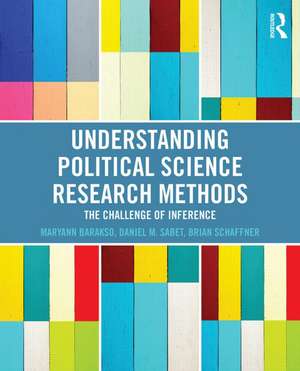
Understanding Political Science Research Methods: The Challenge of Inference
Autor Maryann Barakso, Daniel M. Sabet, Brian Schaffneren Limba Engleză Paperback – 16 dec 2013
Subliniem faptul că Understanding Political Science Research Methods adoptă o perspectivă inovatoare în peisajul academic, prioritizând înțelegerea inferenței înainte de orice discuție despre designul de cercetare propriu-zis. Credem că această abordare rezolvă o problemă fundamentală a studenților: tendința de a colecta date fără a înțelege limitările cauzale. Autorii Maryann Barakso, Daniel M. Sabet și Brian Schaffner nu se limitează la prezentarea tehnică a metodelor, ci construiesc o argumentație despre validitatea internă și externă, erorile de selecție și variabilele omise.
Textul este organizat riguros în două secțiuni principale. Prima secțiune stabilește cadrul conceptual, legând teoria de inferență, în timp ce a doua secțiune oferă un „meniu” de abordări metodologice. Reținem utilitatea capitolelor dedicate studiilor observaționale de tip Large-n și Small-n, care oferă instrumente analitice clare pentru diverse scenarii de cercetare. Această lucrare acoperă aceeași arie tematică ca The Craft of Political Research de W. Phillips Shively, însă se diferențiază printr-o structură mai ancorată în provocările practice ale procesului de cercetare non-linear, evidențiate prin casetele speciale de studiu.
În contextul operei sale, Maryann Barakso aduce aici rigoarea metodologică aplicată anterior în lucrări precum Governing NOW – Grassroots Activism in the National Organization for Women. Dacă în acea monografie se concentra pe viabilitatea organizațională, în volumul de față transferă acea experiență practică către un cadru didactic generalist. Rezultatul este un ghid care nu doar pregătește viitorii cercetători, ci formează consumatori critici de informație politică, capabili să identifice afirmațiile cauzale eronate din discursul public.
Preț: 600.58 lei
Preț vechi: 652.80 lei
-8%
Carte disponibilă
Livrare economică 26 octombrie-09 noiembrie
Livrare express 09-15 octombrie pentru 32.38 lei
Specificații
ISBN-10: 0415895200
Pagini: 250
Ilustrații: 8 black & white tables
Dimensiuni: 187 x 235 x 15 mm
Greutate: 0.44 kg
Ediția:New.
Editura: Taylor & Francis
Colecția Routledge
Locul publicării:Oxford, United Kingdom
V-ar putea interesa
-
 DriftRachel MaddowPreț: 101.91 lei
 -
 Preț: 469.66 lei
 -
 -15%Preț: 420.58 lei494.79 lei
 -
 -18%Preț: 1252.71 lei1527.70 lei
 -
 -15%Preț: 470.74 lei553.81 lei
 -
 International Relations and the First Great DebateBrian Schmidt-15%Preț: 527.13 lei620.15 lei
 -
 Civil Society Activism under Authoritarian Rule: A Comparative PerspectiveFrancesco Cavatorta-18%Preț: 1257.96 lei1534.10 lei
 -
 Contemporary Morocco: State, Politics and Society under Mohammed VIBruce Maddy-Weitzman-18%Preț: 1252.71 lei1527.70 lei
 -
 Securities Against MisruleJon ElsterPreț: 239.66 lei
 -
 The Quest for Authority in Iran: A History of The Presidency from Revolution to RouhaniSiavush Randjbar-Daemi-33%Preț: 774.01 lei1148.86 lei
 -
 -23%Preț: 227.65 lei296.40 lei
 -
 TransatlantikSebastian LorenzPreț: 435.60 lei
Public țintă
Postgraduate and UndergraduateDe ce să citești această carte
Recomandăm această carte studenților la științe politice și sociologie care doresc să depășească bariera definițiilor tehnice uscate. Cititorul câștigă o înțelegere profundă a modului în care se construiesc inferențele valide, învățând să navigheze natura non-lineară a cercetării reale. Este un instrument esențial pentru pregătirea lucrărilor de licență sau disertație, oferind exemple concrete care fac legătura între teorie și datele empirice.
Despre autor
Maryann Barakso este o cercetătoare recunoscută în domeniul științelor politice, cu un interes marcat pentru activismul politic și structurile organizaționale. Lucrările sale anterioare, precum Governing NOW, au analizat în detaliu dezvoltarea politică a mișcărilor sociale din SUA. În Understanding Political Science Research Methods, ea colaborează cu Daniel M. Sabet și Brian Schaffner pentru a sintetiza expertiza lor colectivă într-un manual metodologic de referință. Abordarea sa pune accent pe rigoarea academică combinată cu o perspectivă practică asupra modului în care instituțiile și mișcările sociale pot fi studiate prin metode științifice solide.
Descriere scurtă
The authors' primary goal is to teach students to critically evaluate their own research designs and others’ and analyze the extent to which they overcome the classic challenges to making inference: internal and external validity concerns, omitted variable bias, endogeneity, measurement, sampling, and case selection errors, and poor research questions or theory. As such, students will not only be better able to conduct political science research, but they will also be more savvy consumers of the constant flow of causal assertions that they confront in scholarship, in the media, and in conversations with others.
Three themes run through Barakso, Sabet, and Schaffner’s text: minimizing classic research problems to making valid inferences, effective presentation of research results, and the nonlinear nature of the research process. Throughout their academic years and later in their professional careers, students will need to effectively convey various bits of information. Presentation skills gleaned from this text will benefit students for a lifetime, whether they continue in academia or in a professional career.
Several distinctive features make this book noteworthy:
- A common set of examples threaded throughout the text give students a common ground across chapters and expose them to a broad range of subfields in the discipline.
- Box features throughout the book illustrate the nonlinear, "non-textbook" reality of research, demonstrate the often false inferences and poor social science in the way the popular press covers politics, and encourage students to think about ethical issues at various stages of the research process.
Cuprins
Recenzii
—Edward B. Hasecke, Wittenberg University
"Barakso, Sabet, and Schaffner ‘draw back the veil’ on the challenges and complexities of political science research, in a refreshingly understandable manner that engages undergraduates. The authors explain the underlying assumptions and hidden decisions underlying the research process, encourage more careful and critical evaluation of the many dubious assertions filling our airwaves and political dialogue, and help students effectively conduct and convey their own research in the classroom and out in the real world."
—Pat Sellers, Davidson College
"Barasko, Sabet, and Schaffner present the fundamentals of designing empirical political science research in a manner that is concise, thorough, and transparent. Students and instructors alike will benefit from this welcome and valuable contribution."
—Francis Neely, San Francisco State University
"One rarely comes across introductory research methods textbooks that strike the perfect balance between accessibility, breadth of coverage, and rigor. That Barakso, Sabet, and Schaffner are able to do so is to their credit. That they do so with a fundamentally fresh and interesting take on the material, all the more so."
—Matthew Wright, American University
"The authors do a wonderful job balancing accessibility and sophistication. The book is a good introduction to political methodology for all types of undergraduates, from the ‘math-phobic’ to those comfortable with statistical analysis."
—David J. Ciuk, Franklin & Marshall College
"Barakso, Sabet, and Schaffner make the often-daunting concepts of inference and research design clear, accessible, and practical. They do an excellent job of conveying the intuition behind and the analytical components of the research process. This book will be a wonderful addition to any undergraduate research methods course and a nice primer for beginning graduate students in political science."
—Jonathan Cole Winburn, The University of Mississippi
"Understanding Political Science Research Methods is an excellent text for undergraduate students. The focus on inference, theory, and research design will give students a solid foundation to build upon as they learn about the research process."
—Sarah Allen Gershon, Georgia State University
Notă biografică
Daniel M. Sabet is Associate Professor and Director of the Center for Enterprise and Society at the University of Liberal Arts Bangladesh and an affiliated researcher with Georgetown University’s School of Foreign Service. He is the author of Police Reform in Mexico: The Challenge of Institutional Change (Stanford University Press, 2012) and Nonprofits and their Networks: Cleaning the Waters along Mexico’s Northern Border (Arizona University Press, 2008).
Brian F. Schaffner is Professor in the Political Science Department at the University of Massachusetts, Amherst and a faculty associate at the Institute for Quantitative Social Science at Harvard University. His research focuses on public opinion, campaigns and elections, political parties, and legislative politics. Schaffner’s research has appeared in over two-dozen refereed journal articles and he previously served as Program Director for the Political Science program at the National Science Foundation.