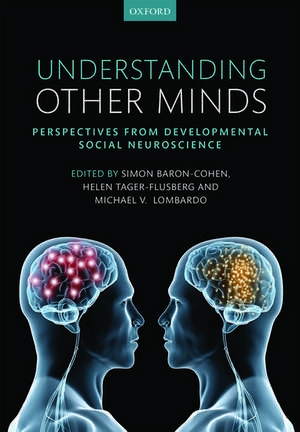
Understanding Other Minds: Perspectives from developmental social neuroscience
Editat de Simon Baron-Cohen, Michael Lombardo, Helen Tager-Flusbergen Limba Engleză Paperback – 22 aug 2013
Preț: 639.89 lei
Preț vechi: 775.80 lei
-18%
Puncte Express: 960
Carte tipărită la comandă
Livrare economică 20-25 noiembrie
Livrare prin curier în România Termenul estimat este afișat lângă disponibilitate.
Transport gratuit pentru acest produs Plată online sau ramburs, în funcție de opțiunile comenzii.
Retur gratuit în 14 zile Comandă securizată și suport în română.
Specificații
ISBN-13: 9780199692972
ISBN-10: 0199692971
Pagini: 518
Ilustrații: illustrations
Dimensiuni: 180 x 244 x 22 mm
Greutate: 0.89 kg
Ediția:Revised
Editura: Oxford University Press
Colecția OUP Oxford
Locul publicării:Oxford, United Kingdom
ISBN-10: 0199692971
Pagini: 518
Ilustrații: illustrations
Dimensiuni: 180 x 244 x 22 mm
Greutate: 0.89 kg
Ediția:Revised
Editura: Oxford University Press
Colecția OUP Oxford
Locul publicării:Oxford, United Kingdom
V-ar putea interesa
-
 The Attachment EffectPeter LovenheimPreț: 98.65 lei
 -
 The Social Neuroscience of EmpathyJean DecetyPreț: 309.47 lei
 -
 MindblindnessSimon Baron-CohenPreț: 271.53 lei
 -
 Defeating Autism: A Damaging DelusionMichael Fitzpatrick-5%Preț: 366.90 lei386.21 lei
 -
 -5%Preț: 504.59 lei531.16 lei
 -
 Mother WarriorsJenny MccarthyPreț: 136.16 lei
 -
 Healing and Preventing AutismJenny MccarthyPreț: 104.05 lei
 -
 Immersed in His GloryMichael LombardoPreț: 114.05 lei
 -
 -5%Preț: 146.55 lei154.27 lei
 -
 Preț: 235.01 lei
 -
 Elijah's CupValerie ParadizPreț: 104.31 lei
 -
 Soul of AutismWilliam StillmanPreț: 114.30 lei
 -
 -22%Preț: 656.91 lei846.55 lei
 -
 -21%Preț: 120.77 lei152.67 lei
 -
 An Exact Mind: An Artist With Asperger SyndromeSimon Baron-Cohen-25%Preț: 182.62 lei243.58 lei
 -
 -20%Preț: 146.50 lei182.48 lei
 -
 Confessions of an Unashamed AspergerRon HedgcockPreț: 155.09 lei
 -
 Memoirs Of An Asperger GirlDulcie HallPreț: 138.18 lei
 -
 The Potty JourneyJudith A CoucouvanisPreț: 133.49 lei
 -
 Visual Support for Children With Autism Spectrum DisordersVera Bernard-OpitzPreț: 209.00 lei
Recenzii
There is no better way to keep up to date with research on theory of mind than through these state-of-the-art reviews. Here, new voices are heard that brim with fresh ideas on how our mind can understand itself. This third volume of a now classic series is essential reading if you wish to keep abreast of a rapidly evolving area of developmental neuroscience - Uta Frith, UCL Institute of Cognitive Neuroscience
Notă biografică
Simon Baron-Cohen is Professor Developmental Psychopathology at the University of Cambridge and Fellow at Trinty College, Cambridge. He is Director of the Autism Research Centre (ARC) in Cambridge. He holds degrees in Human Sciences from New College, Oxford, a PhD in Psychology from UCL, and an M.Phil in Clinical Psychology at the Institute of Psychiatry in London. He held lectureships in both of these departments before moving to Cambridge in 1994. He is author of Mindblindness (1995), The Essential Difference (2003), Prenatal Testosterone in Mind (2005), and Zero Degrees of Empathy (2011). He has edited a number of scholarly anthologies including Understanding Ohter Minds (1993, 2000, and 2013), Synaesthesia (1997), and The Maladapted Mind (1997). He has also written books for parents and teachers including Autism and Asperger Syndrome: The Facts (2008), and Teaching Children with Autism to Mindread (1999). He has celebrated art in autism in An Exact Mind (2004).Michael V. Lombardo received a BA from the University of California, Davis and PhD from the University of Cambridge. Soon after his PhD he took up a research fellowship from Jesus College, Cambridge and a postdoctoral research fellowship from the British Academy. Dr. Lombardo is currently a research associate and Director of MRI at the Autism Research Centre at the University of Cambridge. His interdisciplinary work focuses on understanding autism, self-referential and social cognition, human brain development, and the early effects that hormones have for programming later development.Helen Tager-Flusberg received her Bachelors in Science in Psychology from University College London, and her doctorate from Harvard University. From 1978 through 2001 she was a Professor in the Department of Psychology at the University of Massachusetts -Boston. From 1996 - 2001 she also held the position of Senior Scientist at the Eunice Kennedy Shriver Center/UMass Medical Center. Since 2001 Dr. Tager-Flusberg has been at Boston University in the Department of Anatomy and Neurobiology and Pediatrics at the School of Medicine and now as Professor of Psychology at Boston University, where she is the Director of the Autism Center of Excellence. Dr. Tager-Flusberg has conducted research on autism and other neurodevelopmental disorders investigating developmental changes in language and social cognition using behavioral and brain imaging methodologies.