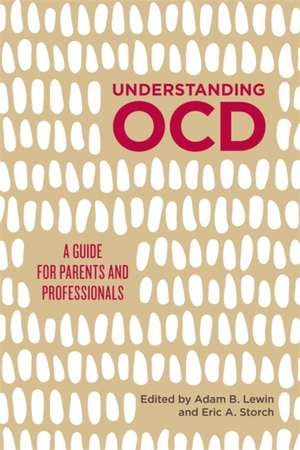
Understanding OCD: A Guide for Parents and Professionals
Editat de Adam B. Lewin, Eric A. Storch Contribuţii de Caleb Lack, Carly Johnco, Dean McKay, Marni Jacob, Joseph McGuire, Joseph McNamara, Gary Geffken, Michael Sulkowski, Jennifer Park, Robert Selles, Lisa Bateman, Brittany Rudyen Limba Engleză Paperback – 21 apr 2017
Preț: 125.41 lei
Preț vechi: 156.40 lei
-20%
Puncte Express: 188
Carte disponibilă
Livrare economică 09-23 noiembrie
Livrare prin curier în România Termenul estimat este afișat lângă disponibilitate.
Transport gratuit de la 400.00 lei Plată online sau ramburs, în funcție de opțiunile comenzii.
Retur gratuit în 14 zile Comandă securizată și suport în română.
Specificații
ISBN-13: 9781849057837
ISBN-10: 1849057834
Pagini: 256
Dimensiuni: 140 x 214 x 20 mm
Greutate: 0.26 kg
Editura: JESSICA KINGSLEY PUBLISHERS
Colecția Jessica Kingsley Publishers
Locul publicării:London, United Kingdom
ISBN-10: 1849057834
Pagini: 256
Dimensiuni: 140 x 214 x 20 mm
Greutate: 0.26 kg
Editura: JESSICA KINGSLEY PUBLISHERS
Colecția Jessica Kingsley Publishers
Locul publicării:London, United Kingdom
Recenzii
OCD is one of the most complex psychological problems, especially when it affects children and families. Adam Lewin and Eric Storch, two of the world's experts, have assembled a highly insightful and practical volume to help those with any level of experience better understand and treat children with this diagnosis. This books is a must for any student or professional working in the field.
A wonderfully accessible read, full of down-to earth information, but thoroughly up to date. Written by a team of recognized experts in the field in a way that allows the medical and non-medical reader to fully grasp all aspects of this disorder and negotiate treatment decisions for themselves, their loved ones and their patients with confidence. A valuable book for consumers and professionals alike.
A comprehensive, yet concise guide for parents and professionals. It is easy to read, and provides quick and relevant access to key areas of interest-an understanding of OCD, its treatment, and how to manage it at home and at school. Highly recommended!
This is one of the most complete and warm-hearted books I have read about people who fight to deal with intrusive thoughts. Readers are given detailed information of what it means to have unwanted intrusive thoughts, as well as the origin and impact of these thoughts on the emotional and social life of people diagnosed with OCD. The book provides both practical and research based guidance to readers and is a must read for anyone experiencing such thoughts, as well as the people who are involved in their lives (family, friends and professionals).
A wonderfully accessible read, full of down-to earth information, but thoroughly up to date. Written by a team of recognized experts in the field in a way that allows the medical and non-medical reader to fully grasp all aspects of this disorder and negotiate treatment decisions for themselves, their loved ones and their patients with confidence. A valuable book for consumers and professionals alike.
A comprehensive, yet concise guide for parents and professionals. It is easy to read, and provides quick and relevant access to key areas of interest-an understanding of OCD, its treatment, and how to manage it at home and at school. Highly recommended!
This is one of the most complete and warm-hearted books I have read about people who fight to deal with intrusive thoughts. Readers are given detailed information of what it means to have unwanted intrusive thoughts, as well as the origin and impact of these thoughts on the emotional and social life of people diagnosed with OCD. The book provides both practical and research based guidance to readers and is a must read for anyone experiencing such thoughts, as well as the people who are involved in their lives (family, friends and professionals).
Cuprins
Contributors. Introduction. Eric Storch and Adam Lewin. PART 1. 1. What is Obsessive Compulsive Disorder?. Dr Caleb Lack, Department of Psychology, College of Education and Professional Studies, University of Central Oklahoma. 2. Possible Causes of OCD. Dr Carly Johnco, Centre for Emotional Health, Department of Psychology, Macquarie University, Sydney, Australia. 3. The Development and Course of Childhood Obsessive Compulsive Disorder. Dr Dean McKay, Department of Psychology, Fordham University, New York. 4. Recognizing Obsessive Compulsive Disorder. Dr Marni Jacob, Private Practice, Florida. 5. Now What? Selecting the Right OCD Treatment for Children and Adolescents. Dr Joseph F. McGuire, Semel Institute of Neuroscience and Human Behavior, University of California. PART 2. 6. An Overview of Cognitive Behavioural Therapy for Childhood Obsessive Compulsive Disorder. Dr Adam M. Reid, Department of Psychiatry, University of Florida, Dr Joseph P.H. McNamara, Department of Psychiatry, University of Florida, and Dr Gary Geffken, Department of Psychiatry, University of Florida. 7. Nuts and Bolts of Exposure and Response Prevention for Childhood OCD. Dr Adam Lewin. 8. Treatment-Resistant Pediatric OCD: Assessment and Treatment Options. Michael Sulkowski, University of Arizona. 9. Factors Related to Prognosis in Pediatric OCD. Dr Jennifer M. Park, Ph.D., Child and Adolescent Psychiatry, Stanford University School of Medicine. PART 3. 10. Decision-Making: Treatment Options and Levels of Care. Robert R. Selles, University of South Florida and Alpert Medical School of Brown University,and Dr Adam Lewin. 11. OCD at School: An Overview for Educators. Dr Lisa Bateman, University of South Florida. 12. Managing OCD at Home. Dr Brittany M. Rudy, Lowdergroup, South Carolina, and Department of Pediatrics and Psychiatry, University of South Florida. References. Index.