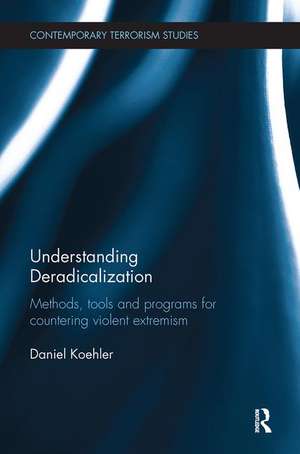
Understanding Deradicalization: Methods, Tools and Programs for Countering Violent Extremism: Contemporary Terrorism Studies
Autor Daniel Koehleren Limba Engleză Paperback – 22 dec 2017
Observăm în volumul Understanding Deradicalization o abordare riguros structurată a procesului de reintegrare a foștilor extremiști, debutând cu o analiză a studiilor de caz ce includ interviuri directe cu foști neo-naziști germani și familii de jihadiști. Subliniem faptul că autorul nu se limitează la teorie, ci oferă instrumente practice și o metodologie pentru evaluarea impactului programelor de combatere a extremismului violent (CVE). Structura cărții urmărește o progresie logică, de la definirea conceptelor și a cadrului teoretic în primele capitole, la aspecte tehnice precum consilierea familială (capitolul 6) și problemele etice sau metodologice (capitolul 8), culminând cu o privire de ansamblu asupra peisajului global al deradicalizării.
Această lucrare ocupă un loc central în opera lui Daniel Koehler, continuând cercetările sale despre parcursul radicalilor din The Radical's Journey și explorând mecanismele de schimbare a convingerilor analizate în From Traitor to Zealot. Dacă în lucrările anterioare accentul cădea pe experiența individuală, Understanding Deradicalization extinde perspectiva către politici publice și managementul programelor de intervenție.
Acoperă aceeași arie tematică ca Deradicalising Violent Extremists de Hamed El-Said, însă Daniel Koehler se distinge printr-o abordare mai tehnică și mai aplicată pe instrumentele de lucru ale practicienilor, spre deosebire de inventarul descriptiv din opt state majoritar musulmane oferit de El-Said. De asemenea, față de Terrorist Deradicalisation in Global Contexts, volumul de față oferă o bază teoretică mai integrată, transformând studiile de caz într-o tipologie coerentă, utilă atât în mediul academic, cât și în cel guvernamental.
Din seria Contemporary Terrorism Studies
- 27%
 Preț: 776.33 lei
 -
 Preț: 439.55 lei
 - 15%
 Preț: 410.16 lei
 -
 Preț: 436.57 lei
 -
 Preț: 454.51 lei
 - 15%
 Preț: 436.42 lei
 - 15%
 Preț: 414.24 lei
 -
 Preț: 427.54 lei
 -
 Preț: 292.78 lei
 - 14%
 Preț: 1022.21 lei
 -
 Preț: 428.36 lei
 - 15%
 Preț: 436.47 lei
 - 15%
 Preț: 414.68 lei
 -
 Preț: 331.08 lei
 -
 Preț: 403.71 lei
 - 15%
 Preț: 399.32 lei
 -
 Preț: 426.57 lei
 - 15%
 Preț: 446.52 lei
 -
 Preț: 438.77 lei
 - 18%
 Preț: 1200.37 lei
 -
 Preț: 223.67 lei
 - 15%
 Preț: 438.69 lei
 -
 Preț: 417.43 lei
 -
 Preț: 219.06 lei
 -
 Preț: 410.27 lei
 - 18%
 Preț: 1068.42 lei
 - 18%
 Preț: 1071.36 lei
 -
 Preț: 427.02 lei
Preț: 411.78 lei
Preț vechi: 484.44 lei
-15%
Carte tipărită la comandă
Livrare economică 19 iunie-03 iulie
Specificații
ISBN-10: 0815347588
Pagini: 322
Ilustrații: 10 Line drawings, black and white; 1 Tables, black and white
Dimensiuni: 156 x 234 x 22 mm
Greutate: 0.6 kg
Ediția:1
Editura: Taylor & Francis
Colecția Routledge
Seria Contemporary Terrorism Studies
Locul publicării:Oxford, United Kingdom
V-ar putea interesa
-
 Stalin, Vol. IStephen Kotkin-18%Preț: 110.77 lei134.33 lei
 -
 Stalin, Vol. IIStephen Kotkin-17%Preț: 116.09 lei139.19 lei
 -
 Language and ControlRoger FowlerPreț: 336.93 lei
Public țintă
Postgraduate, Professional, and UndergraduateDe ce să citești această carte
Această carte este esențială pentru studenții și profesioniștii din securitate națională, criminologie și relații internaționale care doresc să înțeleagă mecanismele practice prin care indivizii părăsesc mișcările extremiste. Veți câștiga o perspectivă unică asupra metodelor de evaluare a eficienței programelor CVE și veți învăța cum să structurați intervenții bazate pe date concrete, dincolo de simpla teorie politică.
Despre autor
Daniel Koehler este un expert recunoscut în studiul radicalizării și deradicalizării, contribuind semnificativ la literatura de specialitate prin analize empirice asupra extremismului de dreapta și jihadismului. În lucrările sale, precum Foreign Fighters and the Extreme Right, Koehler explorează motivațiile complexe ale militanților și procesele de dezertează. Activitatea sa academică este dublată de o vastă experiență practică în consilierea familiilor și în evaluarea programelor de securitate, fiind o voce de referință în cadrul seriei Contemporary Terrorism Studies.
Descriere scurtă
It analyzes the practical and theoretical aspects of deradicalization programs and the methods being employed to bring extremists and terrorist back to a non-violent life. The book includes in-depth case studies on programs and former extremists, including interviews with former German neo-Nazis and families of Jihadists who have received deradicalization counselling. Using a coherent theory of radicalization and deradicalization, it integrates existing programs into a typology and methodology regarding the effects and concepts behind deradicalization. In addition, a current state of the art assessment of deradicalization programs around the world provides a collection of programs and landscapes worldwide. It thereby functions as a unique guide for practitioners and policymakers in need of evaluation or construction of such programs, as well as a resource pool for academics interested in research about deradicalization programs and processes. The major aim of this book is to consolidate the existing scholarship on deradicalization and to move the field forward by proposing a coherent theory of deradicalization, including ways to measure effectiveness, standard methods and procedures, different actors of such programs and cooperation on national and international level. In essence, this work enables the reader to identify how, when and why deradicalization programs work, how they can be built and structured, and to identify their limitations.
This book will be of interest to students of radicalisation, counter-terrorism, radical Islam, criminology, security studies and IR.
Cuprins
1. Introduction
2. Methods, Sources, State of the Art
3. The Theory of (De)-Radicalization
4. De-Radicalization and Counter Terrorism
5. A Typology of De-Radicalizaiton Programs
6. Family Counselling as a Special Case of De-Radicalization
7. Effects and Effectiveness of De-Radicalization Programs
8. Moral and Methodological Problems
9. Tools and Methods
10. The Global De-Radicalization and CVE Landscape at a Glance
11. Conclusion: Lessons Learned
Notă biografică
Recenzii
‘Understanding Deradicalization provides the most comprehensive, up-to-date overview of worldwide efforts to bring extremists and those on the path to violent extremism back into mainstream society. As Director of the German Institute on Radicalization and Deradicalization Studies, Daniel Koehler combines practical experience with academic expertise. With this encyclopaedic monograph, he has written a seminal text against which all others in this field will be judged for years to come.’ -- Alex P. Schmid, International Centre for Counter-Terrorism (ICCT), Netherlands
‘This is the single most comprehensive work I have read on de-radicalisaiotn processes and programs. Daniel Koehler has made a valuable contribution to both the literature on terrorism and de-radicalisation. Very highly recommended to anyone interested in understanding the dynamics of transition from armed to unarmed activism.’ -- Omar Ashour, University of Exeter, UK
‘Daniel Koehler is widely recognized as a pioneer in both the practical and theoretical aspects of de-radicalization. In this book he condenses his immense knowledge, making it a must read for anybody interested in extremism and terrorism.’ -- Lorenzo Vidino, George Washington University, USA
‘A pathfinder for practitioners and scholars, Koehler's book is the most comprehensive study on global deradicalization programs.’ -- Rohan Gunaratna, Nanyang Technological University Singapore
'Koehler's book is the most methodologically rigorous, theoretically-informed, and comprehensive on this topic, to date. He brings immense depth of both experience and scholarship to this important volume.' -- Michael J. Williams, Georgia State University, USA
'...the breadth of the topics covered, the use of unique data, the attention drawn to important yet underexplored topics and a presentation style that will appeal to both academics and practitioners combine to make Koehler’s book an important and valuable addition to the debate on deradicalization and disengagement.' -- Bart Schuurman, Perspectives on Terrorism