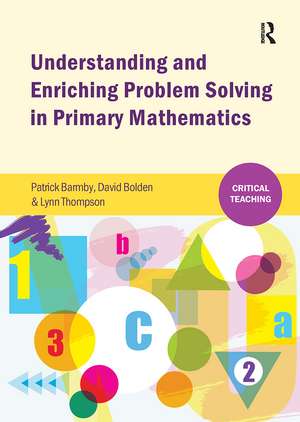
Understanding and Enriching Problem Solving in Primary Mathematics: Critical Teaching
Autor Patrick Barmby, David Bolden, Lynn Thompsonen Limba Engleză Paperback – 19 mai 2014








Preț: 614.10 lei
Puncte Express: 921
Carte disponibilă
Livrare economică 11-25 noiembrie
Livrare prin curier în România Termenul estimat este afișat lângă disponibilitate.
Transport gratuit pentru acest produs Plată online sau ramburs, în funcție de opțiunile comenzii.
Retur gratuit în 14 zile Comandă securizată și suport în română.
Specificații
ISBN-13: 9781909330696
ISBN-10: 1909330698
Pagini: 142
Ilustrații: 25 Diagrams
Dimensiuni: 174 x 246 x 8 mm
Greutate: 9.74 kg
Ediția:1
Editura: Taylor & Francis
Colecția Routledge
Seria Critical Teaching
Locul publicării:Oxford, United Kingdom
ISBN-10: 1909330698
Pagini: 142
Ilustrații: 25 Diagrams
Dimensiuni: 174 x 246 x 8 mm
Greutate: 9.74 kg
Ediția:1
Editura: Taylor & Francis
Colecția Routledge
Seria Critical Teaching
Locul publicării:Oxford, United Kingdom
Public țintă
Professional Practice & DevelopmentNotă biografică
Patrick Barmby is a Lecturer in Primary Mathematics at Durham University and is the Programme Director for the BA Primary Education course at Durham. Patrick’s area of research is in primary mathematics, with a particular focus on developing children’s understanding in maths. He has also carried out research projects on developing teachers’ knowledge in primary maths. For him, one of the best parts of teaching on the Primary Education degree at Durham University is not only influencing student teachers’ practice in primary maths, but also being influenced himself by the wealth of experiences and expertise from the classroom that students bring to the sessions.
David Bolden is a Lecturer in Mathematics Education at Durham University. After earning his first degree from Newcastle University he went on to teach and obtain an MSc in Social Research. In 1999 he took up a research post at the University of Northumbria where he stayed for six years, primarily conducting evaluation research and lecturing on ITE programmes. While at Northumbria, he completed his doctoral thesis at Durham University, focusing on primary teachers’ epistemological views of mathematics. He moved to Durham University’s School of Education in 2006, where he teaches on the BA Primary Education, PGCE Primary Education and the MSc Mathematics Education courses. His research interests include, and he has published in the areas of, creativity in mathematics, the use of representations in developing confidence and understanding in mathematics and teacher epistemologies (particularly in relation to primary mathematics).
Lynn Thompson is an educational consultant and founder of North East School Support (NESS), supporting schools to raise standards and improve the teaching and learning of mathematics. She also teaches part time on the Primary BA and PGCE courses at Durham University.
David Bolden is a Lecturer in Mathematics Education at Durham University. After earning his first degree from Newcastle University he went on to teach and obtain an MSc in Social Research. In 1999 he took up a research post at the University of Northumbria where he stayed for six years, primarily conducting evaluation research and lecturing on ITE programmes. While at Northumbria, he completed his doctoral thesis at Durham University, focusing on primary teachers’ epistemological views of mathematics. He moved to Durham University’s School of Education in 2006, where he teaches on the BA Primary Education, PGCE Primary Education and the MSc Mathematics Education courses. His research interests include, and he has published in the areas of, creativity in mathematics, the use of representations in developing confidence and understanding in mathematics and teacher epistemologies (particularly in relation to primary mathematics).
Lynn Thompson is an educational consultant and founder of North East School Support (NESS), supporting schools to raise standards and improve the teaching and learning of mathematics. She also teaches part time on the Primary BA and PGCE courses at Durham University.
Cuprins
1. Introduction – the importance of problem solving, including the current context of curriculum and OfSTED focus on problem solving, enrichment and the structure of the book 2. What is problem solving? (Types of problems and processes for problem solving) 3. Representing problems (Interpreting and comprehending problems, Influence of language, prior knowledge, importance of estimation) 4. Reasoning with problems (the role of mathematical thinking in problem solving) 5. Reflecting on your answers (Problem posing and creativity) 6. Keeping it real? (Investigations and mathematical modeling) 7. Enrichment and engagement in mathematics through problem solving 8. Summary
Recenzii
I like the fact that it is focused on problem solving and relates to the new curriculum. The chapters are structured clearly with Key Issues identified early for ease of finding relevant sections. Reflections and questions are useful to direct student teachers toward in being 'active' readers. This will be particularly supportive of specialist student teachers and those who wish to develop more 'open approaches' (a useful section in the book). There is nothing that stands out to dislike. - Sandy Pepperell, Roehampton UniversityThe book allows for easy navigation in terms of finding discussion/information on specific aspects of mathematics. Concrete examples related to Primary maths given to back up key points. I particularly like that it engages the reader in questioning their knowledge and/or developing practice. - Alison Jakins, Bishop Grossteste UniversityWhat I liked about the book: a. Contents cover a good range of topicsb. Good mix of theory and practicec. The use of critical questions and reflections enables students to think about and develop their subject knowledge and classroom practice d. Clarity of the informationThere was nothing I particularly disliked! - Christine Hines, Leeds Metropolitan University
Descriere
Essential reading for all those teaching or training to teach primary mathematics, tackling the knowledge and skills required to successfully teach the tricky area of problem solving.