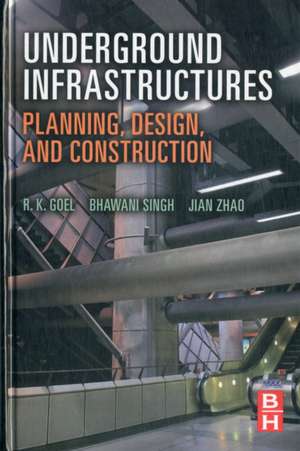
Underground Infrastructures: Planning, Design, and Construction
Autor R K Goelen Limba Engleză Hardback – 19 iun 2012
Descoperim în Underground Infrastructures un ghid tehnic riguros, axat pe soluții de proiectare pentru spațiile subterane, o necesitate critică în urbanismul modern unde densitatea populației limitează extinderea la suprafață. Autorii R K Goel, Bhawani Singh și Jian Zhao își ancorează expunerea în peste șapte decenii de experiență practică, oferind o resursă esențială pentru inginerii civili și geotehnicieni. Volumul debutează cu o clasificare clară a spațiului subteran și considerente geotehnice fundamentale, continuând cu module de sine stătătoare dedicate unor aplicații diverse: de la rețele de apă și gaze, până la structuri complexe pentru proiecte hidroelectrice și depozite de deșeuri nucleare.
Notăm cu interes progresia logică a celor 15 capitole, care transformă concepte teoretice în reguli de proiectare aplicabile pentru parcări moderne, metrouri și adăposturi pe timp de război. Dacă Underground Infrastructure of Urban Areas de Cezary Madryas v-a oferit cadrul teoretic și o colecție de lucrări despre mentenanță, această carte oferă instrumentele practice și studiile de caz necesare execuției propriu-zise. R K Goel rafinează aici abordările din lucrările sale anterioare, precum Engineering Rock Mass Classification, mutând accentul de la simpla clasificare a rocii către managementul riscului și planificarea infrastructurii integrate. Ilustrată cu 135 de figuri și tabele, lucrarea servește drept manual de referință pentru optimizarea utilizării subsolului în metropolele contemporane.
Preț: 524.18 lei
Preț vechi: 648.15 lei
-19%
Carte tipărită la comandă
Livrare economică 20 noiembrie-04 decembrie
Specificații
ISBN-10: 0123971683
Pagini: 352
Ilustrații: black & white illustrations, black & white tables, figures
Dimensiuni: 156 x 234 x 25 mm
Greutate: 0.68 kg
Editura: ELSEVIER SCIENCE
V-ar putea interesa
-
 Civil Engineering: A Very Short IntroductionDavid Muir Wood-21%Preț: 55.29 lei69.84 lei
 -
 -15%Preț: 94.82 lei112.10 lei
 -
 Humane InfrastructuresPatrik Svensson-14%Preț: 445.86 lei518.45 lei
 -
 Preț: 370.66 lei
 -
 Underground Engineering for Sustainable Urban DevelopmentNational Research CouncilPreț: 369.76 lei
 -
 UndergroundDavid MacaulayPreț: 86.17 lei
 -
 Preț: 385.30 lei
 -
 Underground CitiesSonya NewlandPreț: 83.55 lei
 -
 Underground Transportation SystemsSimon RosePreț: 83.56 lei
 -
 Epic CitiesSam Sedgman-30%Preț: 76.47 lei109.98 lei
 -
 The Conservation of Subterranean Cultural HeritageC. Saiz-Jimenez-18%Preț: 955.40 lei1165.12 lei
 -
 UndergroundWill Hunt-18%Preț: 100.69 lei122.51 lei
 -
 Under GroundCatherine ZerdounPreț: 228.58 lei
 -
 Global UndergroundsCarlos López Galviz-14%Preț: 159.55 lei186.44 lei
 -
 Modeling the Underground Infrastructure of Urban EnvironmentsNataliya Pankratova-18%Preț: 880.50 lei1073.78 lei
 -
 -11%Preț: 407.58 lei457.95 lei
 -
 -14%Preț: 1480.05 lei1720.99 lei
 -
 -18%Preț: 1136.73 lei1386.26 lei
Public țintă
Rajnish Kumar Goel, Scientist G, Central Institute of Mining and Fuel Research (CIMFR)Bhawani Singh, Ex. Professor, Department of Civil Engineering, Indian Institute of Technology (IIT)
Jian Zhao, Chair of Rock Mechanics and Tunnelling, Swiss Federal Institute of Technology (EPFL)
De ce să citești această carte
Această lucrare este indispensabilă inginerilor civil și proiectanților care caută soluții concrete pentru gestionarea spațiului subteran. Cititorul câștigă acces la 20 de istorii de caz și instrucțiuni specifice pentru depozitarea resurselor strategice (combustibil, alimente) și construcția tunelurilor. Este un ghid practic ce transformă experiența vastă de teren în reguli de design direct aplicabile, esențiale pentru dezvoltarea urbană sustenabilă și sigură.
Descriere scurtă
One of the first book to address all of the major areas in which this technology is used, this book deals with major topics such as: hydroelectric projects with modern planning of complex underground structures; underground storages of food items, crude oil and explosives and highly cautious underground nuclear waste repositories. Rail and road tunnels and TBM are described briefly. Risk management in underground infrastructures is of vital importance. Civil Engineers, Mining Engineers, and Geotechnical Engineers will find this book a valuable guide to designing and planning underground infrastructures both in terms of its applications.
- Risk management method for underground infrastructures
- Vital tips for the underground storage of food, water, crude oil, natural gas and munitions
- Provides design tips for Underground Parking Facilities
- Instruction for the designing planning and construction for underground Metros and road tunnels
- Planning and design of underground nuclear waste repositories
- Clearly explains the benefits and drawbacks of underground facilities
- Quick guide to the various modern mechanical underground parking options
- Explanation of construction planning and Risk management
- Places expert advice for planning and constructing projects at the finger tips
Cuprins
2. CLASSIFICATION OF UNDERGROUND SAPCE
3. IMPORTANT CONSIDERATIONS
4. UNDERGROUND PLANNING
5. UNDERGROUND STORAGE OF FOOD ITEMS
6. UNDERGROUND WATER STORAGE
7. UNDERGROUND CAR PARKS
8. UNDERGROUND METROS & ROAD TUNNELS
9. UNDERGROUND STORAGE OF CRUDE OIL, LPG AND NATURAL GAS
10. UNDERGROUND SPACE FOR CIVIC FACILITIES
11. UNDERGROUND STRUCTURES FOR HYDROELECTRIC PROJECTS
12. UNDERGROUND SHELTERS FOR WAR TIME
13. UNDERGROUND STORAGE OF AMMUNITIONS AND EXPLOSIVES
14. UNDERGROPUND NUCLEAR WASTE REPOSITORIES
15. CONTRACTUAL RISK SHARING