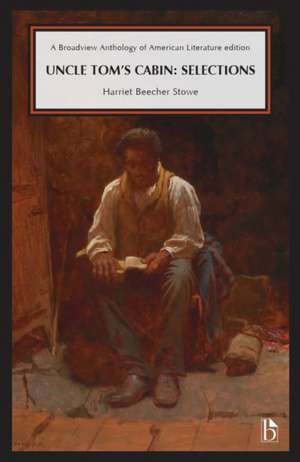
Uncle Tom’s Cabin: Selections
Autor Harriet Beecher Stoween Limba Engleză Paperback – 22 iul 2023
This volume is one of a number of editions that have been drawn from the pages of the acclaimed Broadview Anthology of American Literature. The series is designed to make selections from the anthology available in a format convenient for use in a wide variety of contexts; each edition features an introduction and exaplanatory footnotes, and is designed to meet the needs of today’s students.
Preț: 110.98 lei
Preț vechi: 133.33 lei
-17%
Puncte Express: 166
Carte disponibilă
Livrare economică 02-16 noiembrie
Livrare express 17-23 octombrie pentru 49.19 lei
Livrare prin curier în România Termenul estimat este afișat lângă disponibilitate.
Transport gratuit de la 400.00 lei Plată online sau ramburs, în funcție de opțiunile comenzii.
Retur gratuit în 14 zile Comandă securizată și suport în română.
Specificații
ISBN-13: 9781554816309
ISBN-10: 1554816300
Pagini: 270
Dimensiuni: 140 x 216 x 13 mm
Greutate: 0.37 kg
Editura: BROADVIEW PR
Colecția Broadview Press
Locul publicării:Peterborough, Canada
ISBN-10: 1554816300
Pagini: 270
Dimensiuni: 140 x 216 x 13 mm
Greutate: 0.37 kg
Editura: BROADVIEW PR
Colecția Broadview Press
Locul publicării:Peterborough, Canada
V-ar putea interesa
-
 To Kill a MockingbirdHarper Lee-19%Preț: 52.34 lei64.56 lei
 -
 The Grapes of WrathJohn Steinbeck-25%Preț: 55.19 lei73.18 lei
 -
 Twelve Years a SlaveSolomon NorthupPreț: 187.39 lei
 -
 Who Was Harriet Beecher Stowe?Dana Meachen RauPreț: 39.09 lei
 -
 The Fall of the House of Usher and Other TalesEdgar Allan PoePreț: 43.82 lei
 -
 Narrative of the Life of Frederick DouglassFrederick Douglass-19%Preț: 23.42 lei28.76 lei
 -
 The Life of Olaudah EquianoOlaudah Equiano-42%Preț: 34.77 lei59.77 lei
 -
 Paradise LostJohn MiltonPreț: 94.76 lei
 -
 Leaves of GrassWalt WhitmanPreț: 29.30 lei
 -
 A Key to Uncle Tom's CabinHarriet Beecher StowePreț: 101.18 lei
 -
 Preț: 26.76 lei
 -
 Preț: 198.49 lei
 -
 The Communist ManifestoFriedrich EngelsPreț: 11.26 lei
 -
 Narrative of the Life of Frederick Douglass, an American SlaveFrederick DouglassPreț: 38.27 lei
 -
 The Minister's WooingHarriet Beecher StowePreț: 67.07 lei
 -
 Preț: 69.51 lei
 -
 Preț: 67.07 lei
 -
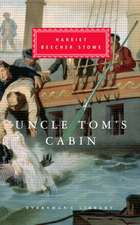 Uncle Tom's CabinHarriet Beecher Stowe-16%Preț: 91.52 lei109.50 lei
Recenzii
Uncle Tom’s Cabin may well have excited more controversy than any other work of fiction in American history. Welcomed by many abolitionists and met with indignation by supporters of slavery, it gave crucial impetus to the antislavery movement, and its characters and dramatic scenes were quickly absorbed into the nation’s consciousness; at the same time, its employment of racial stereotypes and emphasis on Christian nonresistance in the face of violence left behind a troubling legacy that was debated by black Americans in the nineteenth century and that culminated in the popular tradition of “Tom shows” that persisted well into the twentieth century. With a brief but robust introduction, judicious selection of the most essential and frequently taught portions of the novel, and examples of contemporary responses, this abridged edition of Harriet Beecher Stowe’s antislavery classic provides an overview of the novel’s plot, themes, and rhetorical strategies, and is ideal for classroom use.
This volume is one of a number of editions that have been drawn from the pages of the acclaimed Broadview Anthology of American Literature. The series is designed to make selections from the anthology available in a format convenient for use in a wide variety of contexts; each edition features an introduction and exaplanatory footnotes, and is designed to meet the needs of today’s students.
Comments on The Broadview Anthology of American Literature
“The expansion, diversification, and revitalization of the texts and terms of American literary history in recent years is made marvelously accessible in the … new Broadview Anthology of American Literature.” — Hester Blum, Penn State University
“The Broadview Anthology of American Literature is, quite simply, a breakthrough. … Meticulously researched and expertly assembled, this anthology should be the new gold standard for scholars and teachers alike.” — Michael D’Alessandro, Duke University
“So much thought has been put into every aspect of the Broadview Anthology of American Literature, from the selection of texts to their organization to their presentation on the page; it will be a gift to classrooms for years to come.” — Lara Langer Cohen, Swarthmore College
“The multiplicity of early American locations, languages, and genres is here on wondrous display.” — Jordan Alexander Stein, Fordham University
“Above all, this is a volume for the 21st century. … Its capaciousness and ample resource materials make for a text that is always evolving and meeting its readers in new ways.” — Russ Castronovo, University of Wisconsin-Madison
“a rich collection that reflects the diversity of American literatures…. [and] that never forgets its most important audience: students. There is a wealth of material here that will help them imagine and reimagine what American literature could be.” — Michael C. Cohen, UCLA
“The Broadview Anthology of American Literature is an instructor’s dream for introducing students to the diversity and complexity of American literature.” — Venetria K. Patton, University of Illinois, Urbana-Champaign
“I am eager to teach with this anthology! It aligns with cutting-edge research through its selections, its introductions, and explanatory notes, and the texts are supplemented with primary documents that encourage teachers and students to think critically and dynamically.” — Koritha Mitchell, The Ohio State University
This volume is one of a number of editions that have been drawn from the pages of the acclaimed Broadview Anthology of American Literature. The series is designed to make selections from the anthology available in a format convenient for use in a wide variety of contexts; each edition features an introduction and exaplanatory footnotes, and is designed to meet the needs of today’s students.
Comments on The Broadview Anthology of American Literature
“The expansion, diversification, and revitalization of the texts and terms of American literary history in recent years is made marvelously accessible in the … new Broadview Anthology of American Literature.” — Hester Blum, Penn State University
“The Broadview Anthology of American Literature is, quite simply, a breakthrough. … Meticulously researched and expertly assembled, this anthology should be the new gold standard for scholars and teachers alike.” — Michael D’Alessandro, Duke University
“So much thought has been put into every aspect of the Broadview Anthology of American Literature, from the selection of texts to their organization to their presentation on the page; it will be a gift to classrooms for years to come.” — Lara Langer Cohen, Swarthmore College
“The multiplicity of early American locations, languages, and genres is here on wondrous display.” — Jordan Alexander Stein, Fordham University
“Above all, this is a volume for the 21st century. … Its capaciousness and ample resource materials make for a text that is always evolving and meeting its readers in new ways.” — Russ Castronovo, University of Wisconsin-Madison
“a rich collection that reflects the diversity of American literatures…. [and] that never forgets its most important audience: students. There is a wealth of material here that will help them imagine and reimagine what American literature could be.” — Michael C. Cohen, UCLA
“The Broadview Anthology of American Literature is an instructor’s dream for introducing students to the diversity and complexity of American literature.” — Venetria K. Patton, University of Illinois, Urbana-Champaign
“I am eager to teach with this anthology! It aligns with cutting-edge research through its selections, its introductions, and explanatory notes, and the texts are supplemented with primary documents that encourage teachers and students to think critically and dynamically.” — Koritha Mitchell, The Ohio State University
Cuprins
Introduction
from Uncle Tom’s Cabin; or, Life Among the Lowly
from Uncle Tom’s Cabin; or, Life Among the Lowly
- Chapters 1, 3, 4, 5, 7, 8, 9, 10, 11, 12, 21, 26, 40, 41, 45
- American Slavery: Contemporary Accounts
- from Theodore Dwight Weld, Angelina Grimké Weld, and Sarah Grimké, American Slavery as It Is: Testimony of a Thousand Witnesses (1839)
- from The Narratives of Fugitive Slaves in Canada (1856)
- Runaway Advertisements (1820–67)
- Uncle Tom’s Cabin and the Public
- William Lloyd Garrison, The Liberator (26 March 1852)
- from William J. Wilson [“Ethiop”], “Uncle Tom’s Cabin!,” Frederick Douglass’ Paper (17 June 1852)
- from Charles Sumner, U.S. Senate Speech on his Motion to repeal the fugitive Slave Bill (as reprinted in the Anti-Slavery Bugle, Lisbon, Ohio) (18 September 1852)
- from anonymous, “Uncle Tom’s Cabin,” The New York Observer (21 October 1852)
- from Louisa S. McCord, “Uncle Tom’s Cabin,” Southern Quarterly Review (January 1853)
- from George Sand, “George Sand and Uncle Tom,” The National Era (27 January 1853)
- from George Frederick Holmes, “A Key to Uncle Tom’s Cabin,” Southern Literary Messenger (June 1853)
- from anonymous, The North American Review (October 1853)
- from Mary Chesnut, Diary, 1861–62
- Advertisement (“An Edition for the Million”), New England Farmer (25 December 1852)
- Advertisement, Hartford Courant (12 August 1852)
- The “Anti-Tom” Novel
- from Caroline Lee Hentz, The Planter’s Northern Bride (1854)
- Martin Delany and Frederick Douglass Debate Harriet Beecher Stowe
- Visualizing Uncle Tom’s Cabin in the Nineteenth Century