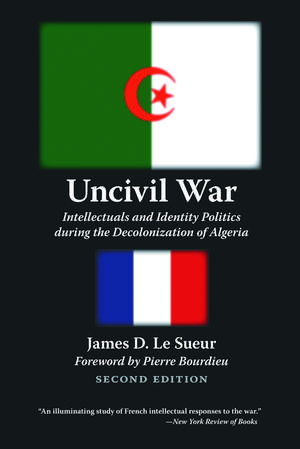
Uncivil War: Intellectuals and Identity Politics during the Decolonization of Algeria, Second Edition
Autor James D. Le Sueur Cuvânt înainte de Pierre Bourdieuen Limba Engleză Paperback – 2006
Uncivil War is a provocative study of the intellectuals who confronted the loss of France’s most prized overseas possession: colonial Algeria. Tracing the intellectual history of one of the most violent and pivotal wars of European decolonization, James D. Le Sueur illustrates how key figures such as Albert Camus, Jean-Paul Sartre, Simone de Beauvoir, Germaine Tillion, Jacques Soustelle, Raymond Aron, Claude Lévi-Strauss, Albert Memmi, Frantz Fanon, Mouloud Feraoun, Jean Amrouche, and Pierre Bourdieu agonized over the “Algerian question.” As Le Sueur argues, these individuals and others forged new notions of the nation and nationalism, giving rise to a politics of identity that continues to influence debate around the world. This edition features an important new chapter on the intellectual responses to the recent torture debates in France, the civil war in Algeria, and terrorism since September 11.
Preț: 233.22 lei
Puncte Express: 350
Carte tipărită la comandă
Livrare economică 27 noiembrie-11 decembrie
Livrare prin curier în România Termenul estimat este afișat lângă disponibilitate.
Transport gratuit de la 400.00 lei Plată online sau ramburs, în funcție de opțiunile comenzii.
Retur gratuit în 14 zile Comandă securizată și suport în română.
Specificații
ISBN-13: 9780803280281
ISBN-10: 0803280289
Pagini: 430
Ilustrații: Illus.
Dimensiuni: 152 x 229 x 29 mm
Greutate: 0.61 kg
Ediția:2
Editura: Nebraska Paperback
Colecția University of Nebraska Press
Locul publicării:United States
ISBN-10: 0803280289
Pagini: 430
Ilustrații: Illus.
Dimensiuni: 152 x 229 x 29 mm
Greutate: 0.61 kg
Ediția:2
Editura: Nebraska Paperback
Colecția University of Nebraska Press
Locul publicării:United States
V-ar putea interesa
-
 Science of Science and ReflexivityPierre BourdieuPreț: 283.59 lei
 -
 Preț: 241.92 lei
 -
 The Politics of Egypt: State-Society RelationshipNinette S. FahmyPreț: 469.66 lei
 -
 Preț: 449.37 lei
 -
 The QuestionHenri AllegPreț: 104.56 lei
 -
 The Mounted Police of NatalH. P. HOLTPreț: 131.22 lei
 -
 Two Years on TrekLouis Eugène du MoulinPreț: 129.18 lei
 -
 Development of Religion and Thought in Ancient EgyptJames Henry BreastedPreț: 140.55 lei
 -
 Egyptian LanguageErnest A. Wallis BudgePreț: 111.69 lei
 -
 Baedeker's EgyptKarl BaedekerPreț: 224.26 lei
 -
 Preț: 233.13 lei
 -
 The Theologian Slave TraderChristiana Oware KnudsenPreț: 172.65 lei
 -
 We Need to TalkJonathan D. Jansen-35%Preț: 57.50 lei88.92 lei
 -
 A Story in StonesJohn Jeremy Hespeler-BoultbeePreț: 327.46 lei
 -
 The Craft of SociologyPierre Bourdieu-8%Preț: 470.10 lei510.98 lei
 -
 Die feinen UnterschiedePierre BourdieuPreț: 208.07 lei
 -
 Preț: 440.00 lei
 -
 -8%Preț: 422.54 lei459.28 lei
 -
 Cheche. Reminiscences of a Radical MagazineKarim HirjiPreț: 320.05 lei
Notă biografică
James D. Le Sueur is an associate professor of history at the University of Nebraska-Lincoln. He is the editor of Mouloud Feraoun's Journal, 1955-1962: Reflections on the French-Algerian War (available in a Bison Books edition) and The Decolonization Reader and The Decolonization Sourcebook. He contributed new material to Ben Abro’s Assassination! July 14 and Henri Alleg’s The Question, both available in Bison Books editions.
Recenzii
“An illuminating study of French intellectual responses to the war.”—New York Review of Books
“Le Sueur’s great achievement is to reveal the complexity of the political and moral choices faced by intellectuals and, by extension, by the wider populations of Algeria and France.”—Journal of Imperial and Commonwealth History
“Le Sueur has provided an insightful and lively interpretation of an ongoing moral, sociological, political, and intellectual struggle taking place on both sides of the Mediterranean Sea.”—American Historical Review
“Uncivil War is indispensable reading for re-assessing the greater historical significance of the Algerian War.”—Islam and Christian-Muslim Relations
"Feraoun is best known for a chronicle of events, titled simply Journal, that he kept during the eight-year war that led to Algerian independence in 1962. . . . His Journal makes clear Feraoun’s lucidity regarding the national question-an issue that has bedeviled our times and of which Algerian history has been in many ways prototypical."—Roger Kaplan, The New Republic
"Feraoun was great novelist and an educator in the colonial system until his assassination by the OAS, a right-wing French terrorist group, just three days before a cease-fire ended Algeria’s eight-year battle for independence from France in 1962. His first entry, from November 1, 1955, prefigures the complexity, irony, and compassion that dictate the intellectual rigor and honesty of his life’s work . . . In passage after passage, Feraoun’s Journal reads like a message in a bottle. Far beyond the particulars of Algeria, it is precisely this gesture that makes Feraoun’s Journal such a timely and timeless historical, political, literary, and human document."—Ammiel Alcalay, The Village Voice
This translation of the original French version published in 1962 is thus long overdue. Perhaps its greatest value it as an unmatched description of the infinite dilemmas faced by Algeria’s ‘Europeanized Muslims’. The journal provides a constant reminder of the inevitable accommodations made by Muslims caught between two bloody extremes. In its focus on the personal consequences of killings and counter-killings within the Algerian Muslim community, it gives real voice to those whom Fanon characterized as Damnès de la terre."—Martin Thomas, The Journal of Imperial and Commonwealth History
"This first English translation of Feraoun's deeply personal and poignant record of the Algerian war of independence is long overdue. The reader will be struck by the historical and anthropological precision that characterizes Mouloud Feraoun’s record of the war."—Nicole Kaplan, North African Studies
"Mouloud Feraoun’s Journal is a precious account not only of the social, political, and military conditions in revolutionary Algeria, but also of a man whose dedication and dignity transcended the atrocity and absurdity of his times. This unsettling yet inspiring book is highly recommended for general as well as specialized collections."—Phillip Naylor, The Journal of Military History
"The Journal has long been known to students of the Algerian War: its appearance in English will make it available to a broader audience, and will be especially welcome to students of postcolonial theory whose themes it admirably exemplifies."—Irwin Wall, Research in African Literatures