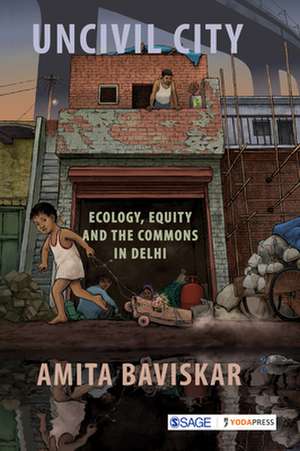
Uncivil City: Ecology, Equity and the Commons in Delhi
Autor Amita Baviskaren Limba Engleză Electronic book text – 22 dec 2019
Preț: 206.58 lei
Precomandă
Puncte Express: 310
Nepublicat încă
Livrare prin curier în România Precomanda se expediază când titlul devine disponibil.
Transport gratuit de la 400.00 lei Plată online sau ramburs, în funcție de opțiunile comenzii.
Retur gratuit în 14 zile Comandă securizată și suport în română.
Doresc să fiu notificat când acest titlu va fi disponibil:
Se trimite...
Specificații
ISBN-13: 9789353289423
ISBN-10: 9353289424
Pagini: 300
Ediția:First Edition
Editura: SAGE Publications
Colecția Sage Publications Pvt. Ltd
Locul publicării:New Delhi, India
ISBN-10: 9353289424
Pagini: 300
Ediția:First Edition
Editura: SAGE Publications
Colecția Sage Publications Pvt. Ltd
Locul publicării:New Delhi, India
Recenzii
“Although published shortly before the arrival of COVID-19 in India, Baviskar’s thesis nonetheless echoes the events unfolding in the capital, and across urban India today…. The vision of Delhi to which Uncivil City is committed emerges from a radial sense of possibility to conceive new, collective futures.”
“Connected by a timely introduction and concluding chapter, the book makes for relevant and sobering pandemic reading… Ethnographic writing in India has come a long way from M.N. Srinivas’s orderly and tranquil prose. This work exemplifies this shift.”
“Her attention to the details of climate change, and how we look at the river Yamuna and the lives of the people who live by its sides is a masterly discourse. Amita uses a spare but interesting prose which occasionally turns chatty, but only to introduce us to an anthropologist’s sense of being part of the picture.”
“Uncivil City is more than an academic tract. It is an elegy for Delhi… That is what makes the book tactile, relatable, and engaged.”
“The power of this collection lies in the evocative writing that often resembles a travelogue… the richness of this collection… contributes to an abundance of fascinating works on the changes in Delhi in the last ten years.”
“One of the first things that strikes one about the book is its’ readability… There are important things in this book for all of us to think about.”
“Connected by a timely introduction and concluding chapter, the book makes for relevant and sobering pandemic reading… Ethnographic writing in India has come a long way from M.N. Srinivas’s orderly and tranquil prose. This work exemplifies this shift.”
“Her attention to the details of climate change, and how we look at the river Yamuna and the lives of the people who live by its sides is a masterly discourse. Amita uses a spare but interesting prose which occasionally turns chatty, but only to introduce us to an anthropologist’s sense of being part of the picture.”
“Uncivil City is more than an academic tract. It is an elegy for Delhi… That is what makes the book tactile, relatable, and engaged.”
“The power of this collection lies in the evocative writing that often resembles a travelogue… the richness of this collection… contributes to an abundance of fascinating works on the changes in Delhi in the last ten years.”
“One of the first things that strikes one about the book is its’ readability… There are important things in this book for all of us to think about.”
Cuprins
Publisher’s Acknowledgements
Acknowledgements
Introduction: An Uncivil City
Part I: Remaking Landscapes and Lives
Making Plans and Places
Sealing Factories and Fates
Playing Games
Part II: Contesting the Commons
Cows, Cars and Cycle-Rickshaws
The River
The Ridge
Part III: Conclusion and Coda
City Limits and Beyond
Climate Change, Uncertainty and the City
Glossary
Bibliography
Index
Acknowledgements
Introduction: An Uncivil City
Part I: Remaking Landscapes and Lives
Making Plans and Places
Sealing Factories and Fates
Playing Games
Part II: Contesting the Commons
Cows, Cars and Cycle-Rickshaws
The River
The Ridge
Part III: Conclusion and Coda
City Limits and Beyond
Climate Change, Uncertainty and the City
Glossary
Bibliography
Index
Descriere
This book looks at two decades of environmental politics in Delhi and argues that ‘bourgeois environmentalists’ who claim to speak for nature and society have perversely worsened the quality of life for most citizens.