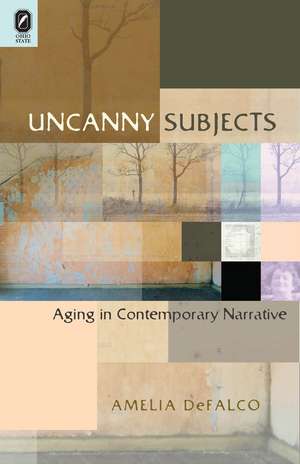
Uncanny Subjects: Aging in Contemporary Narrative
Autor Amelia DeFalcoen Limba Engleză Paperback – 8 sep 2022
Applies a humanities lens to contemporary representations of aging, drawing together theories of the uncanny with research on aging and temporality.
In the United States anti-aging is a multibillion-dollar industry, and efforts to combat signs of aging have never been stronger, or more lucrative. Although there are many sociological studies of aging and culture, there are few studies that examine the ways cultural texts construct multiple narratives of aging that intersect and sometimes conflict with existing social theories of aging. In Uncanny Subjects, Amelia DeFalco incorporates methodologies and theories derived from the humanities in her investigation into contemporary representations of aging.
Both aging and narrative are a function of time, of change, of one event happening after another. Subjects understand their lives through narrative trajectories—not necessarily as they are living moment to moment, but in the sort of reflection that many argue becomes more prevalent with age. As a result, narrative fiction provides compelling representations of the strange—indeed uncanny—familiarity of the aging self.
DeFalco examines a range of contemporary fiction and film by authors and directors such as John Banville, John Cassavetes, and Alice Munro. As these texts suggest, old age involves a growing awareness of the otherness within, an awareness that reveals identity as multiple, shifting, and contradictory—in short, uncanny. Drawing together theories of the uncanny with research on aging and temporality, DeFalco argues that aging is a category of difference integral to a contemporary understanding of identity and alterity.
In the United States anti-aging is a multibillion-dollar industry, and efforts to combat signs of aging have never been stronger, or more lucrative. Although there are many sociological studies of aging and culture, there are few studies that examine the ways cultural texts construct multiple narratives of aging that intersect and sometimes conflict with existing social theories of aging. In Uncanny Subjects, Amelia DeFalco incorporates methodologies and theories derived from the humanities in her investigation into contemporary representations of aging.
Both aging and narrative are a function of time, of change, of one event happening after another. Subjects understand their lives through narrative trajectories—not necessarily as they are living moment to moment, but in the sort of reflection that many argue becomes more prevalent with age. As a result, narrative fiction provides compelling representations of the strange—indeed uncanny—familiarity of the aging self.
DeFalco examines a range of contemporary fiction and film by authors and directors such as John Banville, John Cassavetes, and Alice Munro. As these texts suggest, old age involves a growing awareness of the otherness within, an awareness that reveals identity as multiple, shifting, and contradictory—in short, uncanny. Drawing together theories of the uncanny with research on aging and temporality, DeFalco argues that aging is a category of difference integral to a contemporary understanding of identity and alterity.
Preț: 220.21 lei
Puncte Express: 330
Preț estimativ în valută:
38.95€ • 45.67$ • 33.89£
38.95€ • 45.67$ • 33.89£
Carte tipărită la comandă
Livrare economică 05-19 martie
Preluare comenzi: 021 569.72.76
Specificații
ISBN-13: 9780814258743
ISBN-10: 0814258743
Pagini: 192
Dimensiuni: 152 x 229 x 18 mm
Greutate: 0.45 kg
Editura: Ohio State University Press
Colecția Ohio State University Press
ISBN-10: 0814258743
Pagini: 192
Dimensiuni: 152 x 229 x 18 mm
Greutate: 0.45 kg
Editura: Ohio State University Press
Colecția Ohio State University Press
Recenzii
“The skill with which Amelia DeFalco analyzes her chosen texts immediately puts her in the category of a major player in age studies. Her scholarship is impeccable and impressive.” —Anne M. Wyatt-Brown, Emeritus Associate Professor in Linguistics, University of Florida
“There can be no doubt that age as a category of difference has been avoided and ignored by literary and cultural critics as well as identity theorists. This critical problem needs to be remedied, and Amelia DeFalco’s analysis adeptly moves this agenda along.” —Ruth E. Ray, Professor of English at Wayne State University and author of Beyond Nostalgia: Aging and Life Story Writing
Notă biografică
Amelia DeFalco is Professor of Contemporary Literature at the University of Leeds. Her research concerns representations of ageing, care, vulnerability and the posthuman in contemporary cultural narratives, including posthuman approaches to care, vulnerability, materiality and touch. In addition to Uncanny Subjects: Aging in Contemporary Narrative, she is the author of Imagining Care: Responsibility, Dependency, and Canadian Literature and Curious Kin in Fictions of Posthuman Care.
Extras
In the of 2005 I had dinner with my grandparents at a restaurant near their home in Utica, New York. The restaurant was chosen because it was my grandmother’s favorite, or more precisely, it was the only place outside her home where she would willingly eat a meal. Our server, a woman I’d guess to be in her fifties, was friendly, in a somewhat overbearing way. She took a self-conscious liking to my grandmother and repeatedly commented on her looks and demeanor to the rest of us at the table, including my grandfather and my parents. My grandmother had lost most of her hearing and was beginning to have trouble with her memory as a result of Alzheimer’s. Her strategy, devised over a decade ago when her hearing began to fail, was to smile or even laugh gently when people spoke to her, which we had to come to recognize as her response to inqui- ries she could not hear. “Is it just her hearing or is anything else wrong with her?” the server asked us at one point. And then later, in reference to my grandmother’s long gray hair, which was pinned to the back of her head with a great number of bobby pins, “most ladies cut and dye and curl their hair into these big poufs, her long hair is so cute, she’s just so cute.”
My grandmother continued to smile.
This encounter, which occurred around the same time I was embarking on this study of aging, proved instructive. The woman’s remarks had much to say about the difference age makes. Her comments reflect the kind of pathologization and objectification that culture inflicts on old age, a pattern of othering that can at least partly explain the antipathy felt by many at the prospect of being categorized as “old.” Such a category, as the server’s comments illustrate, can render one invisible or entirely absent; although present, my grandmother was transformed into the third person. The aging, or here aged, subject is both objectified and exiled. The woman’s observations reveal her efforts to read correctly the sign of difference that sat before her. This study seeks to restore what this kind of quotidian interaction erases—the presence of an older subject—and, more importantly, to investigate the repercussions of occupying the tenuous cultural position of “old.”
Though old age may be a category that awaits everyone lucky enough to live a long life, experiences of the difference of age vary immensely as aging interacts with other cultural categories including race, class, ethnicity, and, most dramatically, gender. As feminism has made clear, gender is largely responsible for the formation of subjectivity, and one need only glance at any representation within popular media, whether print, tele- vision, or digital, to quickly recognize that aging is distinctly gendered. Casually surveying the anti-aging discourse of magazines displayed at the supermarket checkout, billboards, “makeover” reality-TV shows, and other so-called women’s television programming, one might be tempted to assume that aging is primarily a “woman’s issue.” Indeed, the server’s comments touched only my grandmother, though my grandfather, who is actually one year older, was also at the table. Her reference to my grandmother’s “cuteness” highlights the role of the “the body as the dominant signifier of old age” and the infantilizing attention paid to “unusual” old bodies (Woodward, Discontents 10). The server’s remarks draw attention to the either/or logic that forces an old person, or, more precisely, an old woman, into a dilemma: conceal, modify, deny your old age and you may be seen as ridiculous, even slightly shameful; wear your age without adjustment and you are “cute”—innocuous and childish.1 And yet without the concealment of cosmetics, dyes, clothing, even surgeries, without appropriate adjustments in activity and behavior made to hide what the not-yet-old, the not-yet-aged, largely interpret as a process of decline and degeneration, the old female subject is rendered benign in other ways, in this case through infantilization.
But I must complicate such a pat gender analysis with a caveat: my grandmother’s disability was apparent at the time—the server was warned of her hearing loss, and my grandmother often looked wary or confused. I argue that the intertwining of pathologization and infantilization implied by the woman’s comments, which were undoubtedly offered in a spirit of friendly concern, reflects attitudes toward old age and disability as much as gender. Anyone who has spent time in a later-life care facility knows that pathologization, infantilization, and objectification are not reserved for older women alone. In advanced age, men are often deemed “cute” as well. I have no doubt that aging is always inflected by other categories of difference, but my aim is to treat aging as its own difference, which means considering both women and men as aging subjects. As a result, discussions of gender have fluctuating prominence throughout my analy- sis of aging, often implied in the background, and occasionally coming into sharp focus, as in chapter 3. My interests lie in the meanings that arise from the often disorienting and inevitable changes of age, as well as how such changes are revised and rewritten by gender. Gender and age are deeply entwined, but I argue that the difference enacted by old age sometimes outweighs the concerns of gender. Meeting a retired elderly professor and department chair at a party he attended with his daughter, I was reminded of my grandmother’s enforced invisibility. The man’s daughter explained how she is consistently relegated to the role of interpreter when they are together, though her father suffers no cognitive disabilities. Strangers often spoke of her father in the third person when he stood or sat right beside her. Such interactions reveal how people in contemporary western culture repeatedly interpret the bodily signs of advanced age as indicators of reduced agency and comprehension.
My grandmother continued to smile.
This encounter, which occurred around the same time I was embarking on this study of aging, proved instructive. The woman’s remarks had much to say about the difference age makes. Her comments reflect the kind of pathologization and objectification that culture inflicts on old age, a pattern of othering that can at least partly explain the antipathy felt by many at the prospect of being categorized as “old.” Such a category, as the server’s comments illustrate, can render one invisible or entirely absent; although present, my grandmother was transformed into the third person. The aging, or here aged, subject is both objectified and exiled. The woman’s observations reveal her efforts to read correctly the sign of difference that sat before her. This study seeks to restore what this kind of quotidian interaction erases—the presence of an older subject—and, more importantly, to investigate the repercussions of occupying the tenuous cultural position of “old.”
Though old age may be a category that awaits everyone lucky enough to live a long life, experiences of the difference of age vary immensely as aging interacts with other cultural categories including race, class, ethnicity, and, most dramatically, gender. As feminism has made clear, gender is largely responsible for the formation of subjectivity, and one need only glance at any representation within popular media, whether print, tele- vision, or digital, to quickly recognize that aging is distinctly gendered. Casually surveying the anti-aging discourse of magazines displayed at the supermarket checkout, billboards, “makeover” reality-TV shows, and other so-called women’s television programming, one might be tempted to assume that aging is primarily a “woman’s issue.” Indeed, the server’s comments touched only my grandmother, though my grandfather, who is actually one year older, was also at the table. Her reference to my grandmother’s “cuteness” highlights the role of the “the body as the dominant signifier of old age” and the infantilizing attention paid to “unusual” old bodies (Woodward, Discontents 10). The server’s remarks draw attention to the either/or logic that forces an old person, or, more precisely, an old woman, into a dilemma: conceal, modify, deny your old age and you may be seen as ridiculous, even slightly shameful; wear your age without adjustment and you are “cute”—innocuous and childish.1 And yet without the concealment of cosmetics, dyes, clothing, even surgeries, without appropriate adjustments in activity and behavior made to hide what the not-yet-old, the not-yet-aged, largely interpret as a process of decline and degeneration, the old female subject is rendered benign in other ways, in this case through infantilization.
But I must complicate such a pat gender analysis with a caveat: my grandmother’s disability was apparent at the time—the server was warned of her hearing loss, and my grandmother often looked wary or confused. I argue that the intertwining of pathologization and infantilization implied by the woman’s comments, which were undoubtedly offered in a spirit of friendly concern, reflects attitudes toward old age and disability as much as gender. Anyone who has spent time in a later-life care facility knows that pathologization, infantilization, and objectification are not reserved for older women alone. In advanced age, men are often deemed “cute” as well. I have no doubt that aging is always inflected by other categories of difference, but my aim is to treat aging as its own difference, which means considering both women and men as aging subjects. As a result, discussions of gender have fluctuating prominence throughout my analy- sis of aging, often implied in the background, and occasionally coming into sharp focus, as in chapter 3. My interests lie in the meanings that arise from the often disorienting and inevitable changes of age, as well as how such changes are revised and rewritten by gender. Gender and age are deeply entwined, but I argue that the difference enacted by old age sometimes outweighs the concerns of gender. Meeting a retired elderly professor and department chair at a party he attended with his daughter, I was reminded of my grandmother’s enforced invisibility. The man’s daughter explained how she is consistently relegated to the role of interpreter when they are together, though her father suffers no cognitive disabilities. Strangers often spoke of her father in the third person when he stood or sat right beside her. Such interactions reveal how people in contemporary western culture repeatedly interpret the bodily signs of advanced age as indicators of reduced agency and comprehension.
Cuprins
Preface ix
Prefatory Note Defining Age xvii
Acknowledgments xix
Introduction Uncanny Subjects 1
Chapter 1 Backward Glances: Narrative Identity and Late-life Review 21
Chapter 2 Troubling Versions: Dementia and Identity 53
Chapter 3 Aging, Doubles, and the Mania of Dissemblance 95
Conclusion Uncanny Aging, Uncanny Selves 125
Works Cited 139
Index 151
Prefatory Note Defining Age xvii
Acknowledgments xix
Introduction Uncanny Subjects 1
Chapter 1 Backward Glances: Narrative Identity and Late-life Review 21
Chapter 2 Troubling Versions: Dementia and Identity 53
Chapter 3 Aging, Doubles, and the Mania of Dissemblance 95
Conclusion Uncanny Aging, Uncanny Selves 125
Works Cited 139
Index 151
Descriere
Examine the ways cultural texts—such as fiction by John Banville and Alice Munro—construct multiple narratives of aging that intersect and sometimes conflict with existing social theories of aging.