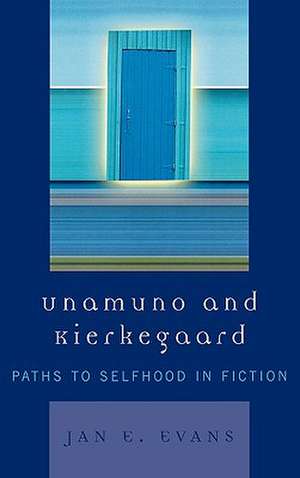
Unamuno and Kierkegaard: Paths to Selfhood in Fiction
Autor Jane Evansen Limba Engleză Hardback – 6 iun 2005
Preț: 513.32 lei
Preț vechi: 790.13 lei
-35%
Puncte Express: 770
Carte tipărită la comandă
Livrare economică 24 noiembrie-08 decembrie
Livrare prin curier în România Termenul estimat este afișat lângă disponibilitate.
Transport gratuit pentru acest produs Plată online sau ramburs, în funcție de opțiunile comenzii.
Retur gratuit în 14 zile Comandă securizată și suport în română.
Specificații
ISBN-13: 9780739110799
ISBN-10: 0739110799
Pagini: 127
Dimensiuni: 158 x 232 x 14 mm
Greutate: 0.36 kg
Editura: Bloomsbury Publishing
Colecția Lexington Books
Locul publicării:New York, United States
ISBN-10: 0739110799
Pagini: 127
Dimensiuni: 158 x 232 x 14 mm
Greutate: 0.36 kg
Editura: Bloomsbury Publishing
Colecția Lexington Books
Locul publicării:New York, United States
V-ar putea interesa
-
 The Song of Middle-earthDavid HarveyPreț: 77.30 lei
 -
 Preț: 193.22 lei
 -
 Ramsey Campbell: Critical Essays on the Modern Master of HorrorGary William Crawford-36%Preț: 676.37 lei1052.46 lei
 -
 Online Counselling and Guidance SkillsJane EvansPreț: 275.92 lei
 -
 Modernism: Evolution of an IdeaProfessor Sean Latham-25%Preț: 200.84 lei266.69 lei
 -
 Preț: 186.47 lei
 -
 The Living GoddessIsabella TreePreț: 137.96 lei
 -
 The Seven Good YearsEtgar KeretPreț: 69.92 lei
 -
 -20%Preț: 94.84 lei118.66 lei
Cuprins
Chapter 1 Introduction
Chapter 2 The Importance of Indirect Communication
Chapter 3 The Formation of the Self in Kierkegaard and Unamuno
Chapter 4 Niebla: A Study in Kierkegaard's Esthetic Stage
Chapter 5 San Manuel Bueno, Mártit: A Study in the Ethical Life
Chapter 6 Abel Sánchez: A Study in the Possibilities for Religious Existence
Chapter 7 Conclusion
Chapter 2 The Importance of Indirect Communication
Chapter 3 The Formation of the Self in Kierkegaard and Unamuno
Chapter 4 Niebla: A Study in Kierkegaard's Esthetic Stage
Chapter 5 San Manuel Bueno, Mártit: A Study in the Ethical Life
Chapter 6 Abel Sánchez: A Study in the Possibilities for Religious Existence
Chapter 7 Conclusion
Recenzii
Supported by archival research on what works by Kierkegaard Unamuno actually read, Jan Evans is the first scholar to take seriously the distinction between Kierkegaard and his pseudonyms in exploring similarities and differences between these two authors on the theme of becoming a self. The result is a fresh and more discerning look at three of Unamuno's most popular novels utilizing Kierkegaard's theory of the stages of existence to show how the Spaniard portrays multiple forms of authentic existence.
A fascinating read, Jan Evans' unusual expertise in both authors gives us original insight into the amazing affinities and fundamental divergence between them, as well as into the extent and limits of Unamuno's use of Kierkegaard. Readers at all levels of familiarity with these authors can benefit.
This is the first study of Unamuno and Kierkegaard that focuses attention on the latter's writerly heteronyms, a focus with immense implications for the study of Unamuno's narratives with multiple internal writers, that is, for practically all of his fictional work. The book also corrects many well-traveled misconceptions about what Unamuno read in Kierkegaard and clarifies how Unamuno's major thought diverges-often significantly-from that of the Dane with whom he has been compared.
A fascinating read, Jan Evans' unusual expertise in both authors gives us original insight into the amazing affinities and fundamental divergence between them, as well as into the extent and limits of Unamuno's use of Kierkegaard. Readers at all levels of familiarity with these authors can benefit.
This is the first study of Unamuno and Kierkegaard that focuses attention on the latter's writerly heteronyms, a focus with immense implications for the study of Unamuno's narratives with multiple internal writers, that is, for practically all of his fictional work. The book also corrects many well-traveled misconceptions about what Unamuno read in Kierkegaard and clarifies how Unamuno's major thought diverges-often significantly-from that of the Dane with whom he has been compared.