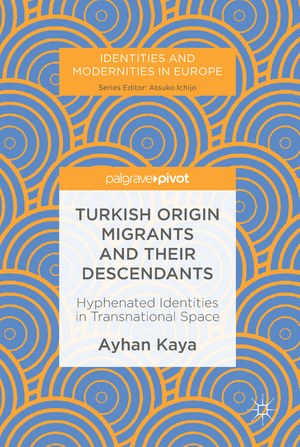
Turkish Origin Migrants and Their Descendants
Autor Ayhan Kayaen Limba Engleză Hardback – 16 iul 2018
This book analyses Muslim-origin immigrant communities in Europe, and the problematic nature of their labelling by both their home and host countries. The author challenges the ways in which both sending and receiving countries encapsulate these migrants within the religiously defined closed box of “Muslim” and/or “Islam”. Transcending binary oppositions of East and West, European and Muslim, local and newcomer, Kaya presents the multiple identities of Muslim-origin immigrants by interrogating the third space paradigm.
Turkish Origin Migrants and Their Descendants analyses the complexity of the hyphenated identities of the Turkish-origin community with their intricate religious, ethnic, cultural, ideological and personal elements. This insight into the life-worlds of transnational individuals and local communities will be of interest to students and scholars of the social sciences, migration studies, and political science, especially those concerned with Islamization of radicalism, populism, and Islamophobia in a European context.
Preț: 432.57 lei
Puncte Express: 649
Carte tipărită la comandă
Livrare economică 08-22 decembrie
Livrare prin curier în România Termenul estimat este afișat lângă disponibilitate.
Transport gratuit pentru acest produs Plată online sau ramburs, în funcție de opțiunile comenzii.
Retur gratuit în 14 zile Comandă securizată și suport în română.
Specificații
ISBN-13: 9783319949949
ISBN-10: 3319949942
Pagini: 180
Ilustrații: XV, 163 p.
Dimensiuni: 153 x 216 x 15 mm
Greutate: 0.31 kg
Ediția:1st ed. 2019
Editura: Springer
Locul publicării:Cham, Switzerland
ISBN-10: 3319949942
Pagini: 180
Ilustrații: XV, 163 p.
Dimensiuni: 153 x 216 x 15 mm
Greutate: 0.31 kg
Ediția:1st ed. 2019
Editura: Springer
Locul publicării:Cham, Switzerland
Cuprins
1. Introduction.- 2. Theoretical and Philosophical Encounters in Migration Studies.- 3. Labelling Migrants: From Migrant Workers to 'Muslims'.- 4. Constructing Communities of Faith, Ethnicity and Culture.- 5. Home-State Politics towards Turkish Emigrants.- 6. Politics of Transnational Space.- 7. Conclusion.
Notă biografică
Karin Borevi is Professor of Political Science at Södertörn University, Sweden. She is also an affiliated researcher at the Centre for Multidisciplinary Research on Religion and Society (CRS) at Uppsala University. Borevi is also part of the Center for the Study of Political Organisation (CPO) and the Institute for Research on Multireligiosity and Secularity (IMS), both at Södertörn University. Borevi’s research revolves around issues of immigration, citizenship, multiculturalism, religious diversity, and the welfare state within three thematic areas: historical analyses of the emergence and development of Swedish policies on immigrant integration; comparative analyses of contemporary European integration and immigration policies; political theoretical debates on multiculturalism, justice, equality, etc. She has analyzed policy developments in the fields of multiculturalism, family migration, refugee settlement and housing, state governance of religious diversity and civil society; approaches towards marginalised Roma EU-migrants, border politics, and more. She is currently completing two large research projects: one examining attitudes toward family migration in Sweden, Germany, and Italy, and another studying the post-war history of Swedish governance of religious diversity, with a particular focus on state approaches toward Muslim organisations. She is also initiating a new project on migrants’ experiences of post-2022 securitised membership policies in the Baltic Sea region, based on interviews and policy analyses in Sweden, Finland, and Estonia. Borevi has published in journals such as Journal of Social Policies, Identities, International Migration Review, Urban Studies, and Comparative Migration Studies, and she has also contributed to many international edited volumes. Borevi also has long experience as a lecturer in political science, from bachelor’s level up to PhD level and is the Master’s Program coordinator of Political Science at Södertörn University. For twelve years, she has been responsible for a course within the Bachelor’s Programme in International Migration and Ethnic Relations that introduces students to political science through analyses of migration and politics.
Ayhan Kaya is Professor of Politics and Jean Monnet Chair of European Politics of Interculturalism at the Department of International Relations, Istanbul Bilgi University; Director of the European Institute, and the Jean Monnet Centre of Excellence; and a member of the Science Academy, Turkey. He is currently a European Research Council Advanced Grant holder (ERC AdG, 2019-2024). He received his PhD and MA degrees from the University of Warwick, England. Kaya was previously a Jean Monnet Fellow at the European University Institute, Robert Schuman Centre for Advanced Studies, Florence, Italy, and an adjunct lecturer at New York University, Florence, between 2016 and 2017. He previously worked and taught at the European University Viadrina as Aziz Nesin Chair in 2013, and at Malmö University, Sweden, as the Willy Brandt Chair in 2011. He works on youth radicalism, nativism, Islamism, Islamophobism in Europe, Turkish-origin migrants and their descendants in Germany, France, Belgium, and the Netherlands, the Circassian diaspora in Turkey, the construction and articulation of modern transnational identities, refugee studies in Turkey, conventional and nonconventional forms of political participation in Turkey, and the rise of populist movements in the EU. His recent manuscripts are Syrian Refugees in Turkey: Between Reception and Integration (Switzerland: Springer IMISCOE, 2023, co-authored with Z. ¿ahin-Mencütek, E. Gökalp-Aras, and S. B. Rottmann), and Populism and Heritage in Europe. Lost in Diversity and Unity (London: Routledge, 2019). His recent edited volumes are Nativist and Islamist Radicalism: Anger and Anxiety (London: Routledge, 2023, with Aysenur Ben
Textul de pe ultima copertă
This book analyses Muslim-origin immigrant communities in Europe, and the problematic nature of their labelling by both their home and host countries. The author challenges the ways in which both sending and receiving countries encapsulate these migrants within the religiously defined closed box of “Muslim” and/or “Islam”. Transcending binary oppositions of East and West, European and Muslim, local and newcomer, Kaya presents the multiple identities of Muslim-origin immigrants by interrogating the third space paradigm.
Turkish Origin Migrants and Their Descendants analyses the complexity of the hyphenated identities of the Turkish-origin community with their intricate religious, ethnic, cultural, ideological and personal elements. This insight into the life-worlds of transnational individuals and local communities will be of interest to students and scholars of the social sciences, migration studies, and political science, especially those concerned with Islamization of radicalism, populism, and Islamophobia in a European context.
Caracteristici
Presents a nuanced analysis of the immigrant communities in Europe and the problematic nature of their labelling by the host countries Going beyond the Muslim-Christian duality, the third space paradigm allows the analyst to focus on transnational subjectivities in the making Offers a syncretic approach to culture arguing against essentialism