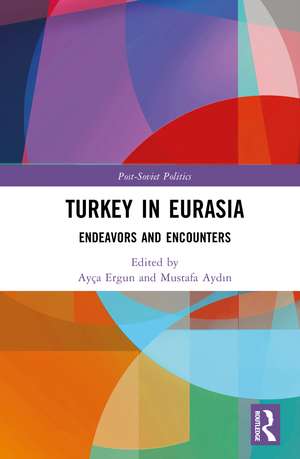
Turkey in Eurasia: Endeavors and Encounters: Post-Soviet Politics
Editat de Ayça Ergun, Mustafa Aydınen Limba Engleză Hardback – 29 apr 2026
Din seria Post-Soviet Politics
-
 Preț: 440.18 lei
 - 18%
 Preț: 764.66 lei
 -
 Preț: 416.96 lei
 -
 Preț: 469.17 lei
 -
 Preț: 416.96 lei
 -
 Preț: 422.73 lei
 -
 Preț: 433.69 lei
 - 15%
 Preț: 434.24 lei
 -
 Preț: 420.67 lei
 -
 Preț: 446.24 lei
 - 18%
 Preț: 1114.85 lei
 - 18%
 Preț: 1254.81 lei
 -
 Preț: 422.58 lei
 - 15%
 Preț: 463.90 lei
 - 11%
 Preț: 374.71 lei
 -
 Preț: 410.99 lei
 - 18%
 Preț: 1250.28 lei
 - 18%
 Preț: 713.80 lei
 -
 Preț: 421.64 lei
 - nou
 Preț: 1345.44 lei
 -
 Preț: 357.72 lei
 - 18%
 Preț: 1254.81 lei
 - 18%
 Preț: 1112.48 lei
 - 18%
 Preț: 1156.24 lei
 -
 Preț: 410.99 lei
 - 25%
 Preț: 1102.32 lei
 - 25%
 Preț: 1102.32 lei
 - 25%
 Preț: 670.36 lei
 - 11%
 Preț: 361.88 lei
 - 11%
 Preț: 325.84 lei
 - 25%
 Preț: 1104.84 lei
Preț: 1347.06 lei
Preț vechi: 1642.76 lei
-18%
Puncte Express: 2021
Carte tipărită la comandă
Livrare economică 28 noiembrie-12 decembrie
Livrare prin curier în România Termenul estimat este afișat lângă disponibilitate.
Transport gratuit pentru acest produs Plată online sau ramburs, în funcție de opțiunile comenzii.
Retur gratuit în 14 zile Comandă securizată și suport în română.
Specificații
ISBN-13: 9780367747831
ISBN-10: 0367747839
Pagini: 228
Ilustrații: 10
Dimensiuni: 156 x 234 mm
Greutate: 0.58 kg
Ediția:1
Editura: Taylor & Francis
Colecția Routledge
Seria Post-Soviet Politics
Locul publicării:Oxford, United Kingdom
ISBN-10: 0367747839
Pagini: 228
Ilustrații: 10
Dimensiuni: 156 x 234 mm
Greutate: 0.58 kg
Ediția:1
Editura: Taylor & Francis
Colecția Routledge
Seria Post-Soviet Politics
Locul publicării:Oxford, United Kingdom
V-ar putea interesa
-
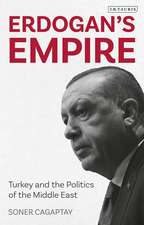 Erdogan's Empire: Turkey and the Politics of the Middle EastSoner Cagaptay-34%Preț: 82.03 lei123.98 lei
 -
 -33%Preț: 551.47 lei817.25 lei
 -
 -28%Preț: 182.60 lei252.01 lei
 -
 -22%Preț: 179.80 lei231.21 lei
 -
 Commonwealth and Independence in Post-Soviet EurasiaBruno CoppietersPreț: 313.82 lei
 -
 Turkism and the Soviets: The Turks of the World and Their Political ObjectivesCharles Warren HostlerPreț: 297.36 lei
 -
 The Eurasian CenturyHal BrandsPreț: 172.36 lei
 -
 Preț: 159.20 lei
 -
 -27%Preț: 1023.75 lei1395.94 lei
 -
 -27%Preț: 1026.02 lei1397.42 lei
 -
 Encyclopedia of TurkeyDennis Rivera-27%Preț: 1636.36 lei2229.32 lei
 -
 Turkish Foreign Policy in the 21st CenturyAlexander Murinson-34%Preț: 525.59 lei791.10 lei
 -
 -15%Preț: 92.33 lei108.77 lei
 -
 -59%Preț: 198.78 lei483.52 lei
 -
 -21%Preț: 250.97 lei319.44 lei
 -
 The 'New' Geopolitics in the Caucasus: What Role for the EU?Gvantsa Davitashvili-21%Preț: 209.02 lei265.30 lei
 -
 Preț: 137.01 lei
 -
 The "Asian Turn" in Russian Foreign PolicyAnatoly Torkunov-18%Preț: 768.94 lei937.73 lei
 -
 Russia and Eurasia 2025–2026Navruz Nekbakhtshoev-20%Preț: 221.18 lei275.24 lei
Public țintă
Postgraduate and Undergraduate AdvancedCuprins
Introduction Part I: Regionalization of Turkey’s Foreign Policy in Eurasia 1. Turkey in Eurasia, 1989–2025: A Balance Sheet 2. ‘Turkish World’ in Turkish Foreign Policy: Reflections on Central Asia and the Caucasus 3. Turkish Foreign Policy in the South Caucasus 4. Imagining Cooperation in a Contested Region: Turkey’s Black Sea Policies 5. From Geopolitical Competition to Strategic Pragmatism: Turkey and Russia after the Cold War 6. Turkey–Ukraine Relations: From Amicable Ties to Multidimensional Partnership Part II: Contestations of Turkish Foreign Policy in Eurasia 7. Eurasianism in Turkey: Understanding the Changing Dynamics of a Contested Concept in Turkey 8. Turkey’s Energy Geopolitics and Regionalization in Eurasia 9. Turkey’s Religion Policy in Eurasia 10. Turkey’s Higher Education Initiatives in Eurasia as a Tool of Soft Power 11. Political Economy of Turkey’s Policies in Eurasia
Notă biografică
Ayça Ergun is a Professor of Sociology at Middle East Technical University (METU). She received her Ph.D. from the Department of Government at University of Essex. Her research interests include state–society relations, democratization, nation and state building, civil society in the South Caucasus, Turkish foreign policy in the South Caucasus, regionalism and regional cooperation in the wider Black Sea region, the Azerbaijani–Turkish relations, internationalization, qualitative methodology, fieldwork and social impact assessment. Her articles appeared in Europe-Asia Studies, Nationalities Papers, Third World Quarterly, Work, Employment and Society, Journal of European Integration, Journal of International Relations, Journal of Church and State, Turkish Studies, Journal of Developing Societies, Journal of Royal Asiatic Society, Field Methods and Electoral Studies.
Mustafa Aydın is a Professor of International Relations at Kadir Has University, the President of the International Relations Council of Turkey, and Coordinator of Global Academy. He served as the Rector of Kadir Has University (2010–2018) and was a guest researcher at Michigan, Harvard and Athens universities, as well as at the Richardson Institute for Peace Studies, the EU Institute for Security Studies and the Institut für die Wissenschaften vom Menschen. Among others, he is a member of the European Leadership Network, the Greek-Turkish Forum and the European Academy of Arts and Sciences. His areas of interest include security issues related to Eurasia and the Middle East, as well as Turkish foreign and security policies.
Mustafa Aydın is a Professor of International Relations at Kadir Has University, the President of the International Relations Council of Turkey, and Coordinator of Global Academy. He served as the Rector of Kadir Has University (2010–2018) and was a guest researcher at Michigan, Harvard and Athens universities, as well as at the Richardson Institute for Peace Studies, the EU Institute for Security Studies and the Institut für die Wissenschaften vom Menschen. Among others, he is a member of the European Leadership Network, the Greek-Turkish Forum and the European Academy of Arts and Sciences. His areas of interest include security issues related to Eurasia and the Middle East, as well as Turkish foreign and security policies.
Descriere
This book provides an analysis of Turkish foreign policy towards Eurasia in the post-Soviet era. Focussing on the sub-regions of the South Caucasus, Central Asia and Black Sea, it problematizes various relevant issues for individualized analysis of bilateral and multilateral relations.