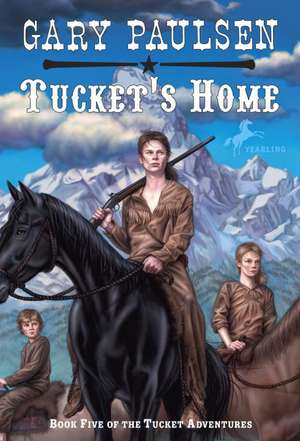
Tucket's Home
Autor Gary Paulsenen Limba Engleză Paperback – 12 feb 2002
Observăm în Tucket's Home finalul unei călătorii inițiatice remarcabile, începută cu ani în urmă pe urmele caravanei spre Oregon. Această ultimă parte a SERIEI semnate de Gary Paulsen aduce laolaltă firele narative ale aventurilor lui Francis Tucket, transformând căutarea familiei pierdute într-o lecție despre responsabilitate și maturizare. Ne-a atras atenția modul în care autorul reușește să mențină tensiunea, punându-i pe Francis, Lottie și Billy în fața unor noi pericole: de la soldați sângeroși la dilema morală a gestionării aurului spaniol descoperit într-un mormânt vechi. Merită menționat că ritmul narațiunii este alert, specific stilului cu care Paulsen și-a obișnuit cititorii în lucrări precum Hatchet sau Brian's Winter. Totuși, spre deosebire de lupta solitară pentru supraviețuire din acele titluri, aici accentul cade pe loialitatea față de grupul format pe drum. Dacă în familia The Devil's Paintbox de Victoria McKernan regăsim aceeași luptă brutală a orfanilor împotriva elementelor naturii pe Oregon Trail, Tucket's Home se diferențiază printr-o notă de speranță și prin prezența mentorului Jason Grimes, omul munților, a cărui întâlnire finală cu protagoniștii este de o încărcătură emoțională aparte. Stilul lui Paulsen rămâne ancorat în realismul dur al frontierei, fără a îndulci pericolele epocii, dar oferind tinerilor cititori un model de perseverență. Epilogul cărții oferă acea încheiere necesară, explicând destinul personajelor pe frontiera din Oregon, oferind astfel o perspectivă istorică valoroasă asupra modului în care s-a format identitatea americană în acea perioadă de expansiune.
Preț: 39.21 lei
Carte disponibilă
Livrare economică 07-21 noiembrie
Specificații
ISBN-10: 0440415586
Pagini: 112
Dimensiuni: 132 x 194 x 7 mm
Greutate: 0.14 kg
Editura: RH Childrens Books
V-ar putea interesa
-
 Joshua DreadLee BaconPreț: 50.86 lei
 -
 Wild RiverP. J. PetersenPreț: 41.35 lei
 -
 Notes from the DogGary PaulsenPreț: 75.07 lei
 -
 The MaelstromHenry H. Neff-19%Preț: 46.68 lei57.88 lei
 -
 Mr. TucketGary PaulsenPreț: 44.01 lei
 -
 The BuccaneersIain LawrencePreț: 60.24 lei
 -
 -25%Preț: 49.20 lei65.90 lei
 -
 Boys of BlurN. D. WilsonPreț: 42.36 lei
 -
 School for Stars: Best Friends Forever: Book 8Holly Willoughby-27%Preț: 36.20 lei49.59 lei
 -
 HatchetGary Paulsen-23%Preț: 37.31 lei48.34 lei
 -
 Arena 13: The PreyJoseph Delaney-17%Preț: 47.62 lei57.68 lei
 -
 AloneD J Brazier-17%Preț: 53.69 lei64.32 lei
De ce să citești această carte
Recomandăm această carte tinerilor de peste 10-12 ani pasionați de istorie și aventură. Cititorul câștigă o înțelegere profundă a dificultăților vieții de pionier, dincolo de miturile romantice. Este o lectură esențială pentru a vedea cum curajul și solidaritatea pot transforma un adolescent capturat de triburile native într-un lider capabil să își protejeze noua familie în drumul spre casă.
Despre autor
Gary Paulsen (1939–2021) a fost unul dintre cei mai apreciați scriitori americani de literatură pentru copii și adolescenți, fiind distins cu premiul Margaret Edwards pentru întreaga carieră. Cunoscut pentru pasiunea sa pentru viața în sălbăticie, Paulsen a scris peste 200 de cărți, multe inspirate din propriile experiențe, cum ar fi memoriile sale din Gone to the Woods. Opera sa explorează frecvent teme precum maturizarea, supraviețuirea și relația profundă dintre om și natură, elemente care l-au consacrat drept un maestru al prozei de aventură contemporane.
Notă biografică
Extras
He turned to look behind him, where ten-year-old Lottie watched their horses graze. Her little brother, Billy, crouched beside her, making an arrow. Francis looked down at the buffalo. The sun was gentle on his back, the dust from the fight was drifting away on a soft breeze, and as Francis lay watching, he let his mind wander back over the trip since he and Lottie and Billy had left the Pueblo Indian village.
They'd stayed there a month so that Francis could recover from a snakebite. With the help of some of the Indians, Lottie had pulled him through, while Billy had learned to hunt and shoot a bow and arrow with amazing skill. The village had been a peaceful place.
Now Francis shifted and scanned the horizon. Even in a quiet moment like this one, you had to be alert, ready for anything. They'd all learned that the hard way.
Francis Tucket had been separated from his family more than a year before, on his fourteenth birthday, when Pawnees kidnapped him from a wagon train. Jason Grimes, a one-armed mountain man, had helped him escape and taught him to survive. After they parted, Francis had found Lottie and Billy alone on the prairie, their father dead of cholera. They'd been members of a wagon train that abandoned them when their father became sick, for fear that he would infect others in the train. So the three had stuck together and headed west to the Oregon Trail to find Francis's family.
Lottie had proved to be the best organizer and camper Francis had ever seen, and Billy, now just shy of eight, had become a hunting and scouting machine of the first order. They'd been through some hair-raising adventures: Kidnapped by the Comanchero outlaw band. Storms. Snakebite. Ambushed by the murderous thieves Courtweiler and Dubs. The three had shared plenty, good and bad, and now they shared a secret--the ancient Spanish silver and gold they carried on the packhorse. When they were being chased by the Comancheros Billy had stumbled upon the grave of a Spanish conquistador, buried with his
armor, sword and plunder of centuries ago. Of course, gold and silver meant nothing out here in the wilderness. But someday, someday they'd find Francis's family and civilization, though they still had five hundred miles of rough country to cover alone.
Francis had feared there would be problems on this part of their journey, but it had turned out to be nothing more than a camping trip in a country so
beautiful that Francis often had trouble believing it was real.
They had started in partial desert, country covered in mesquite and pinons, but it quickly gave way to mountains. Spring had come early and had stayed. Thick, green grass kept the horses well fed and happy; streams ran full of cold water and trout. Billy caught the fish easily, using a skill he'd learned from the Pueblos that required only a bit of line braided from horsehair, taken from the ponies' tails, and a bent and sharpened piece of wire.
Francis had no trouble getting deer with his rifle, and Billy supplemented the venison and trout diet with rabbit and turkey and grouse he shot with his bow. Within a week they were all getting fat, and the packhorse nearly staggered with extra meat as they rode through grassy mountain meadows amid high mountain peaks still covered with snow.
But they hadn't seen any buffalo until they'd come to this rise and seen below them the small herd with the fighting bulls.
"Honestly, Francis, I don't see why we need more meat." Lottie had crawled up alongside him. Billy, his arrow finished, was a hundred yards back, below the ridge, adjusting the makeshift packs on the horses. "We have so much now we can't carry it all."
"Not so loud--if the wind shifts they'll hear us and run," Francis whispered. "The reason is that we don't have buffalo meat. Besides that, they're fat and we need the grease for our moccasins and leather and my rifle. So we're going to shoot a buffalo, all right?"
She nodded and became quiet and he studied the terrain around the herd to see how best to approach them for a shot. The buffalo were in a small basin with a series of drainage gullies that fed in and out. Francis saw that the one that ran off to the east seemed to provide the best course. It was deep and wound back toward him in a big loop, with a smaller ditch he could use for access. He nodded and pointed with his chin.
"See that ditch off to the right?" He looked at Lottie, then back. "You go back with Billy, I'll make my way down there and--"
Suddenly, as if by magic, there was a burst of gray smoke below them from the edge of the gully that pointed toward the buffalo. Half an instant later
Francis heard the crack of a rifle--they were so far away it took that long for the sound to reach them--and one of the cows watching the fighting bulls pitched forward and down onto her side.
"What . . ."
There was another puff of smoke. Another cow went down; then another shot, and another and another, coming so fast they were almost on top of each other, and each time, a cow would drop on her side and start kicking in death. Twelve shots. Twelve cows.
"Francis, somebody is shooting our buffalo!" Lottie punched his shoulder.