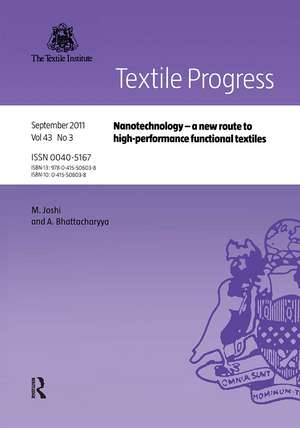
TTPR 43.3
Editat de Various Authorsen Limba Engleză Hardback – 30 sep 2020
Preț: 932.89 lei
Preț vechi: 1063.50 lei
-12%
Puncte Express: 1399
Carte disponibilă
Livrare economică 22 august-05 septembrie
Livrare prin curier în România Termenul estimat este afișat lângă disponibilitate.
Transport gratuit pentru acest produs Plată online sau ramburs, în funcție de opțiunile comenzii.
Retur gratuit în 14 zile Comandă securizată și suport în română.
Specificații
ISBN-13: 9781138458710
ISBN-10: 1138458716
Pagini: 88
Dimensiuni: 174 x 246 x 12 mm
Greutate: 0.32 kg
Ediția:1
Editura: Taylor & Francis
Colecția Routledge
Locul publicării:Oxford, United Kingdom
ISBN-10: 1138458716
Pagini: 88
Dimensiuni: 174 x 246 x 12 mm
Greutate: 0.32 kg
Ediția:1
Editura: Taylor & Francis
Colecția Routledge
Locul publicării:Oxford, United Kingdom
Cuprins
1. Introduction -- 2. From functional to smart and intelligent textiles -- 3. Nanotechnology in multifunctional, smart and intelligent textiles -- 3.1. Nanofinishing -- 3.1.1. Oil and water repellent nanofinishes -- 3.1.2. Super hydrophobic nanofinishes -- 3.1.3. Photocatalytic self-cleaning nanofinishes -- 3.1.4. Hydrophilic nanofinishes -- 3.1.5. Antibacterial nanofinishes -- 3.1.6. UV protective nanofinishes -- 3.1.7. Antistatic nanofinishes -- 3.2. Nanocoating -- 3.2.1. Self-assembly based nanocoating -- 3.2.2. Plasma polymerization assisted nanocoating -- 3.2.3. Sol-gel -- 3.2.4. Layer-by-layer -- 3.2.5. Other nanocoating techniques -- 3.3. Nanocomposite coating -- 3.3.1. Clay based nanocomposite coating -- 3.3.2. Silica based nanocomposite coating -- 3.3.3. Carbon nanomaterial based nanocomposite coating -- 3.3.4. Other nanoparticles based nanocomposite coating -- 3.4. Nanodyeing -- 3.4.1. Modification in substrate and dye -- 3.4.2. Surface texturing using plasma -- 3.4.3. Surface texturing using UV /O3 -- 4. Nanotechnology in multifunctional fibers and nanofibrous forms -- 4.1. Nanocomposite fiber -- 4.1.1. Polymer /clay nanocomposite fibers -- 4.1.1.1. Nylon /clay nanocomposite fibers -- 4.1.1.2. Polyethylene terephthalate (PET) /clay nanocomposite fibers -- 4.1.1.3. Viscose /clay nanocomposite fibers -- 4.1.1.4. Polyurethane /clay nanocomposite fiber -- 4.1.1.5. Polypropylene /clay nanocomposite fiber -- 4.1.2. Polymer /carbon nanotube nanocomposite fibers -- 4.1.2.1. Nylon /CNT based nanocomposite fibers -- 4.1.2.2. Liquid crystal polymer /CNT based nanocomposite fibers -- 4.1.2.3. Polyurethane /CNT-based nanocomposite fibers -- 4.1.2.4. Polyethylene /CNT based nanocomposite fibers -- 4.1.3. Other nanoparticle-based nanocomposite fibers -- 4.2. Nanofibers 4.2.1. Electrospinning -- 4.2.1.1. Background -- 4.2.1.2. Process -- 4.2.1.3. Taylor cone formation -- 4.2.1.4. Approaches to produce a nanofiber -- 4.2.1.5. Instability of jets -- 4.2.I.6. Collectors -- 4.2.2. Effect of process parameters -- 4.2.2.1. Effect of instrument variables -- 4.2.2.2. Effect of salt addition -- 4.2.2.3. Effect of jet diameter -- 4.2.2.4. Effect of solvent -- 4.2.2.5. Nanofiber morphology: voltage dependence -- 4.2.2.6. Nanofiber morphology: concentration dependence -- 4.2.2.7. Nanofiber morphology: temperature dependence -- 4.2.3. Nanofiber properties -- 4.2.3.1. Surface area -- 4.2.3.2. Crystallinity -- 4.2.3.3. Residual charge -- 4.2.3.4. Size and size distribution -- 4.2.3.5. Morphology -- 4.2.3.6. Cross-sectional shape -- 4.2.4. Melt spinning of nanofibers -- 4.2.5. Nanofibers from a variety of polymers -- 4.2.6. Functionalized nanofibers -- 4.2.7. Nanofiber applications -- 4.2.8. Other techniques to produce nanofibers -- Conclusion.
Descriere
This is Volume 43, Number 3 September 2011 edition of the Textile Progress series, it focuses on Nanotechnology-a new route to high-performance functional textiles.