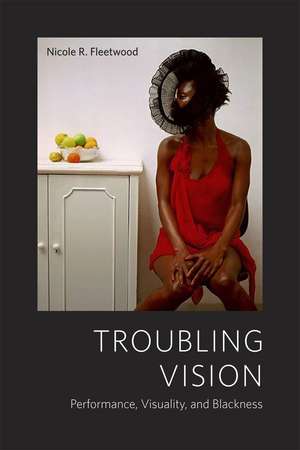
Troubling Vision: Performance, Visuality, and Blackness
Autor Nicole R. Fleetwooden Limba Engleză Paperback – 30 ian 2011
Remarcăm importanța volumului Troubling Vision pentru cercetarea academică contemporană, fiind o lucrare de referință pentru studenții și specialiștii în studii culturale, istoria artei și sociologie care pregătesc acreditări în analiza vizuală și teoria rasei. Nicole R. Fleetwood propune o reorientare critică a modului în care „negritatea” este percepută în spațiul public american, investigând mecanismele prin care corpul negru devine simultan hiper-vizibil și invizibil în regimurile scopice actuale. Analiza nu se limitează la discursul teoretic, ci se ancorează în practici documentare și media, evaluând modul în care valoarea socială este atribuită în funcție de vizibilitate.
Cititorii familiarizați cu The Black Female Body in American Literature and Art de Caroline Brown vor aprecia modul în care Fleetwood extinde discuția de la literatură către arta media și cultura pop, aducând o perspectivă nouă asupra modului în care artistele de culoare utilizează „excesul” pentru a perturba normele estetice. Structura cărții facilitează o progresie logică de la fotografia de arhivă a lui Charles „Teenie” Harris, prin analiza colorismului și a corpului feminin, până la estetica hip-hop și reprezentarea masculinității. Volumul culminează cu un examen al iconicității și doliului, folosind figura lui Michael Jackson ca studiu de caz pentru limitele reprezentării.
În contextul operei autoarei, Troubling Vision pune bazele teoretice pentru explorările ulterioare din On Racial Icons și completează viziunea despre invizibilitate și rezistență dezvoltată în Marking Time. Dacă lucrarea anterioară se concentra pe sistemul penitenciar, volumul de față analizează „seam-urile” (cusăturile) vizibile ale culturii de masă, oferind un instrumentar critic esențial pentru înțelegerea modului în care imaginile produc și reproduc ierarhii sociale.
Preț: 303.70 lei
Carte tipărită la comandă
Livrare economică 28 noiembrie-12 decembrie
Specificații
ISBN-10: 0226253031
Pagini: 296
Ilustrații: 42 halftones
Dimensiuni: 152 x 229 x 20 mm
Greutate: 0.4 kg
Editura: University of Chicago Press
Colecția University of Chicago Press
V-ar putea interesa
-
 Preț: 127.55 lei
 -
 Preț: 410.99 lei
 -
 Marking TimeNicole R. FleetwoodPreț: 255.27 lei
 -
 Doing Business With Beauty: Black Women, Hair Salons, and the Racial Enclave EconomyAdia Harvey Wingfield-35%Preț: 593.39 lei909.83 lei
 -
 The School that Cared: A Story of the Marva Collins Preparatory School of CincinnatiP. Kamara Sekou Collins-24%Preț: 309.48 lei404.72 lei
 -
 -25%Preț: 304.07 lei405.72 lei
 -
 -27%Preț: 280.25 lei383.23 lei
 -
 Black Americans and Organized LaborPaul D. MorenoPreț: 210.66 lei
 -
 -23%Preț: 262.81 lei343.35 lei
 -
 Ebony Jr!Laretta Henderson-31%Preț: 501.42 lei723.45 lei
 -
 Booker T. Washington and Black ProgressW. Fitzhugh BrundagePreț: 178.81 lei
 -
 A Turbulent Voyage: Readings in African American StudiesFloyd W. Hayes-28%Preț: 500.72 lei698.69 lei
 -
 -20%Preț: 371.73 lei464.70 lei
 -
 Rhythmic African Spirituality in Sports, Dance, Music and ArtWilliam Jr. GunnPreț: 95.77 lei
 -
 When Blacks Were GreenKarla J. CooperPreț: 54.66 lei
 -
 Greener Pastures: Green AssociateFlorence Virginia Wilkins ColemanPreț: 43.23 lei
 -
 Out of Pain Came PoetryValerie Martin-StewartPreț: 113.38 lei
 -
 Preț: 79.28 lei
 -
 A Dream So Far AwayShbrone MimsPreț: 218.31 lei
 -
 When A Good Will Goes BadOmar ScottPreț: 116.17 lei
 -
 The Larry Holliday StoryNorma Jean HollidayPreț: 138.00 lei
 -
 History of Negro Soldiers in the Spanish American WarEdward a. JohnsonPreț: 114.93 lei
 -
 The African-In-AmericaJesse HerriottPreț: 44.02 lei
 -
 When We Become MenKhalil BaaqiPreț: 105.67 lei
 -
 Sweet ReleaseJames DavisonPreț: 160.32 lei
 -
 Second Decade of the Korean Presbyterian Church in America, 1985-2006 (Korean)P Korean Presbyterian Church in AmericaPreț: 241.05 lei
 -
 Taryn Simon: The InnocentsTaryn Simon-8%Preț: 546.95 lei594.52 lei
De ce să citești această carte
Recomandăm această carte cercetătorilor care doresc să înțeleagă complexitatea reprezentării rasiale dincolo de simpla vizibilitate. Troubling Vision oferă o analiză riguroasă a modului în care spectacolul și spectacolul vizual modelează identitatea. Este un câștig esențial pentru orice bibliotecă de științe sociale, oferind perspective critice asupra culturii pop, fotografiei și artei media, premiate pentru originalitate și profunzime academică.
Despre autor
Nicole R. Fleetwood este o distinsă profesoară și cercetătoare, recunoscută pentru contribuțiile sale majore în domeniul studiilor americane și al culturii vizuale. Expertiza sa se concentrează pe intersecția dintre artă, politică și justiție socială, fiind laureată a premiului Lora Romero pentru debutul său editorial. Prin lucrări precum Marking Time, ea a explorat estetica creată în condiții de încarcerare, consolidându-și reputația de voce critică ce analizează modul în care grupurile marginalizate își revendică prezența în spațiul public. Activitatea sa academică este dublată de o prezență activă în curatarea de expoziții și proiecte media.
Descriere scurtă
Fleetwood documents multiple forms of engagement with the visual, even as she meticulously underscores how the terms of engagement change in various performative contexts. Examining a range of practices from the documentary photography of Charles “Teenie” Harris to the “excess flesh” performances of black female artists and pop stars to the media art of Fatimah Tuggar to the iconicity of Michael Jackson, Fleetwood reveals and reconfigures the mechanics, codes, and metaphors of blackness in visual culture.
“Troubling Vision is a path-breaking book that examines the problem of seeing blackness—the simultaneous hyper-visibility and invisibility of African Americans—in US visual culture in the last half century. Weaving together critical modes and methodologies from performance studies, art history, critical race studies, visual culture analysis, and gender theory, Fleetwood expands Du Bois’s idea of double vision into a broad questioning of whether ‘representation itself will resolve the problem of the black body in the field of vision.’ With skilled attention to historical contexts, documentary practices, and media forms, she takes up the works of a broad variety of cultural producers, from photographers and playwrights to musicians and visual artists and examines black spectatorship as well as black spectacle. In chapters on the trope of ‘non-iconicity’ in the photographs of Charles (Teenie) Harris, the ‘visible seams’ in the digital images of the artist Fatimah Tuggar, and a coda on the un-dead Michael Jackson, Fleetwood's close analyses soar. Troubling Vision is a beautifully written, original, and important addition to the field of American Studies.”—Announcement of the American Studies Association for the 2012 Lora Romero First Book Publication Prize
Notă biografică
Cuprins
Preface
Acknowledgments
ONE / “One Shot”: Charles “Teenie” Harris and the Photographic Practice of Non-Iconicity
TWO / Her Own Spook: Colorism, Vision, and the Dark Female Body
THREE / Excess Flesh: Black Women Performing Hypervisibility
FOUR / “I am King”: Hip-Hop Culture, Fashion Advertising, and the Black Male Body
FIVE / Visible Seams: The Media Art of Fatimah Tuggar
CODA / The Icon Is Dead: Mourning Michael Jackson
Notes
Bibliography
Index