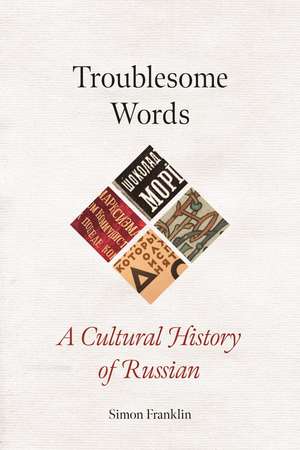
Troublesome Words: A Cultural History of Russian: Language Worlds
Autor Simon Franklinen Limba Engleză Hardback – 4 noi 2026
Across 350 years, the Russian language has been shaped by competing visions of what it should be, from early grammarians defining a literary standard to digital-era debates about slang, obscenity, and online identity. In this book, Simon Franklin traces how tradition and disruption have continually reshaped the language, including the linguistic experiments of writers and revolutionaries, the rhetoric of empire, and the global diversity of Russian today. Clear, concise, and engaging, Troublesome Words is both a history and a cultural portrait, revealing how language reflects power, imagination, and the changing world.
Preț: 191.34 lei
Nou
Puncte Express: 287
Carte disponibilă
Livrare economică 07-21 noiembrie
Livrare express 24-30 octombrie pentru 32.67 lei
Livrare prin curier în România Termenul estimat este afișat lângă disponibilitate.
Transport gratuit de la 400.00 lei Plată online sau ramburs, în funcție de opțiunile comenzii.
Retur gratuit în 14 zile Comandă securizată și suport în română.
Specificații
ISBN-13: 9781836392668
ISBN-10: 1836392664
Pagini: 296
Ilustrații: 47 illustrations
Dimensiuni: 156 x 234 mm
Greutate: 0.64 kg
Editura: REAKTION BOOKS
Colecția Reaktion Books
Seria Language Worlds
ISBN-10: 1836392664
Pagini: 296
Ilustrații: 47 illustrations
Dimensiuni: 156 x 234 mm
Greutate: 0.64 kg
Editura: REAKTION BOOKS
Colecția Reaktion Books
Seria Language Worlds
Notă biografică
Simon Franklin is emeritus professor of Slavic studies at the University of Cambridge. His books include The Russian Graphosphere, 1450–1850.
Recenzii
“Given its technical subject, it’s hard to imagine a more seductive presentation, accessible at multiple levels to readers fascinated by all manner of aspects of Russian culture and politics.”
“Written with Franklin’s sublime combination of wit and deep learning, Troublesome Words follows the contested development of the Russian language as a site of meaning from the seventeenth century to today. Its vivid examples, lively writing, and brilliant visual analysis make it rewarding for any reader.”
“Troublesome Words is an engaging, erudite, and witty exploration of the origins of the Russian language. Franklin sets out in an accessible way how Russian speakers have made sense of the world throughout Russia’s turbulent and often violent history. He maps out the religious, political, societal, and cultural forces that have shaped today’s Russian language, the uses to which it is put by Russia’s political leaders, and how ‘non-normative’ use of language is used to challenge authority. Highly recommended.”
“Franklin investigates the codification of the Russian language as it accommodates culture from the late seventeenth century to the present. With deep insight and delightful humour, Franklin reveals the problematics of norm building amidst competing authoritative voices—sociopolitical, educational, literary, demotic—all vying to regulate cultivated Russian in an ever-changing world.”
“Written with Franklin’s sublime combination of wit and deep learning, Troublesome Words follows the contested development of the Russian language as a site of meaning from the seventeenth century to today. Its vivid examples, lively writing, and brilliant visual analysis make it rewarding for any reader.”
“Troublesome Words is an engaging, erudite, and witty exploration of the origins of the Russian language. Franklin sets out in an accessible way how Russian speakers have made sense of the world throughout Russia’s turbulent and often violent history. He maps out the religious, political, societal, and cultural forces that have shaped today’s Russian language, the uses to which it is put by Russia’s political leaders, and how ‘non-normative’ use of language is used to challenge authority. Highly recommended.”
“Franklin investigates the codification of the Russian language as it accommodates culture from the late seventeenth century to the present. With deep insight and delightful humour, Franklin reveals the problematics of norm building amidst competing authoritative voices—sociopolitical, educational, literary, demotic—all vying to regulate cultivated Russian in an ever-changing world.”