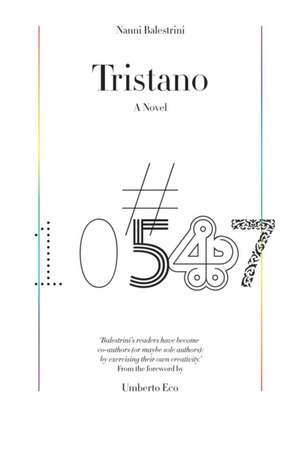
Tristano
Autor Nanni Balestrinien Limba Engleză Paperback – 11 feb 2014
The story involves two lovers, there is disruption on the streets of Milan, protesters by Porta Ticinese. Can they escape and be together? How will events change their destiny? In Tristano, Nanni Balestrini brilliantly experiments with form and storytelling to create a new type of novel in which technology, author and the reader themselves collaborate to create the narrative. Constructed of ten chapters, each consisting of twenty texts taken from guidebooks, atlases, newspapers and fiction, each printed edition of the novel is ordered uniquely.
Preț: 112.15 lei
Puncte Express: 168
Cartea se retipărește
Doresc să fiu notificat când acest titlu va fi disponibil:
Se trimite...
Specificații
ISBN-13: 9781781681695
ISBN-10: 1781681694
Pagini: 120
Dimensiuni: 139 x 208 x 12 mm
Greutate: 0.17 kg
Editura: VERSO
ISBN-10: 1781681694
Pagini: 120
Dimensiuni: 139 x 208 x 12 mm
Greutate: 0.17 kg
Editura: VERSO
Notă biografică
Nanni Balestrini was born in Milan in 1935 and was a member of the influential avant-garde Gruppo 63, along with Umberto Eco and Eduardo Sanguineti. He is the author of numerous volumes of poetry, including Blackout and Ipocalisse, and novels such as Tristano, Vogliamo Tutto, and La Violenza Illustrata.
During the notorious mass arrests of writers and activists associated with Autonomy, which began in 1979, Balestrini was charged with membership of an armed organization and with subversive association. He went underground to avoid arrest and fl ed to France. As in so many other cases, no evidence was provided and he was acquitted of all the charges.
He currently lives in Rome, where he runs the monthly magazine of cultural intervention Alfabeta2 with Umberto Eco and others.
During the notorious mass arrests of writers and activists associated with Autonomy, which began in 1979, Balestrini was charged with membership of an armed organization and with subversive association. He went underground to avoid arrest and fl ed to France. As in so many other cases, no evidence was provided and he was acquitted of all the charges.
He currently lives in Rome, where he runs the monthly magazine of cultural intervention Alfabeta2 with Umberto Eco and others.
Recenzii
“Goodbye Gutenberg. Many alternative ways of spreading the adventure of literature are emerging. This exercise by Balestrini is absolutely central.”—La Stampa
“Finally the historical impasse between literature and new media ... turns into an opportunity to create something radically new.”—Aldo Nove, Il Sole 24 Ore
“Balestrini has created with Tristano a kind of poetry of the language ... promoting language to the role of protagonist, that is of hero, and where in traditional novels language voices the hero’s thoughts and actions, in this new Tristano language voices itself and celebrates its The Unseen wide number of opportunities and movements.”—Angelo Guglielmi, L’Unità
"Goodbye Gutenberg. Many alternative ways of spreading the adventure of literature are emerging. This exercise by Balestrini is absolutely central." La Stampa "Finally the historical impasse between literature and new media ... turns into an opportunity to create something radically new." Aldo Nove, Il Sole 24 Ore "Balestrini has created with Tristano a kind of poetry of the language ... promoting language to the role of protagonist, that is of hero, and where in traditional novels language voices the hero's thoughts and actions, in this new Tristano language voices itself and celebrates its wide number of opportunities and movements." Angelo Guglielmi, L'Unità
“Finally the historical impasse between literature and new media ... turns into an opportunity to create something radically new.”—Aldo Nove, Il Sole 24 Ore
“Balestrini has created with Tristano a kind of poetry of the language ... promoting language to the role of protagonist, that is of hero, and where in traditional novels language voices the hero’s thoughts and actions, in this new Tristano language voices itself and celebrates its The Unseen wide number of opportunities and movements.”—Angelo Guglielmi, L’Unità
"Goodbye Gutenberg. Many alternative ways of spreading the adventure of literature are emerging. This exercise by Balestrini is absolutely central." La Stampa "Finally the historical impasse between literature and new media ... turns into an opportunity to create something radically new." Aldo Nove, Il Sole 24 Ore "Balestrini has created with Tristano a kind of poetry of the language ... promoting language to the role of protagonist, that is of hero, and where in traditional novels language voices the hero's thoughts and actions, in this new Tristano language voices itself and celebrates its wide number of opportunities and movements." Angelo Guglielmi, L'Unità