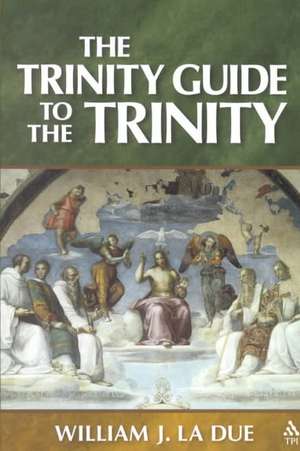
Trinity Guide to the Trinity
Autor William J. La Dueen Limba Engleză Paperback – feb 2003
Preț: 278.06 lei
Puncte Express: 417
Carte tipărită la comandă
Livrare economică 28 noiembrie-12 decembrie
Livrare prin curier în România Termenul estimat este afișat lângă disponibilitate.
Transport gratuit de la 400.00 lei Plată online sau ramburs, în funcție de opțiunile comenzii.
Retur gratuit în 14 zile Comandă securizată și suport în română.
Specificații
ISBN-13: 9781563383953
ISBN-10: 1563383950
Pagini: 228
Dimensiuni: 152 x 229 x 12 mm
Greutate: 0.36 kg
Editura: Bloomsbury Publishing
Colecția Trinity Press International
Locul publicării:New York, United States
ISBN-10: 1563383950
Pagini: 228
Dimensiuni: 152 x 229 x 12 mm
Greutate: 0.36 kg
Editura: Bloomsbury Publishing
Colecția Trinity Press International
Locul publicării:New York, United States
V-ar putea interesa
-
 The Church for the World: A Theology of Public WitnessJennifer McBride-13%Preț: 303.36 lei347.27 lei
 -
 -35%Preț: 884.53 lei1355.17 lei
 -
 Researching Practice in Ministry and MissionHelen CameronPreț: 204.27 lei
 -
 The Problem of EvilDaniel SpeakPreț: 140.19 lei
 -
 Preț: 323.65 lei
 -
 What Is Biblical Theology?James M Hamilton JrPreț: 70.75 lei
 -
 Jesus or NothingDan DeWittPreț: 81.00 lei
 -
 Figuring Out the ChurchAidan NicholsPreț: 97.06 lei
 -
 How to Share Your Faith with AnyoneTerry BarberPreț: 85.57 lei
 -
 Preț: 238.52 lei
 -
 Evangelical TruthJohn R. W. StottPreț: 122.75 lei
Recenzii
"William J. La Due has provided the interested reader with a wonderful survey of the doctrine of the Trinity...The student just starting their study of the doctrine of the Trinity will benefit greatly from this book, and certainly be equipped to engage in much more detailed study, whether they want to focus on Patristics, Medieval theology, or something more contemporary... All in all, this book is the perfect introduction to the Trinity in my opinion... I recommend this book to all beginning students, as well as to intermediate students who might not be familiar with a particular era of Trinitarian theology. I would also recommend this to advanced students as a great refresher for information they have already obtained, and also as a good study guide to teach classes on the Trinity." -Nick Norelli, Rightly Dividing the Word of Truth, April 21, 2008
"The present work discusses Trinitarian teachings in Scripture and church history, giving special attention to the views of various recent theologians...[the author] demonstrates a masterful ability to condense lengthy, complex material into manageable packages. As a classroom text this allows freedom for the professor and students to form their own judgments." - Bibliotheca Sacra
"The doctrine of the Trinity, while fundamental to and emblematic of Christian faith in God, has rarely captivated popular Christian imagination the way Jesus has. As noted by La Due (e.g., Jesus Among the Theologians), this probably has something to do with the human accessibility of Jesus and the concurrent transcendence of the Father and invisibility of the Holy Spirit. Here La Due investigates the history of the doctrine of the Trinity in the Jewish and Christian Scriptures and in the early Christian Church and presents a synthesis of medieval Trinitarian theology. He also examines the influence of post-Enlightenment voluntarism and rationalism on the doctrine and presents a summary of Trinitarian theology by Catholic, Protestant, and Orthodox scholars--including feminist scholars--of the last 50 years. La Due shows how contemporary Christian theology has navigated through the dangers of Fideism's circular subjectivity, rationalism's skeptical negativity, Ontologism's elitist obscurity, and Modalism's necessary heresy. La Due has written an uncommonly comprehensive study, through which the Trinitarian doctrine can become more accessible to contemporary religious imagination. The result is a valuable handbook for students of religion. Recommended for seminary and academic libraries and for public libraries with heavy circulation in the religion department"--David I. Fulton, Library Journal, March 2003
"This volume goes a long way toward helping Christians understand the history of the doctrine of the Trinity..La Due's historical overview, though brief, is a useful digest of the major voices and movements in trinitarian theology."--Publishers Weekly, February 2003
I am deeply grateful to William LaDue for his exhaustive survey of the reflections of theologians from the second century of the Christian era to the present day on the central mystery of our religion. It clarifies for me semantic problems created by developments since the Enlightenment in the concept of person and personality. Even more important, I have an increased awareness of the centrality of the Trinity in my life. Far from being a routine gesture, blessing myself is a reaffirmation of the eternal communion of Father, Son and Spirit as the prototype of all my associations in family, church, and society.
"La Due allows the various authors to speak for themselves, seldom intruding with his own analysis or evaluations."--J. Gresham, Kenrick-Glennon Seminary, Paul VI Institute, for CHOICE.
"All the major players are here: La Due's choice of theologians is impressively inclusive, as are his efforts to show the historic interaction of their thoughts. As such, La Due's Guide serves as a more than adequate compendium to introduce the novice "
"The present work discusses Trinitarian teachings in Scripture and church history, giving special attention to the views of various recent theologians...[the author] demonstrates a masterful ability to condense lengthy, complex material into manageable packages. As a classroom text this allows freedom for the professor and students to form their own judgments." - Bibliotheca Sacra
"The doctrine of the Trinity, while fundamental to and emblematic of Christian faith in God, has rarely captivated popular Christian imagination the way Jesus has. As noted by La Due (e.g., Jesus Among the Theologians), this probably has something to do with the human accessibility of Jesus and the concurrent transcendence of the Father and invisibility of the Holy Spirit. Here La Due investigates the history of the doctrine of the Trinity in the Jewish and Christian Scriptures and in the early Christian Church and presents a synthesis of medieval Trinitarian theology. He also examines the influence of post-Enlightenment voluntarism and rationalism on the doctrine and presents a summary of Trinitarian theology by Catholic, Protestant, and Orthodox scholars--including feminist scholars--of the last 50 years. La Due shows how contemporary Christian theology has navigated through the dangers of Fideism's circular subjectivity, rationalism's skeptical negativity, Ontologism's elitist obscurity, and Modalism's necessary heresy. La Due has written an uncommonly comprehensive study, through which the Trinitarian doctrine can become more accessible to contemporary religious imagination. The result is a valuable handbook for students of religion. Recommended for seminary and academic libraries and for public libraries with heavy circulation in the religion department"--David I. Fulton, Library Journal, March 2003
"This volume goes a long way toward helping Christians understand the history of the doctrine of the Trinity..La Due's historical overview, though brief, is a useful digest of the major voices and movements in trinitarian theology."--Publishers Weekly, February 2003
I am deeply grateful to William LaDue for his exhaustive survey of the reflections of theologians from the second century of the Christian era to the present day on the central mystery of our religion. It clarifies for me semantic problems created by developments since the Enlightenment in the concept of person and personality. Even more important, I have an increased awareness of the centrality of the Trinity in my life. Far from being a routine gesture, blessing myself is a reaffirmation of the eternal communion of Father, Son and Spirit as the prototype of all my associations in family, church, and society.
"La Due allows the various authors to speak for themselves, seldom intruding with his own analysis or evaluations."--J. Gresham, Kenrick-Glennon Seminary, Paul VI Institute, for CHOICE.
"All the major players are here: La Due's choice of theologians is impressively inclusive, as are his efforts to show the historic interaction of their thoughts. As such, La Due's Guide serves as a more than adequate compendium to introduce the novice "