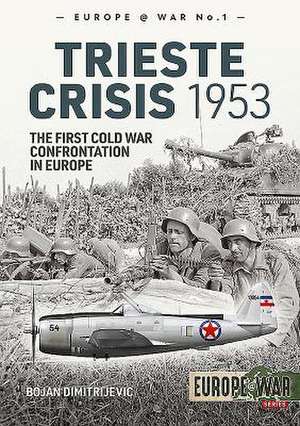
Trieste Crisis 1953
Autor Bojan Dimitrijevicen Limba Engleză Paperback – 4 sep 2019
În cadrul studiilor de securitate și istorie a Războiului Rece, Trieste Crisis 1953 ocupă o nișă critică, oferind o perspectivă tehnică asupra unui punct de tensiune geopolitică adesea analizat doar prin prisma socio-economică. Suntem de părere că această lucrare a lui Bojan Dimitrijevic, publicată de HELION & COMPANY, reușește să umple un gol documentar major prin concentrarea pe dimensiunea strict militară a disputei de frontieră italo-iugoslave. Încadrată în programele de studiu ale istoriei contemporane europene, cartea examinează cum zona Trieste a devenit, timp de un deceniu, locul de întâlnire brutal dintre democrația occidentală și ideologia comunistă. Ne-a atras atenția rigoarea cu care este reconstruită mobilizarea din octombrie 1953, momentul de apogeu în care ambele țări au desfășurat cele mai mari efective militare din istoria lor postbelică. Spre deosebire de alte lucrări care tratează subiectul la nivel diplomatic, Trieste Crisis 1953 oferă detalii specifice despre unitățile implicate, armamentul greu și structura forțelor aliate. Această abordare continuă direcția începută de autor în volume precum Cominform Crisis, unde a explorat primele conflicte din interiorul blocului comunist, sau în analizele sale despre conflictele balcanice mai recente, precum Operation Allied Force - Volume 1 și Operation Deliberate Force. Structura narativă este una densă, sprijinită de un aparat ilustrativ remarcabil: peste 150 de imagini, multe publicate în premieră, și profiluri color realizate de experți precum Tom Cooper sau David Bocquelet. Aceste elemente vizuale transformă textul dintr-o simplă cronică istorică într-un instrument de referință pentru istorici și pasionații de tehnică militară, oferind o imagine clară a modului în care s-a manifestat prima confruntare reală a Războiului Rece în inima Europei.
Preț: 141.87 lei
Carte indisponibilă temporar
Specificații
ISBN-10: 191286634X
Pagini: 72
Ilustrații: 123 b/w photos, 17 colour profiles, 4 colour ills, 2 maps, 9 tables
Dimensiuni: 209 x 292 x 5 mm
Greutate: 0.26 kg
Editura: HELION & COMPANY
De ce să citești această carte
Recomandăm această carte cercetătorilor și studenților la istorie sau științe politice care doresc să înțeleagă mecanica militară a Războiului Rece. Cititorul câștigă acces la date tehnice și fotografii de arhivă rare, care clarifică poziționarea trupelor italiene și iugoslave într-un moment critic pentru stabilitatea europeană. Este un studiu esențial despre cum mobilizarea armată a dictat termenii diplomației în 1953.
Despre autor
Bojan Dimitrijevic este un istoric militar de prestigiu, cercetător la Institutul pentru Istorie Contemporană din Belgrad. Cu o carieră dedicată documentării conflictelor din spațiul balcanic, acesta a publicat peste 40 de volume, fiind o autoritate în ceea ce privește evoluția forțelor armate iugoslave. Expertiza sa se extinde de la analizele tehnice ale vehiculelor de luptă, așa cum apare în colaborările pentru seria Panzerwrecks 19, până la studii strategice complexe despre intervențiile NATO și crizele ideologice din perioada comunistă.
Descriere
The city of Trieste stands as a symbol of the Italian-Yugoslav border dispute in the first decade after the Second World War. The problem included a much larger territory which covers the wider area of Trieste: ranging from the Julian Alps in the north to the base of the Istrian peninsula in the south; in the area where the Italians meet the South Slavs. Moreover, after the Second World War it was an area of confrontation for two ideologies: western democracy and communism. It was the place where the Iron Curtain lay between the two worlds for many decades of the Cold War. Often discussed from the socio-economic point of view, military aspects of the Trieste Crisis remain remarkably under-reported – and not only in the English language. One of the primary reasons is the relative unavailability of relevant Italian and Yugoslav documentation, but also the general focus on political and ethnic issues instead. The Trieste Crisis focusses on military-related affairs in this part of the world from the ‘race to Trieste’ of May 1945 until the creation of the Free Territory of Trieste and the culmination of tensions between Italy and former Yugoslavia, in October 1953. By the later date, the crisis had reached a point where it resulted in the largest deployment of military forces from both countries. Correspondingly, this work provides a detailed account of the Allied, Italian and Yugoslav military presence in the area befor, and their build-up during this near-war. Paying special attention to the description of the troops involved, their armament and equipment, the heavy weaponry deployed, and aerial and naval forces, The Trieste Crisis is illustrated by more than 150 photographs – most of them never published before – colour profiles and maps, and thus closing a gap in the history of the early Cold War in Europe of the mid-20th Century.
"Besides the fantastic text, attached photos give a special value to this book as they are precisely following the written topic... a great foundation for everybody interested in the military part of this eight-year crisis which happened in the heart of Europe. This publication explains in an excellent way ...all the events and individuals who were directly involved in the first real cold war confrontation and therefore I am sure that this book is going to be read and some parts even studied by a wide audience." Maketar Plus
"Excellent background and military comparison of the Western confrontation with Tito's Yugoslav Army..." Historial Miniatures Gaming Society
"Dozens of rare, previously unpublished photos season the study. Twenty-one color plates – eight military vehicles by David Bocquelet, four uniforms by Anderson Subtil, and nine aircraft by Tom Cooper – provide plenty of period project prospects." Cybermodeler