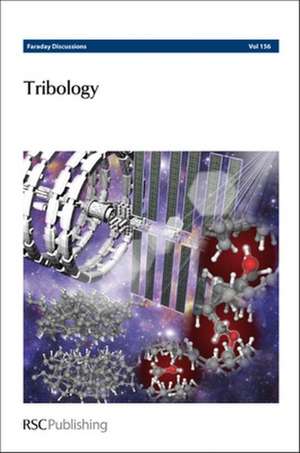
Tribology
en Limba Engleză Hardback – 21 iul 2012
ABORDAREA PRACTICĂ: Acest volum, publicat sub egida Royal Society of Chemistry, se distinge printr-un raport echilibrat între rigoarea teoretică a modelării multiscalare și studiile de caz experimentale. Observăm o tranziție clară de la mecanismele moleculare fundamentale la aplicații industriale și medicale critice. Recomandăm această lucrare pentru modul în care fundamentează predicțiile macro-contactului pe date obținute la nivel nano și micro, oferind inginerilor instrumente pentru dezvoltarea sistemelor cu întreținere redusă și emisii scăzute. Structura volumului reflectă formatul specific al Faraday Discussions, debutând cu o prelegere introductivă despre bio-tribologie și continuând cu secțiuni tehnice ce includ prezentări de lucrări urmate de discuții critice. Cititorul care a aplicat deja principiile fundamentale din Tribology for Engineers de J. Paulo Davim va găsi aici o completare esențială prin studiile avansate de tribochimie și dinamica microstructurală a suprafețelor în timpul contactului tribologic. Spre deosebire de manualele clasice, această lucrare analizează comportamente specifice, precum eșecul prin oboseală în contactele lubrifiate concentrate sau utilizarea lichidelor ionice ca aditivi în aliajele oțel/cupru-staniu. Ne-a atras atenția în mod deosebit secțiunea dedicată dispozitivelor microelectromecanice și protezelor medicale, unde precizia modelării determină viabilitatea pe termen lung a produsului. Progresia conținutului permite o înțelegere stratificată, de la dinamica moleculară a metanolului între filme de carbon, până la protocoale pre-clinice pentru evaluarea articulațiilor artificiale. Este o resursă tehnică ce transformă teoria tribologică într-un avantaj competitiv pentru proiectarea mașinilor viitorului.
Preț: 1287.54 lei
Preț vechi: 1497.15 lei
-14%
Carte disponibilă
Livrare economică 09-23 noiembrie
Specificații
ISBN-10: 184973447X
Pagini: 448
Dimensiuni: 163 x 237 x 33 mm
Greutate: 0.93 kg
Ediția:1
Editura: RSC Publishing
V-ar putea interesa
-
 Atlas of Orthoses and Assistive DevicesDouglas P. Murphy-28%Preț: 1169.10 lei1618.81 leiRecomandat
 -
 Advanced Computational NanomechanicsNuno Silvestre-23%Preț: 760.29 lei987.39 lei
 -
 -18%Preț: 945.22 lei1152.70 lei
 -
 Sticky: The Secret Science of SurfacesLaurie Winkless-31%Preț: 59.71 lei86.16 lei
 -
 Tribology & Surface Engineering: Volume 1J. Paulo Davim-27%Preț: 1551.16 lei2111.80 lei
 -
 Advances in Mechanics Research: Volume 1Jeremy M Campbell-26%Preț: 1643.55 lei2234.06 lei
 -
 Multiscale Thermal Transport in Energy SystemsYuwen Zhang-27%Preț: 1526.53 lei2078.03 lei
 -
 -30%Preț: 97.81 lei139.80 lei
 -
 Replaceable YouMary Roach-5%Preț: 108.32 lei114.03 lei
 -
 Tribology of Machine ElementsGiuseppe Pintaude-23%Preț: 816.55 lei1060.45 lei
 -
 Thermo-Hydrodynamic Lubrication in Hydrodynamic BearingsDominique Bonneau-23%Preț: 973.45 lei1264.21 lei
 -
 Component SurfacesJan C. Aurich-24%Preț: 1175.29 lei1546.43 lei
 -
 Fundamentals of Friction and Wear on the NanoscaleEnrico Gnecco-18%Preț: 1129.94 lei1377.98 lei
 -
 Triboelectric NanogeneratorsYunlong Zi-23%Preț: 818.95 lei1063.57 lei
 -
 Tribology in Total Hip ArthroplastyKarl Knahr-5%Preț: 358.86 lei377.76 lei
 -
 -5%Preț: 355.28 lei373.98 lei
 -
 -5%Preț: 687.74 lei723.94 lei
 -
 -18%Preț: 2388.83 lei2913.21 lei
 -
 -18%Preț: 1328.36 lei1619.96 lei
De ce să citești această carte
Recomandăm acest volum profesioniștilor din ingineria materialelor și proiectanților de dispozitive medicale sau energetice. Cititorul câștigă acces la cercetări de frontieră despre controlul frecării și uzurii la scară nanometrică, esențiale pentru creșterea duratei de viață a implanturilor și eficiența sistemelor de energie regenerabilă. Este o resursă indispensabilă pentru cei care doresc să implementeze modele predictive bazate pe mecanisme chimice și fizice reale.
Despre autor
Royal Society of Chemistry (RSC) este una dintre cele mai prestigioase organizații profesionale din lume, dedicată avansării științelor chimice. Cu o istorie ce depășește 175 de ani, RSC publică cercetări de înalt impact și organizează conferințe internaționale de renume, precum Faraday Discussions. Expertiza colectivă a autorilor din acest volum reflectă standardele înalte ale societății în domeniul chimiei materialelor, tribologiei și ingineriei chimice, oferind soluții științifice pentru provocările globale legate de energie și sănătate.