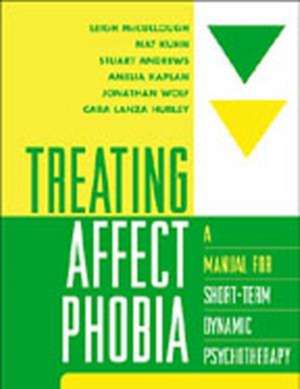
Treating Affect Phobia: A Manual for Short-Term Dynamic Psychotherapy
Autor Leigh McCullough, Nat Kuhn, Stuart Andrews, Amelia Kaplan, Jonathan Wolfen Limba Engleză Paperback – 27 mar 2003
Remarcăm încă de la primele pagini caracterul aplicat al acestui manual, care transformă teoria psihodinamică în pași concreți prin exerciții de scriere și studii de caz detaliate. Treating Affect Phobia nu este doar o expunere teoretică, ci un instrument de lucru în format mare, conceput special pentru a facilita învățarea tehnicilor de intervenție rapidă. Găsim în această lucrare o metodologie clară pentru evaluarea pacienților și formularea conflictelor de bază, oferind clinicienilor ghidaje precise despre momentul și modul de a interveni.
Autorii propun o sinteză inovatoare între rigoarea psihanalitică și tehnicile comportamentale probate, precum desensibilizarea sistemică. Această abordare este aplicată în tratarea „fobiei de afect” — conflictul intern legat de trăirea și exprimarea emoțiilor. Notăm progresia logică a volumului, structurat în patru părți esențiale: de la evaluare și formulare, la fazele critice de restructurare a apărării și a afectului, finalizând cu ajustarea percepției despre sine și ceilalți. Comparabil cu Skills Training in Psychodynamic Psychotherapy de Fredric N. Busch prin accentul pus pe instrumente practice și fișe de lucru, volumul de față se distinge prin focalizarea specifică pe modelul integrativ al fobiei de afect, oferind o punte solidă între abordările dinamice și cele cognitiv-comportamentale.
Această lucrare reprezintă o rafinare a conceptelor introduse de Leigh McCullough în Short-Term Therapy for Long-Term Change, consolidând poziția autoarei ca figură centrală în terapia dinamică de scurtă durată. În timp ce lucrările anterioare puneau bazele teoretice ale schimbării caracteriale, acest manual oferă mecanismele practice necesare pentru implementarea acestor schimbări în practica clinică cotidiană.
Preț: 440.29 lei
Preț vechi: 478.58 lei
-8%
Carte disponibilă
Livrare economică 07-21 noiembrie
Livrare express 27-31 octombrie pentru 50.11 lei
Specificații
ISBN-10: 1572308109
Pagini: 365
Ilustrații: Illustrations
Dimensiuni: 210 x 280 x 20 mm
Greutate: 0.87 kg
Ediția:New.
Editura: Guilford Publications
Colecția Guilford Press
V-ar putea interesa
-
 Easy Physics Step-by-StepJonathan Wolf-23%Preț: 155.18 lei201.47 lei
 -
 Unitarian RadicalismStuart Andrews-15%Preț: 643.57 lei757.14 lei
 -
 -5%Preț: 1229.82 lei1294.55 lei
 -
 -18%Preț: 1255.03 lei1530.52 lei
 -
 -15%Preț: 426.22 lei501.43 lei
 -
 Performing HomeStuart Andrews-18%Preț: 1105.75 lei1348.47 lei
 -
 -5%Preț: 1271.27 lei1338.18 lei
 -
 -5%Preț: 1287.02 lei1354.77 lei
 -
 Solution Building in Couples TherapyElliott MA LPC Connie-5%Preț: 393.65 lei414.37 lei
 -
 Preț: 147.82 lei
 -
 -5%Preț: 526.81 lei554.53 lei
 -
 The Rediscovery of AmericaStuart Andrews-15%Preț: 640.44 lei753.46 lei
 -
 Interpersonal Psychotherapy 2E A Clinician's GuideScott Stuart-5%Preț: 467.41 lei492.01 lei
 -
 Three Blind Men and a Lady: Sexual DeviantLola Carlile Ph. D.-5%Preț: 80.09 lei84.30 lei
 -
 -5%Preț: 89.07 lei93.75 lei
 -
 Bipolar Disorder, Second Edition: A Family-Focused Treatment ApproachDavid J. Miklowitz-5%Preț: 331.95 lei349.42 lei
 -
 Developing a Dynamic Life! - While Putting the Past to DeathDrake P. Perry-5%Preț: 78.88 lei83.03 lei
 -
 -20%Preț: 161.87 lei202.11 lei
 -
 -5%Preț: 370.63 lei390.13 lei
 -
 Dalla Psicoanalisi Alla Fondazione Della GruppoanalisiTrigant Burrow-5%Preț: 170.76 lei179.75 lei
Public țintă
Postgraduate, Professional, and Professional Practice & DevelopmentDe ce să citești această carte
Această carte este esențială pentru terapeuții care doresc să integreze tehnici practice în cadrul psihodinamic. Cititorul câștigă acces la o metodologie structurată pentru tratarea conflictelor emoționale rezistente, beneficiind de exerciții clinice și formulare de evaluare gata de utilizat. Este un ghid indispensabil pentru tranziția de la teoria abstractă la intervenția eficientă în terapia de scurtă durată.
Despre autor
Leigh McCullough este profesor clinician asociat la Harvard Medical School și o autoritate recunoscută în domeniul psihoterapiei dinamice de scurtă durată. Opera sa se concentrează pe facilitarea schimbării psihologice profunde într-un interval de timp limitat, integrând cercetarea empirică în practica terapeutică. Prin contribuțiile sale, McCullough a dezvoltat modele teoretice care unesc perspectivele psihodinamice cu cele comportamentale, oferind clinicienilor instrumente validate pentru tratarea tulburărilor de personalitate și a conflictelor afective complexe.
Cuprins
Part I. Theory, Evaluation, and Formulation
Chapter 1. Affect and Affect Phobia in Short-Term Treatment
Chapter 2. Affect Phobia, Psychodynamic Conflict, and Malan's Two Triangles
Chapter 3. Assessment and Selection of Treatment for the Patient
Chapter 4. How to Formulate a Core Psychodynamic Conflict: Spotting Affect Phobias
Part II. Defense and Affect Restructuring
Introduction to Part II
Chapter 5. Defense Restructuring Phase I: Defense Recognition
Chapter 6. Defense Restructuring Phase II: Defense Relinquishing
Chapter 7. Affect Restructuring Phase I: Affect Experiencing
Chapter 8. Affect Restructuring Phase II: Affect Expression
Part III. Self- and Other-Restructuring
Introduction to Part III
Chapter 9. Self-Restructuring: Building Compassion and Care for Self
Chapter 10. Other-Restructuring: Building Adaptive Inner Images of Others
Part IV. Diagnostic Considerations and Termination
Chapter 11. Treating Specific Diagnoses: The Relationship between DSM Diagnoses and Affect Phobias
Chapter 12. Termination
Appendix. Answers to Exercises
References
Notă biografică
Nat Kuhn, MD, PhD, is Clinical Instructor in Psychiatry and Assistant Director of the Psychotherapy Research Program at Harvard Medical School. He teaches STDP and supervises at the Cambridge Hospital and elsewhere. Dr. Kuhn has a private psychotherapy and psychiatry practice in the Boston area, and a Web site, www.natkuhn.com. Before going to medical school he was a mathematician.
Stuart Andrews, PhD, is a psychotherapist in private practice in Brookline, Massachusetts, and Assistant Director of the Psychotherapy Research Program at Harvard Medical School. He has presented at international conferences and conducted training seminars on STDP. He has taught and supervised clinicians and students, and published articles on psychotherapy integration and short-term therapy. Mr. Andrews is also Director of the Center for Families in Transition, where his program, "For the Sake of the Children," is mandated in a number of communities in Massachusetts for parents going through divorce.
Amelia Kaplan is a graduate student in clinical psychology at the Graduate School of Applied and Professional Psychology, Rutgers University, where she pursues interests in mind-body psychology, STDP, group therapy, and human sexuality.
Jonathan Wolf, MD, was a member of the Psychotherapy Research Program for three years. After graduating from Boston University School of Medicine, he entered the Harvard Longwood Psychiatry Residency Training Program.
Cara Lanza Hurley, PhD, received her doctorate in clinical psychology from Loyola University Chicago in 2005.
Recenzii
This is the training manual that teachers and practitioners of short-term dynamic therapy have been eagerly anticipating. It is the first psychodynamically oriented volume that expertly guides the novice through emotion-focused, time-sensitive psychotherapy in an explicit, step-by-step fashion. The manual is enhanced by very useful exercises that allow therapists to try out their interventions and compare them to the authors' expert responses. This volume represents a new and exciting development in the teaching, learning, and practice of psychodynamic/integrative therapy in general, and brief psychotherapy in particular.--Stanley B. Messer, PhD, Dean, Graduate School of Applied and Professional Psychology, Rutgers University
This is a treatment manual with a number of fabulous characteristics: it takes the astute clinical observations of psychodynamic therapists and sets them within modern principles of learning and behavioral change; it draws from the best of the behavior therapy treatments for phobias; it is beautifully clear and easy to follow; and it has comprehensive learning exercises at the end of each chapter to help the clinician actually learn how to apply the treatment in clinical practice. I plan to have my students read it.--Marsha M. Linehan, PhD, Department of Psychology, University of Washington
This carefully reasoned and researched manual starts with the simple assumption that many people are afraid of their own emotions, offers easy ways to identify whatever is being expressed or even suppressed, and explains clearly the authors' suggestions for treatment.--Donald L. Nathanson, MD, The Silvan S. Tomkins Institute and Department of Psychiatry and Human Behavior, Jefferson Medical College
"This work is an extraordinary synthesis of depth and practicality. It is as clear, concrete, and richly exampled a treatment manual as I have seen, yet it depicts not a simple or mechanistic therapy but one that goes to the very heart of human feeling and experience. Incorporating a profoundly integrative vision, Treating Affect Phobia will be of great value not only to psychodynamically oriented therapists but to anyone in the field who appreciates the accumulating evidence for the central role of affect--and fear of affect--in our lives."--Paul L. Wachtel, PhD, Doctoral Program in Clinical Psychology, City College and the CUNY Graduate Center, New York
"This is the training manual that teachers and practitioners of short-term dynamic therapy have been eagerly anticipating. It is the first psychodynamically oriented volume that expertly guides the novice through emotion-focused, time-sensitive psychotherapy in an explicit, step-by-step fashion. The manual is enhanced by very useful exercises that allow therapists to try out their interventions and compare them to the authors' expert responses. This volume represents a new and exciting development in the teaching, learning, and practice of psychodynamic/integrative therapy in general, and brief psychotherapy in particular."--Stanley B. Messer, PhD, Dean, Graduate School of Applied and Professional Psychology, Rutgers University
"This is a treatment manual with a number of fabulous characteristics: it takes the astute clinical observations of psychodynamic therapists and sets them within modern principles of learning and behavioral change; it draws from the best of the behavior therapy treatments for phobias; it is beautifully clear and easy to follow; and it has comprehensive learning exercises at the end of each chapter to help the clinician actually learn how to apply the treatment in clinical practice. I plan to have my students read it."--Marsha M. Linehan, PhD, Department of Psychology, University of Washington
"This carefully reasoned and researched manual starts with the simple assumption that many people are afraid of their own emotions, offers easy ways to identify whatever is being expressed or even suppressed, and explains clearly the authors' suggestions for treatment."--Donald L. Nathanson, MD, The Silvan S. Tomkins Institute and Department of Psychiatry and Human Behavior, Jefferson Medical College-