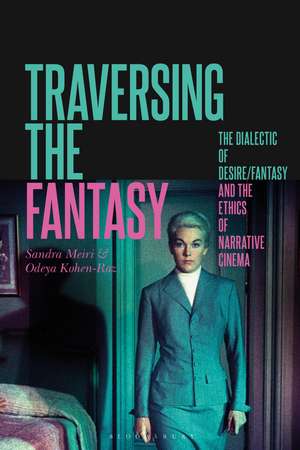
Traversing the Fantasy: The Dialectic of Desire/Fantasy and the Ethics of Narrative Cinema
Autor Sandra Meiri, Odeya Kohen-Razen Limba Engleză Paperback – 26 aug 2021
The authors discuss the affinities that the ontology and aesthetics of narrative film share with subjective, unconscious processes, offering new insights into the popular appeal of narrative film, through three film corpora, analyzed at length: body-character-breach films; dreaming-character films; and gender-crossing films. With a range of case studies from the old (Rebecca, Vertigo, Some Like it Hot) to the new (Being John Malkovich, A Fantastic Woman), Sandra Meiri and Odeya Kohen Raz build on psychoanalytic ideas about the cinema and take them in a completely new direction that promises to be the basis for further developments in the field.
| Toate formatele și edițiile | Preț | Express |
|---|---|---|
| Paperback (1) | 225.06 lei 6-8 săpt. | +0.00 lei 6-12 zile |
| Bloomsbury Publishing – 26 aug 2021 | 225.06 lei 6-8 săpt. | +0.00 lei 6-12 zile |
| Hardback (1) | 735.46 lei 6-8 săpt. | |
| Bloomsbury Publishing – 6 feb 2020 | 735.46 lei 6-8 săpt. |
Preț: 225.06 lei
Preț vechi: 249.41 lei
-10%
Puncte Express: 338
Preț estimativ în valută:
39.83€ • 46.55$ • 34.58£
39.83€ • 46.55$ • 34.58£
Carte tipărită la comandă
Livrare economică 20 februarie-06 martie
Livrare express 15-21 ianuarie pentru 277.31 lei
Preluare comenzi: 021 569.72.76
Specificații
ISBN-13: 9781501385810
ISBN-10: 150138581X
Pagini: 320
Ilustrații: 24 bw illus
Dimensiuni: 152 x 229 x 24 mm
Greutate: 0.43 kg
Editura: Bloomsbury Publishing
Colecția Bloomsbury Academic
Locul publicării:New York, United States
ISBN-10: 150138581X
Pagini: 320
Ilustrații: 24 bw illus
Dimensiuni: 152 x 229 x 24 mm
Greutate: 0.43 kg
Editura: Bloomsbury Publishing
Colecția Bloomsbury Academic
Locul publicării:New York, United States
Cuprins
Introduction
Part I: Body-Character-Breach Films
Chapter 1 - Desire, Fantasy, and the Ontology of Film
Chapter 2 -Traversing the Fantasy: Body-Character-Breach Films
Part II: Dreaming-Character Films
Chapter 3 - Dreams in Films and Implicit Reflexivity
Chapter 4 - Cinematography, Subjectivity, and Guilt
Part III: Gender-Crossing Films
Chapter 5 - This Gender That is Mine: Feminine Enjoyment and Self-Creation
Chapter 6 - From "Inherent Transgression" to the Body as "Semiotc Chora"
Appendix
Notes
References
Index
Part I: Body-Character-Breach Films
Chapter 1 - Desire, Fantasy, and the Ontology of Film
Chapter 2 -Traversing the Fantasy: Body-Character-Breach Films
Part II: Dreaming-Character Films
Chapter 3 - Dreams in Films and Implicit Reflexivity
Chapter 4 - Cinematography, Subjectivity, and Guilt
Part III: Gender-Crossing Films
Chapter 5 - This Gender That is Mine: Feminine Enjoyment and Self-Creation
Chapter 6 - From "Inherent Transgression" to the Body as "Semiotc Chora"
Appendix
Notes
References
Index
Recenzii
Traversing the Fantasy is an epochal engagement with the ethics of cinemagoing. By elaborating on the central role that fantasy has in the cinema, Sandra Meiri and Odeya Kohen-Raz make clear the ethical stakes in play every time we see a film. By taking fantasy as the starting point, they produce an ethical system that permits spectators how a given film asks them to relate to their own desire. The final result of Traversing the Fantasy is a psychoanalytic conception of cinema that allows us to completely reimagine what is at stake when we see a film.
Traversing the Fantasy is the finest book on psychoanalysis and cinema I have read for many years. Meiri and Kohen-Raz propose a remarkable range of original arguments on the nature of cinematic desire. In doing so, they offer an engaging critique of the current orthodoxies of film theory. Of particular note is the authors' championing of narrative cinema as generator of intersecting conflicts in which viewers engage with fantasy and desire in ways that are captivating, confronting, and potentially liberating.
Traversing the Fantasy is the finest book on psychoanalysis and cinema I have read for many years. Meiri and Kohen-Raz propose a remarkable range of original arguments on the nature of cinematic desire. In doing so, they offer an engaging critique of the current orthodoxies of film theory. Of particular note is the authors' championing of narrative cinema as generator of intersecting conflicts in which viewers engage with fantasy and desire in ways that are captivating, confronting, and potentially liberating.