Notă biografică
Vamik Volkan, MD, DFLAPA, received his medical education at the School of Medicine, University of Ankara, Turkey. He is an emeritus professor of psychiatry at the University of Virginia, Charlottesville and an emeritus training and supervising analyst at the Washington Psychoanalytic Institute, Washington, DC. In 1987, Dr Volkan established the Center for the Study of Mind and Human Interaction (CSMHI) at the School of Medicine, University of Virginia. CSMHI applied a growing theoretical and field-proven base of knowledge to issues such as ethnic tension, racism, large-group identity, terrorism, societal trauma, immigration, mourning, transgenerational transmissions, leader-follower relationships, and other aspects of national and international conflict. A year after his 2002 retirement, Dr Volkan became the Senior Erik Erikson Scholar at the Erikson Institute of the Austen Riggs Center, Stockbridge, Massachusetts and he spent three to six months there each year for ten years. In 2006, he was Fulbright/Sigmund Freud-Privatstiftung Visiting Scholar of Psychoanalysis in Vienna, Austria. Dr Volkan holds honorary doctorate degrees from Kuopio University (now called the University of Eastern Finland), Finland; from Ankara University, Turkey; and the Eastern European Psychoanalytic Institute, Russia. He was a former president of the Turkish-American Neuropsychiatric Society, the International Society of Political Psychology, the Virginia Psychoanalytic Society, and the American College of Psychoanalysts. Among many the awards he received are the Nevitt Sanford Award, Elise M. Hayman Award, L. Bryce Boyer Award, Margaret Mahler Literature Prize, Hans H. Strupp Award, the American College of Psychoanalysts' Distinguished Officer Award for 2014, and the Mary S. Sigourney Award for 2015. He received the Sigmund Freud Award given by the city of Vienna, Austria in collaboration with the World Council of Psychotherapy. He also was honoured on several occasions by being nominated for the Nobel Peace Prize with letters of support from twenty-seven countries. Dr Volkan is the author, co-author, editor, or co-editor of more than fifty psychoanalytic and psychopolitical books, including Enemies on the Couch: A Psychopolitical Journey through War and Peace. Currently Dr Volkan is the president emeritus of the International Dialogue Initiative (IDI), which he established in 2007. He continues to lecture nationally and internationally. Regine Scholz, Dr. Phil., is training director and Fellow of the International Dialogue Initiative, and a group analyst. Since 1987, she has worked in private practice, specializing in individual and collective trauma. As board member (2010-2017) of the Group Analytic Society International (GASI) she organized its international summer schools (Belgrade 2013, Prague 2015, Athens 2016). She also is the co-organizer of five conferences so far on the heritage of Auschwitz, "Voices after Auschwitz". A founding member of the German Society for Group Analysis and Group Psychotherapy (D3G), Dr. Scholz is a supervisor and training analyst of D3G and member of the editorial board of the journal Group Analysis. M. Gerard Fromm, PhD, is a distinguished faculty member of the Erikson Institute of the Austen Riggs Center and a fellow of the American Board and Academy of Psychoanalysis. He was the first Evelyn Stefansson Nef Director of the Erikson Institute, and directed the therapeutic community program at Riggs for many years before that. Dr Fromm has taught at, and consulted to, a number of psychoanalytic institutes across the country and has served on the faculties of the Yale Child Study Center and Harvard Medical School. He is president of the International Dialogue Initiative, an interdisciplinary group that studies the psychodynamics of societal conflict. He is also a past president of the International Society for the Psychoanalytic Study of Organizations and of the Center for the Study of Groups and Social Systems in Boston. Dr Fromm has directed or served on the staff of group relations conferences in the United States, Canada, Europe, and Israel. In addition to an independent practice of clinical and organisational consulting, he is also a partner in College Health and Counseling Services Consulting. Dr Fromm has presented and published widely, including the edited volumes Lost in Transmission: Studies of Trauma across Generations; A Spirit That Impels: Play, Creativity and Psychoanalysis; and (with Bruce L. Smith) The Facilitating Environment: Clinical Applications of Winnicott's Theory. He is also the author of a book of clinical papers called Taking the Transference, Reaching toward Dreams: Clinical Studies in the Intermediate Area.
Descriere scurtă
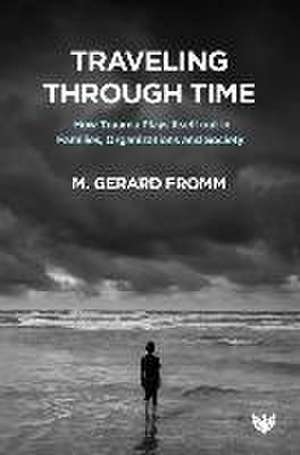
"Bullets don't just travel through skin and bone. They travel through time." These words were tattooed onto the shoulder of a young woman whose father was shot during "The Troubles" in Northern Ireland. This wrenching, volatile but also binding truth is the subject of this book. It's a truth about traumatic experiences that happen to a family, but also to a society, and to the organizations that link these intimate units with the larger context of history and culture. It's also a truth about the way trauma plays out over time, including between generations. Grounded in Erik Erikson's "way of looking at things", the book is a journal of encounters between clinical psychoanalysis and other disciplines, and an inquiry into what might be learned there for both. Sometimes that learning has to do with trauma: the way in which what can't be emotionally contained, thought about or spoken in one part of a system is passed along, with disorganizing, sometimes heartbreaking consequences, to another. After a reflection on dignity, the book examines intergenerational trauma in families, including Erikson's. It then illustrates how trauma to organizations slips below the threshold of awareness and yet continues to wear down its members. The final section examines aspects of the larger society, including radicalization, war trauma, the pandemic and cultural healing. What emerges is the sober yet hopeful truth that what people discover by taking their own emotional experiences seriously, though that might markedly differ from what is accepted in the everyday world, is a primary path toward recovery from trauma.