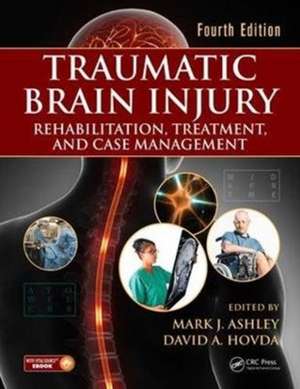
Traumatic Brain Injury: Rehabilitation, Treatment, and Case Management, Fourth Edition
Editat de Mark J. Ashley, David A. Hovdaen Limba Engleză Hardback – 17 aug 2017
Preț: 1455.15 lei
Preț vechi: 1745.79 lei
-17%
Puncte Express: 2183
Carte indisponibilă temporar
Doresc să fiu notificat când acest titlu va fi disponibil:
Se trimite...
Specificații
ISBN-13: 9781498710299
ISBN-10: 1498710298
Pagini: 796
Ilustrații: 110
Dimensiuni: 210 x 280 x 49 mm
Greutate: 2.3 kg
Ediția:4
Editura: CRC Press
Colecția CRC Press
ISBN-10: 1498710298
Pagini: 796
Ilustrații: 110
Dimensiuni: 210 x 280 x 49 mm
Greutate: 2.3 kg
Ediția:4
Editura: CRC Press
Colecția CRC Press
Public țintă
Professional ReferenceCuprins
4th EDITION TABLE OF CONTENTS
NEUROSCIENCE
NEUROSCIENCE
- Bioscience Indications for Chronic Disease Management and Neuromedical Interventions Following Traumatic Brain Injury– Mark J. Ashley, Grace S. Griesbach, David L. Ripley, Matthew J. Ashley
- The Neurobiology of Traumatic Brain Injury– Thomas C. Glen, Richard L. Sutton and David A. Hovda
- Repeat Traumatic Brain Injury Models– Mayumi Prins
- Neuroplasticity and Rehabilitation Therapy– Robert P. Lehr
- Environment Enrichment: A Preclinical Model of Neurorehabilitation for Traumatic Brain Injury– Corina O. Bondi & Anthony E. Kline
- Neuroanatomy of Basic Cognitive Function– Mark J. Ashley, Jessica G. Ashley & Matthew J. Ashley
- TBI Rehabilitation: Lessons Learned from Animal Studies about Mechanisms, Timing and Combinatorial Approaches– Dorothy A. Kozlowski
- Diet and Exercise Interventions to Promote Metabolic Homeostasis in TBI Pathology– Fernando Gomez-Pinilla
- Disruptions in Physical Substrates of Vision Following Traumatic Brain Injury– Richard E. Helvie
- Potential Utility of Resting State fMRI-Determined Functional Connectivity to Guide Neurorehabilitation– Neil G. Harris and Jessica G. Ashley
- TBI and Sensory Sensitivity: Translational Opportunities– Timothy W. Ellis and Jonathan Lifshitz
- The Neuroimaging Challenges in Hemispherectomy Patients– Zachary Jacokes, Avnish Bhattrai, Carinna Torgerson, Andrew Zywiec, Sumiko Abe, Andrei Irimia, Meng Law, Saman Hazany, and John Darrell Van Horn
MEDICAL - Clinical Management of the Minimally Conscious State– Yelena G. Bodien, Sabrina R. Taylor, and Joseph T. Giacino
- Neuropharmacologic Considerations in the Treatment of Vegetative State and Minimally Conscious State Following Brain Injury– Deborah L. Doherty
- Clinical Management of Pituitary Dysfunction After Traumatic Brain Injury – Adam H. Maghrabi, Brent E. Masel, Randall J. Urban, and David L. Ripley
- Neurotransmitters and Pharmacology– Ronald A. Browning and Richard W. Clough
- Pituitary Dysfunction After Traumatic Brain Injury – Tiffany Greco
- Increasing Physiologic Readiness to Improve Functional Independence Following Neurotrauma–Gregory J. O’Shanick and Ryan McQueen
- Assessment and Management of Mild Traumatic Brain Injury– Mark J. Ashley, Matthew J. Ashley
- Chronic Traumatic Encephalopathy (CTE)– Anne C. McKee
- Posttraumatic Epilepsy and Neurorehabilitation– Theresa D. Hernández, Sudha S. Tallavajhula, Kristina Legget, and Paul M. Levisohn
THERAPY - Evaluation of Traumatic Brain Injury Following Acute Rehabilitation– Mark J. Ashley
- Neuropsychology following Brain Injury: A Pragmatic Approach to Outcomes, Treatment, and Applications- James J. Mahoney, III
- Neuropsychological Interventions Following Traumatic Brain Injury– Jason W. Krellman, TheodoreTsaousides, and Wayne A. Gordon
- The Use of Applied Behavioral Analysis in Traumatic Brain Injury Rehabilitation– Craig S. Persel and Chris H. Persel
- Rehabilitation and Management of Visual Dysfunction Following Traumatic Brain Injury– Penelope S. Suter
- Remediative Approaches for Cognitive Disorders After TBI– Mark J. Ashley, Rose Leal, Zenobia Mehta, Jessica G. Ashley, Matthew J. Ashley
- Principles of Cognitive Rehabilitation in TBI: An Integrative Neuroscience Approach– Fofi Constantinidou and Robin D. Thomas
- Management of Residual Physical Deficits– Velda L. Bryan, David W. Harrington, Michael G. Elliott
- Undertaking Vocational Rehabilitation in TBI Rehabilitation– Mark J. Ashley, Joe Ninomiya, Jr., Amy Berryman, Karen Rasavage
CASE MANAGEMENT - The Contribution of Neuropsychological Evaluation to Traumatic Brain Injury Rehabilitation– Jay M. Uomoto
- Neurobehavioral Consequences of Mild Traumatic Brain Injury in Military Service Members and Veterans– Jay M. Uomoto, Sarah M. Wilson, Rhonda M. Williams, and Leigh A. Randa
- Issues in Aging Following Traumatic Brain Injury– Grace S. Griesbach, Mark J. Ashley, Alan Weintraub
- Children and Adolescents: Practical Strategies for School Participation and Transition– Roberta DePompei and Janet Siantz Tyler
- Long-Term Discharge Planning in Traumatic Brain Injury Rehabilitation– Mark J. Ashley and Susan M. Ashley
- Patients’ Rights and Responsibilities, Health Care Reform and Telehealth: Ethical Considerations
Notă biografică
Dr. Mark J. Ashley is founder and president/CEO of Centre for Neuro Skills (CNS), which has operated postacute brain injury rehabilitation programs in Bakersfield, Los Angeles, Dallas, Fort Worth, and San Francisco since 1980. In 2011, Dr. Ashley participated in the Blue Ribbon Panel on Traumatic Brain Injury and Post-Traumatic Stress convened by Generals Peter W. Chiarelli and Joseph Dunford, and he established the CNS Clinical Research and Education Foundation, a nonprofit research organization. He serves on the board of directors of the Brain Injury Association of America (BIAA) and holds several positions in that organization, including chairman emeritus, chair of the fund development committee, and member of the Business and Professional Council. Dr. Ashley also serves on the board of directors of the California Brain Injury Association and is chairman emeritus. He is an adjunct professor at the Rehabilitation Institute of the College of Education at Southern Illinois University and a member of the advisory board of the Center for Applied Neuroscience, University of Cyprus. Dr. Ashley received his master’s degree in speech pathology and a doctorate of science from Southern Illinois University in Carbondale, Illinois. He is a licensed speech-language pathologist in California and Texas and is a certified case manager.
Dr. David A. Hovda is the director of the UCLA Brain Injury Research Center, which was created in 1990. It incorporates teaching, research, patient care, and service for patients suffering from traumatic brain injury. Dr. Hovda has received a number of awards for his research on brain injury and recovery of function, including the "Strength of the Nation Award" from the United States Army in 2011. This is the highest civilian award given by the Secretary of the Army in recognition of Dr. Hovda’s efforts to help treat military personnel suffering from mild traumatic brain injury returning from theater. In addition, Dr. Hovda received the Alumni Association’s James F. Zimmerman Award from the University of New Mexico in 2012 for his research accomplishments recognized in the field of traumatic brain injury. Dr. Hovda is most well known internationally for his translational work on the pathobiology of traumatic brain injury and has devoted most of his career to understanding the mechanisms of recovery of function. Dr. Hovda continues to serve as a consultant for professional sport organizations as well as the Department of Defense, addressing issues related to traumatic brain injury and recovery of function. Dr. Hovda is a professor of neurosurgery and of molecular and medical pharmacology at the David Geffen School of Medicine at UCLA. He received his doctoral degree under the supervision of Dr. Dennis M. Feeney in the field of Physiological Psychology at the University of New Mexico. He completed his postdoctoral training in neurophysiology under Dr. Jamie Villablanca at UCLA.
Dr. David A. Hovda is the director of the UCLA Brain Injury Research Center, which was created in 1990. It incorporates teaching, research, patient care, and service for patients suffering from traumatic brain injury. Dr. Hovda has received a number of awards for his research on brain injury and recovery of function, including the "Strength of the Nation Award" from the United States Army in 2011. This is the highest civilian award given by the Secretary of the Army in recognition of Dr. Hovda’s efforts to help treat military personnel suffering from mild traumatic brain injury returning from theater. In addition, Dr. Hovda received the Alumni Association’s James F. Zimmerman Award from the University of New Mexico in 2012 for his research accomplishments recognized in the field of traumatic brain injury. Dr. Hovda is most well known internationally for his translational work on the pathobiology of traumatic brain injury and has devoted most of his career to understanding the mechanisms of recovery of function. Dr. Hovda continues to serve as a consultant for professional sport organizations as well as the Department of Defense, addressing issues related to traumatic brain injury and recovery of function. Dr. Hovda is a professor of neurosurgery and of molecular and medical pharmacology at the David Geffen School of Medicine at UCLA. He received his doctoral degree under the supervision of Dr. Dennis M. Feeney in the field of Physiological Psychology at the University of New Mexico. He completed his postdoctoral training in neurophysiology under Dr. Jamie Villablanca at UCLA.
Descriere
The fourth edition of this text constitutes a continuation of 20 years of coverage of traumatic brain injury, and broadens the discussion of acquired brain injury.