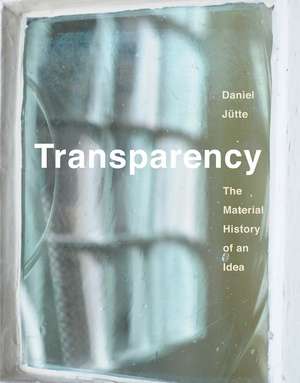
Transparency: The Material History of an Idea
Autor Daniel Jutteen Limba Engleză Hardback – 25 apr 2023
Subliniem relevanța capitolului dedicat evoluției ferestrei de sticlă, pe care Daniel Jutte îl propune nu doar ca element de construcție, ci ca fundament pentru înțelegerea societății liberale occidentale. În acest volum publicat de Yale University Press, transparența încetează să fie un simplu atribut fizic al materialelor, devenind o mantră politică și corporatistă. Analiza pornește de la sticla antică și ajunge la estetica radicală a sediilor moderne, demonstrând cum acest material „pur” a modelat modul în care percepem spațiul public și privat.
Observăm o continuitate tematică remarcabilă în opera autorului. Dacă în The Strait Gate Jütte explora rolul ușilor și al încuietorilor în navigarea spațiului domestic, iar în The Age of Secrecy analiza cunoașterea arcană a Europei premoderne, Transparency completează această istorie materială a ideilor prin studiul deschiderii și al vizibilității. Considerăm că forța acestui text rezidă în capacitatea de a conecta istoria culturală cu provocările actuale, ridicând întrebări incomode despre prețul ecologic al „visului de cristal” și despre eroziunea intimității într-o lume care cere vizibilitate totală.
Lucrarea reprezintă o alternativă solidă la The Age of Glass de Stephen Eskilson pentru cursurile de istoria arhitecturii sau istorie socială, cu avantajul că Transparency extinde cadrul de cercetare dincolo de ultimele două secole, oferind o perspectivă de tip „longue durée”. Față de abordările tehnice din Blurred Transparencies in Contemporary Glass Architecture, volumul de față prioritizează dimensiunea filozofică și simbolică a materialului, fără a neglija însă rigoarea datelor istorice.
Preț: 270.05 lei
Carte disponibilă
Livrare economică 28 octombrie-11 noiembrie
Livrare express 13-17 octombrie pentru 70.42 lei
Specificații
ISBN-10: 0300237243
Pagini: 512
Ilustrații: 105 color + 24 b-w illus.
Dimensiuni: 178 x 229 x 39 mm
Greutate: 1.4 kg
Editura: Yale University Press
Colecția Yale University Press
De ce să citești această carte
Recomandăm această carte cercetătorilor și profesioniștilor din arhitectură, istorie și sociologie care doresc să înțeleagă rădăcinile culturale ale obsesiei noastre moderne pentru transparență. Cititorul câștigă o perspectivă critică asupra modului în care mediul construit ne influențează valorile politice. Este o resursă esențială pentru a descifra contradicțiile dintre estetica deschiderii și nevoia umană de protecție și intimitate.
Despre autor
Daniel Jutte este un istoric premiat, specializat în istoria culturală și materială a Europei și a Statelor Unite. Cercetările sale se concentrează pe modul în care obiectele cotidiene și tehnologiile arhitecturale influențează experiența umană și structurile sociale. Prin lucrările sale anterioare, acesta s-a impus ca o voce importantă în studiul spațiilor urbane și al granițelor simbolice, analizând tranziția de la cultura secretului la idealul transparenței moderne.
Descriere scurtă
“With impressive detail and wide-ranging erudition, Jütte charts the history of a single material, glass, as a product of human ingenuity developed across centuries.”—James Gleick, New York Review of Books
Transparency is a mantra of our day. It is key to the Western understanding of a liberal society. We expect transparency from, for instance, political institutions, corporations, and the media. But how did it become such a powerful—and global—idea?
From ancient glass to Apple’s corporate headquarters, this book is the first to probe how Western people have experienced, conceptualized, and evaluated transparency. Daniel Jütte argues that the experience of transparency has been inextricably linked to one element of Western architecture: the glass window.
Windows are meant to be unnoticed. Yet a historical perspective reveals the role that glass has played in shaping how we see and interpret the world. A seemingly “pure” material, glass has been endowed, throughout history, with political, social, and cultural meaning, in manifold and sometimes conflicting ways. At the same time, Jütte raises questions about the future of vitreous transparency—its costs in terms of visual privacy but also its ecological price tag in an age of accelerating climate change.
Recenzii
“Transparency is a tour de force and an inspiring model for how to study the material history of an idea.”—Technology and Culture
“The book’s shifting between transparency’s pro- and anti-rhetoricians, backed by careful consideration of more technical matters, is key to its attractively shaded rendition of the subject’s historical complexity. More than a material history of an idea, it is a history of a condition or effect that has material, experiential, and ideological dimensions.”—Journal of Modern History
“A masterful and thought-provoking exploration of the history of glass architecture, offering a nuanced, multifaceted perspective on its evolution.”—Art Journal
“Transparency is a big-idea book from a stimulating perspective. . . . To my knowledge, there is no single work of scholarship that encompasses the multifaceted history [Jütte] seeks to tell, and for that reason alone, his book provides an invaluable service.”—West 86th
“A remarkable achievement—a work of stunning range and erudition. Revelation upon revelation follow in ways that readers will find dazzling and unexpected: very quickly the history of glass and transparency opens up into a much wider vista than the reader ever could have anticipated.”—Darrin M. McMahon, Dartmouth College
“Glass is something we rarely look at, transparency something we almost never achieve. Daniel Jütte’s novel account of their fraught entanglement from ancient Rome to the present is a tour de force: lucid, surprising, and consistently illuminating.”—David Armitage, Harvard University
“This enthralling book opens a window onto windows: what they’re made of and what they mean. The long history of piercing walls to let in light is rich in lessons about the aesthetics of light and shadow, the politics of privacy and publicity, and the economics of glitzy glass—whether in the stained glass of a medieval cathedral or the reflecting glass of a soaring skyscraper. Daniel Jütte’s long history of transparency is an object lesson in how matter can become metaphor.”—Lorraine Daston, director emerita, Max Planck Institute for the History of Science
“Astonishingly erudite and global in embrace, Jütte examines a crucial concept across history, both in thought and, more important, embedded concretely—as building material. A remarkable marriage of intellectual and architectural history.”—Peter Baldwin, University of California at Los Angeles
“This world history of the glass window across millennia will take you by surprise and make you think about the material bases of one of the key cultural metaphors of our time. An elegant and fascinating book.”—Francesca Trivellato, Institute for Advanced Study, Princeton
“Daniel Jütte is already known for a brilliant study of thresholds and power in western history. Transparency presents an equally brilliant history of windows and their associations with both surveillance and democracy, from ancient Rome to the present.”—Peter Burke, Emmanuel College, Cambridge
“Enthralling. Jütte’s book will make you think differently about Western history, architecture, art, literature, and your very surroundings. Full of surprises, brilliantly conceptualized, impressively researched, a joy to read and feast for the eyes, it ranks among the best works on material history and cultural studies.”—Ulinka Rublack, St. John’s College, Cambridge