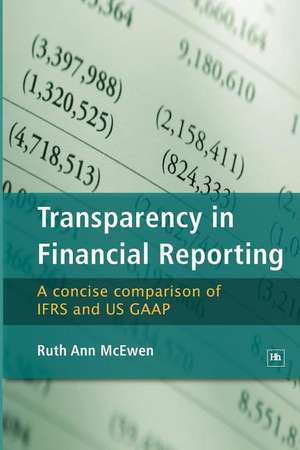
Transparency in Financial Reporting
Autor Ruth Ann Mcewenen Limba Engleză Paperback – 16 iul 2009
În volumul de față, Ruth Ann McEwen propune un model de analiză comparativă riguros, menit să clarifice tranziția globală către Standardele Internaționale de Raportare Financiară. Modelul său funcționează prin deconstrucția mitului conform căruia simpla adoptare a unor standarde unitare garantează transparența piețelor, demonstrând că legătura dintre raportarea tehnică și percepția investitorilor rămâne una profund subiectivă. Notăm cu interes modul în care autoarea navighează prin complexitatea convergenței, oferind soluții concrete pentru depășirea barierelor de interpretare între sistemele de tip „common law” și cele bazate pe coduri juridice. Suntem de părere că structura cărții este optimizată pentru eficiență maximă. Prima parte stabilește cadrul teoretic al calității raportării, urmată de o secțiune dedicată bazei legale a convergenței IFRS-GAAP, pentru ca în final să ofere o analiză tehnică exhaustivă a elementelor de bilanț, contului de profit și pierdere și recunoașterii veniturilor. Această progresie de la concept la execuție tehnică permite cititorului să înțeleagă nu doar „ce” se schimbă, ci și „de ce” anumite estimări specifice entității pot afecta transparența bilanțieră. Complementar volumului International Financial Reporting Standards de Greg F. Burton, care se concentrează pe cadrul general și judecata profesională în aplicarea standardelor, lucrarea de față acoperă zona critică a diferențelor practice punctuale față de US GAAP, fiind un instrument de lucru indispensabil pentru analiștii care trebuie să reconcilieze raportări din jurisdicții diferite. Găsim în această carte o rigoare academică dublată de o viziune pragmatică, esențială într-un peisaj financiar marcat de volatilitate.
Preț: 215.92 lei
Preț vechi: 324.42 lei
-33%
Carte disponibilă
Livrare economică 13-27 noiembrie
Specificații
ISBN-10: 1906659133
Pagini: 152
Dimensiuni: 156 x 234 x 8 mm
Greutate: 0.24 kg
Editura: HARRIMAN HOUSE
Locul publicării:United Kingdom
V-ar putea interesa
-
 Financial Accounting, Reporting, and AnalysisJennifer Maynard-19%Preț: 497.78 lei616.03 lei
 -
 Preț: 427.25 lei
 -
 -23%Preț: 2019.06 lei2622.15 lei
 -
 -8%Preț: 540.04 lei587.00 lei
 -
 ICAEW Financial Accounting and Reporting IFRSBpp Learning MediaPreț: 93.85 lei
 -
 Intermediate Accounting For DummiesMaire LoughranPreț: 161.13 lei
 -
 Accounting Principles: IFRS Version, Global EditionJerry J. Weygandt-19%Preț: 515.41 lei636.31 lei
 -
 -23%Preț: 884.88 lei1149.19 lei
 -
 Advanced Financial Accounting: 2025 Release ISETheodore Christensen-4%Preț: 417.63 lei435.03 lei
 -
 Comparative International AccountingChristopher Nobes-11%Preț: 666.60 lei748.98 lei
 -
 Financial Accounting, Global EditionWalter Harrison-11%Preț: 711.54 lei799.49 lei
 -
 Financial Accounting and ReportingJamie Elliott-9%Preț: 524.94 lei576.86 lei
 -
 International Financial Reporting: A Practical GuideAlan Melville-9%Preț: 511.62 lei562.23 lei
 -
 Financial Accounting For Dummies, 2nd UK EditionMaire LoughranPreț: 174.37 lei
 -
 International Financial Reporting and AnalysisDavid Alexander-23%Preț: 465.51 lei606.77 lei
 -
 Introduction to Financial Accounting 10eAnne Marie Ward-37%Preț: 416.39 lei661.12 lei
 -
 -26%Preț: 405.39 lei548.12 lei
 -
 Preț: 400.80 lei
De ce să citești această carte
Recomandăm această carte profesioniștilor contabili și analiștilor financiari care au nevoie de o înțelegere profundă a diferențelor dintre IFRS și US GAAP. Cititorul câștigă claritate în evaluarea activelor la valoarea justă și în recunoașterea veniturilor, beneficiind de expertiza unei autoare consacrate. Este o resursă esențială pentru cei care gestionează raportări internaționale și doresc să evite capcanele subiective ale interpretării standardelor.
Despre autor
Ruth Ann McEwen este decan asociat și profesor de contabilitate la Sawyer Business School, Suffolk University. Deține un doctorat în Management Industrial cu specializare în contabilitate de la Georgia Institute of Technology. Cu o carieră academică de peste două decenii, timp în care a predat contabilitate financiară la nivel de masterat și doctorat, McEwen a publicat peste 40 de articole de specialitate în jurnale de prestigiu precum „The Accounting Review”. Expertiza sa se concentrează pe utilitatea informației contabile pentru utilizatorii externi, fiind o autoritate recunoscută în domeniul standardelor de raportare.