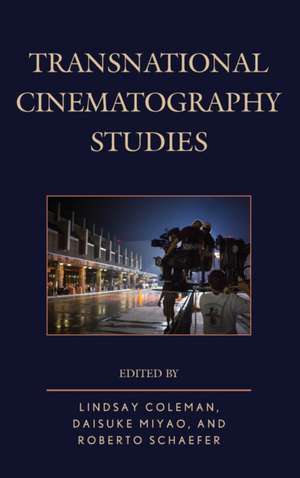
Transnational Cinematography Studies
Editat de Lindsay Coleman, Daisuke Miyao, Roberto Schaefer Contribuţii de Ceri Higgins, Patrick Keating, Evan Lieberman, Jakob Isak Nielsen, Peter H. Rist, Carlos Rojas, Julie Turnocken Limba Engleză Hardback – 27 dec 2016
Preț: 556.63 lei
Preț vechi: 796.97 lei
-30%
Puncte Express: 835
Preț estimativ în valută:
98.51€ • 115.13$ • 85.53£
98.51€ • 115.13$ • 85.53£
Carte tipărită la comandă
Livrare economică 19 februarie-05 martie
Preluare comenzi: 021 569.72.76
Specificații
ISBN-13: 9781498524278
ISBN-10: 1498524273
Pagini: 234
Ilustrații: 3 b/w illustrations; 27 b/w photos;
Dimensiuni: 158 x 239 x 20 mm
Greutate: 0.56 kg
Editura: Bloomsbury Publishing
Colecția Lexington Books
Locul publicării:New York, United States
ISBN-10: 1498524273
Pagini: 234
Ilustrații: 3 b/w illustrations; 27 b/w photos;
Dimensiuni: 158 x 239 x 20 mm
Greutate: 0.56 kg
Editura: Bloomsbury Publishing
Colecția Lexington Books
Locul publicării:New York, United States
V-ar putea interesa
-
 -35%Preț: 156.29 lei240.12 lei
 -
 Techniques of Special Effects of CinematographyRaymond Fielding-29%Preț: 966.26 lei1362.87 lei
 -
 Video and Media ServersKarl Paulsen-19%Preț: 385.13 lei472.59 lei
 -
 CompositionDavid Prakel-29%Preț: 814.37 lei1153.39 lei
 -
 Preț: 256.04 lei
 -
 CinematographyKris MalkiewiczPreț: 146.81 lei
 -
 American Cinematographer Manual 9th Ed. Vol. IIAsc Stephen H. BurumPreț: 251.16 lei
 -
 Monstrous ThingsJeffrey Andrew WeinstockPreț: 299.60 lei
 -
 Preț: 193.15 lei
 -
 The Sound Production HandbookDon Atkinson-37%Preț: 529.75 lei837.97 lei
 -
 The Sacred Cinema of Andrei TarkovskyJeremy Mark RobinsonPreț: 352.66 lei
 -
 Moving Image Technology – from Zoetrope to DigitalLeo EnticknapPreț: 202.02 lei
 -
 Preț: 445.10 lei
 -
 Preț: 380.53 lei
 -
 Deutsche Daily SoapsNikola Weiss-23%Preț: 625.03 lei811.72 lei
 -
 -19%Preț: 504.88 lei623.31 lei
 -
 -19%Preț: 514.80 lei635.55 lei
 -
 -23%Preț: 634.38 lei823.86 lei
 -
 Preț: 379.86 lei
 -
 Preț: 239.67 lei
 -
 Preț: 368.84 lei
Cuprins
Preface by Roberto Schaefer
Introduction by Daisuke Miyao
Chapter 1: Leviathan, by Lindsay Coleman
Chapter 2: Five Functions of Camera Movement in Narrative Cinema, by Jakob Isak
Nielsen
Chapter 3: À Travers: The Cinematography of Depth in Japan, by Daisuke Miyao
Chapter 4: The Eyes of the World: Christopher Doyle, Anthony Dod Mantle, Roger
Deakins and the Emergence of a Transnational Cinematic Language, by Evan
Lieberman
Chapter 5: What Does it Mean to Say that Cinematography is Like Painting with Light?,
by Patrick Keating
Chapter 6: Hou Hsiao-hsien and Mark Lee Ping-bing: A Taiwanese Creative Team,
by Peter H. Rist
Chapter 7: The Making of Hong Kong: The Texture of Cinema, by Carlos Rojas
Chapter 8: The Transnational Gothic Visions of Luis Buñuel and Gabriel Figueroa,
by Ceri Higgins
Chapter 9: Gravity and the 'Lighting Designer' Controversy: Cinematographers, Special
Visual Effects Artists and the Rhetoric of Digital Convergence, by Julie Turnock
About the Ed
Introduction by Daisuke Miyao
Chapter 1: Leviathan, by Lindsay Coleman
Chapter 2: Five Functions of Camera Movement in Narrative Cinema, by Jakob Isak
Nielsen
Chapter 3: À Travers: The Cinematography of Depth in Japan, by Daisuke Miyao
Chapter 4: The Eyes of the World: Christopher Doyle, Anthony Dod Mantle, Roger
Deakins and the Emergence of a Transnational Cinematic Language, by Evan
Lieberman
Chapter 5: What Does it Mean to Say that Cinematography is Like Painting with Light?,
by Patrick Keating
Chapter 6: Hou Hsiao-hsien and Mark Lee Ping-bing: A Taiwanese Creative Team,
by Peter H. Rist
Chapter 7: The Making of Hong Kong: The Texture of Cinema, by Carlos Rojas
Chapter 8: The Transnational Gothic Visions of Luis Buñuel and Gabriel Figueroa,
by Ceri Higgins
Chapter 9: Gravity and the 'Lighting Designer' Controversy: Cinematographers, Special
Visual Effects Artists and the Rhetoric of Digital Convergence, by Julie Turnock
About the Ed
Recenzii
This book demonstrates with its specific analysis about several aspects of the art of cinematography . . . that the cinematographer can no longer be defined as a 'skilled technician' with some 'aesthetic ambitions' but that the cinematographer is fully and completely an artist. . . .This book can be and it will be another step forward in this decisive clarification.
Transnational Cinematography Studies leads you on a voyage of discovery of the craft. It looks at the philosophy, the practicality, and the past influences forming the present and the future. It studies the creative processes that make cinema the most compelling art form.
I'm very happy to finally see a book which takes into account the actual problems we all are confronted with and has a clear look not only toward aesthetic consequences but also to the impact drastically concerning our working methods on the set. . . . Can't wait to have this book in my hands!
Transnational Cinematography Studies leads you on a voyage of discovery of the craft. It looks at the philosophy, the practicality, and the past influences forming the present and the future. It studies the creative processes that make cinema the most compelling art form.
I'm very happy to finally see a book which takes into account the actual problems we all are confronted with and has a clear look not only toward aesthetic consequences but also to the impact drastically concerning our working methods on the set. . . . Can't wait to have this book in my hands!