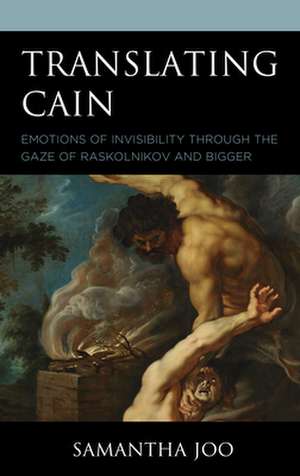
Translating Cain: Emotions of Invisibility through the Gaze of Raskolnikov and Bigger
Autor Samantha Jooen Limba Engleză Hardback – 10 dec 2020
To better understand and experience Cain's emotions in the narrative, Joo provides a method for re-contextualizing an ancient story in modern contexts. Drawing from post-colonial theories of Latin America translators, Joo focuses on analogies which simulate the "moveable event" of a story. She shows that novels like Fyodor Dostoevsky's Crime and Punishment and Richard Wright's Native Son, in which protagonists kill to escape their invisibility, capture the "event" of Cain and Abel. Consequently, readers can empathize with the anger and shame resulting from the social marginalization of Cain through the alienation of a poor, ex-university student, Raskolnikov, and the oppression of a young black man, Bigger Thomas.
Preț: 553.77 lei
Preț vechi: 836.41 lei
-34%
Puncte Express: 831
Carte tipărită la comandă
Livrare economică 26 noiembrie-10 decembrie
Livrare prin curier în România Termenul estimat este afișat lângă disponibilitate.
Transport gratuit pentru acest produs Plată online sau ramburs, în funcție de opțiunile comenzii.
Retur gratuit în 14 zile Comandă securizată și suport în română.
Specificații
ISBN-13: 9781978709843
ISBN-10: 1978709846
Pagini: 228
Ilustrații: 10 b/w photos;
Dimensiuni: 163 x 237 x 17 mm
Greutate: 0.44 kg
Editura: Bloomsbury Publishing
Colecția Fortress Academic
Locul publicării:New York, United States
ISBN-10: 1978709846
Pagini: 228
Ilustrații: 10 b/w photos;
Dimensiuni: 163 x 237 x 17 mm
Greutate: 0.44 kg
Editura: Bloomsbury Publishing
Colecția Fortress Academic
Locul publicării:New York, United States
Cuprins
Chapter 1 Introduction
Chapter 2 Methodology
Chapter 3 Cain and Abel
Chapter 4 Crime and Punishment
Chapter 5 Native Son
Chapter 6 Conclusion
Chapter 2 Methodology
Chapter 3 Cain and Abel
Chapter 4 Crime and Punishment
Chapter 5 Native Son
Chapter 6 Conclusion
Recenzii
In this deft interweaving of shared and timeless themes from three very different texts and contexts, the iconic myth from the Bible, of Cain's murder of his brother Abel, is translated to speak to the violence of our present. Joo has produced a work of subtlety and wisdom, which demonstrates that the past abides and haunts.
Who knew that the story of Cain and Abel is so rich and relevant? In this carefully argued and richly documented book, Samantha Joo offers a new reading of this brief story by elucidating its ancient context while reading it alongside Wright's Native Son and Dostoevsky's Crime and Punishment. This compelling interpretation brings the biblical story to bear on contemporary life by highlighting the themes of social marginalization, shame, anger, dehumanization, and the "other" in the biblical story, which illustrates how invisibility can lead to bloodshed. The book creates a deeply satisfying dialogue between more traditional historical-critical and new methods.
Employing a theoretical approach informed by post-colonial studies, socio-linguistics, and the field of comparative literature, Samantha Joo explores the emotional dynamics and ethnographic implications of the biblical story of Cain. Juxtaposing this composition with two classic novels, Dostoevsky's Crime and Punishment and Richard Wright's Native Son, Joo produces an original analysis-a creative, thoughtful study with deep implications for religious ethics.
Joo has provided an excellent example of the method and has clearly articulated it. Even if one does not agree with the method, this book is well worth reading as it demonstrates an important approach to a text. I could easily see using this book in a classroom setting to give an example of a method that translates emotional connotations of an ancient narrative via modern analogies from classic literature.
Who knew that the story of Cain and Abel is so rich and relevant? In this carefully argued and richly documented book, Samantha Joo offers a new reading of this brief story by elucidating its ancient context while reading it alongside Wright's Native Son and Dostoevsky's Crime and Punishment. This compelling interpretation brings the biblical story to bear on contemporary life by highlighting the themes of social marginalization, shame, anger, dehumanization, and the "other" in the biblical story, which illustrates how invisibility can lead to bloodshed. The book creates a deeply satisfying dialogue between more traditional historical-critical and new methods.
Employing a theoretical approach informed by post-colonial studies, socio-linguistics, and the field of comparative literature, Samantha Joo explores the emotional dynamics and ethnographic implications of the biblical story of Cain. Juxtaposing this composition with two classic novels, Dostoevsky's Crime and Punishment and Richard Wright's Native Son, Joo produces an original analysis-a creative, thoughtful study with deep implications for religious ethics.
Joo has provided an excellent example of the method and has clearly articulated it. Even if one does not agree with the method, this book is well worth reading as it demonstrates an important approach to a text. I could easily see using this book in a classroom setting to give an example of a method that translates emotional connotations of an ancient narrative via modern analogies from classic literature.