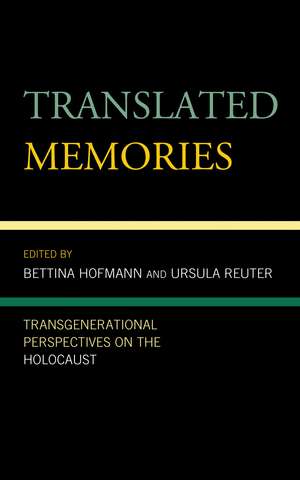
Translated Memories: Transgenerational Perspectives on the Holocaust: Bloomsbury Studies in Jewish Literature
Editat de Bettina Hofmann, Ursula Reuter Contribuţii de Anne Ranasinghe, Carol Ascher, Daniel Feldman, Bruno Arich-Gerz, Rebecca Margolis, Doron Ben-Atar, Julia Epstein, Lori Hope Lefkovitz, Steven Leonard Jacobs, Elizabeth Rosner, Federico Dal Bo, Christoph Houswitschka, Naomi Shmuel, Joseph Swann, Richard Aronowitz, Christoph Heyl, Victoria Aarons, Maria Roca Lizarazu, Yael Munk, Lilian Gergely, Sue Lieberman, Dani Kranz, Peter Wortsmanen Limba Engleză Hardback – 26 feb 2020
| Toate formatele și edițiile | Preț | Express |
|---|---|---|
| Paperback (1) | 270.19 lei 6-8 săpt. | |
| Bloomsbury Publishing – 6 mai 2022 | 270.19 lei 6-8 săpt. | |
| Hardback (1) | 784.90 lei 3-5 săpt. | |
| Bloomsbury Publishing – 26 feb 2020 | 784.90 lei 3-5 săpt. |



Preț: 784.90 lei
Preț vechi: 957.20 lei
-18%
Puncte Express: 1177
Preț estimativ în valută:
138.96€ • 161.80$ • 120.71£
138.96€ • 161.80$ • 120.71£
Carte disponibilă
Livrare economică 02-16 februarie
Preluare comenzi: 021 569.72.76
Specificații
ISBN-13: 9781793606068
ISBN-10: 1793606064
Pagini: 404
Ilustrații: 2 b/w illustrations;9 b/w photos;
Dimensiuni: 161 x 229 x 30 mm
Greutate: 0.81 kg
Editura: Bloomsbury Publishing
Colecția Lexington Books
Seria Bloomsbury Studies in Jewish Literature
Locul publicării:New York, United States
ISBN-10: 1793606064
Pagini: 404
Ilustrații: 2 b/w illustrations;9 b/w photos;
Dimensiuni: 161 x 229 x 30 mm
Greutate: 0.81 kg
Editura: Bloomsbury Publishing
Colecția Lexington Books
Seria Bloomsbury Studies in Jewish Literature
Locul publicării:New York, United States
Cuprins
Acknowledgments
Prologue: On Taking Renuka to Her First Concert
Anne Ranasinghe
Introduction
Bettina Hofmann and Ursula Reuter
Part I
Language and Memory
01
The Tongue in Exile
Carol Ascher
02
Translating Oral Memory and Visual Media in Ida Fink's "Traces"
Daniel Feldman
03
Lies of Ulysses in the Forgotten Camps: French Accounts by Mittelbau-Dora Survivors and Their Uses in Memory Politics
Bruno Arich-Gerz
04
French Canada as a Site of Holocaust Representation
Rebecca Margolis
Part II
Making Sense of the Parents' Holocaust History
05
Intimate Horror: Memorializing my Mother's Holocaust
Doron Ben-Atar
06
Invisible Ink: The Limits of Recovery
Julia Epstein and Lori Hope Lefkovitz
07
The Impact of the Shoah on One Scholar's Journey: An Autobiographical Reflection
Steven Leonard Jacobs
08
Against Forgetting: An Essay in Three Parts
Elizabeth Rosner
Part III
1.5 Generation
09
Hebrew as "Remedy" to the Shoah in Dan Pagis' Poetry
Federico Dal Bo
Prologue: On Taking Renuka to Her First Concert
Anne Ranasinghe
Introduction
Bettina Hofmann and Ursula Reuter
Part I
Language and Memory
01
The Tongue in Exile
Carol Ascher
02
Translating Oral Memory and Visual Media in Ida Fink's "Traces"
Daniel Feldman
03
Lies of Ulysses in the Forgotten Camps: French Accounts by Mittelbau-Dora Survivors and Their Uses in Memory Politics
Bruno Arich-Gerz
04
French Canada as a Site of Holocaust Representation
Rebecca Margolis
Part II
Making Sense of the Parents' Holocaust History
05
Intimate Horror: Memorializing my Mother's Holocaust
Doron Ben-Atar
06
Invisible Ink: The Limits of Recovery
Julia Epstein and Lori Hope Lefkovitz
07
The Impact of the Shoah on One Scholar's Journey: An Autobiographical Reflection
Steven Leonard Jacobs
08
Against Forgetting: An Essay in Three Parts
Elizabeth Rosner
Part III
1.5 Generation
09
Hebrew as "Remedy" to the Shoah in Dan Pagis' Poetry
Federico Dal Bo
Recenzii
Translated Memories grew out of a conference held in Essen, Germany, in July 2015. As editors Hofmann (Univ. of Wuppertal, Germany) and Reuter (Germania Judaica, Cologne Library on the History of German Jewry) state in the introduction, their "interest is in specific cases of Holocaust memory as expressed in different languages and media by members of the second and third generations of Holocaust survivors." Another crucial point of interest for them "is the mode of translation ... [understood] both literally and metaphorically." The resulting 22 essays are groundbreaking in their conceptual diversity, many of them insightful and well researched and enriched by, and sometimes paired with, compelling personal stories by the children and grandchildren of survivors. The existing literature on Holocaust memory is already vast, yet these essays put forth new and invaluable ideas that seek to answer how "later-born authors approach memories transmitted by surviving family members." Of particular note are the five essays in part 4 ("Objects and What to Make of Them"), which look at the special significance of memories carried by simple objects handed down through generations. Summing Up: Highly recommended. Lower-division undergraduates through faculty.
This book is a groundbreaking addition to two emergent fields: the study of the linguistic and cultural translation of Holocaust texts, and the study of intergenerational memory. It is a must-read for scholars in the field.
This book is a groundbreaking addition to two emergent fields: the study of the linguistic and cultural translation of Holocaust texts, and the study of intergenerational memory. It is a must-read for scholars in the field.