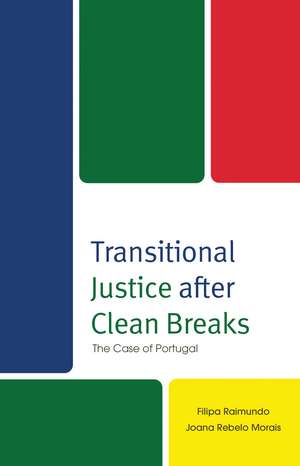
Transitional Justice after Clean Breaks: The Case of Portugal
Autor Filipa Raimundo, Joana Rebelo Moraisen Limba Engleză Hardback – 15 oct 2024
Filipa Raimundo and Joana Rebelo Morais present a comprehensive theoretical framework, intertwining institutional and attitudinal factors to explain the processes of coming to terms with the past that emerge out of clean break transitions. The lens provided by Portugal's unique case study illustrates the effect of preemption and strategic calculation as well as the enduring impact of early choices in shaping the trajectory of transitional justice.
Focusing on democracies emerging from collapsed regimes, this book contends that the delegitimization of the autocratic elite and its exit from power are as relevant as the anti-dictator bias and the authoritarian stigmas in shaping transitional justice debates and decision-making.
Preț: 500.29 lei
Preț vechi: 753.90 lei
-34%
Puncte Express: 750
Preț estimativ în valută:
88.54€ • 103.48$ • 76.87£
88.54€ • 103.48$ • 76.87£
Carte tipărită la comandă
Livrare economică 19 februarie-05 martie
Preluare comenzi: 021 569.72.76
Specificații
ISBN-13: 9781666900644
ISBN-10: 1666900648
Pagini: 196
Ilustrații: 18 BW Illustrations, 12 Tables
Dimensiuni: 150 x 232 x 18 mm
Greutate: 0.44 kg
Editura: Bloomsbury Publishing
Colecția Lexington Books
Locul publicării:New York, United States
ISBN-10: 1666900648
Pagini: 196
Ilustrații: 18 BW Illustrations, 12 Tables
Dimensiuni: 150 x 232 x 18 mm
Greutate: 0.44 kg
Editura: Bloomsbury Publishing
Colecția Lexington Books
Locul publicării:New York, United States
Cuprins
Introduction
Chapter 1. Portugal: From Authoritarianism to Democracy
Chapter 2. Prosecuting Secret Police Officials
Chapter 3. Party Bans and Restrictions on Political Rights
Chapter 4. Establishing a Truth Commission
Chapter 5. Path Dependent Effects: Low Salience and Low Politicization
Conclusion
Appendix 1. Full List of Portugal's Transitional Justice Legislation 1976-2022
Chapter 1. Portugal: From Authoritarianism to Democracy
Chapter 2. Prosecuting Secret Police Officials
Chapter 3. Party Bans and Restrictions on Political Rights
Chapter 4. Establishing a Truth Commission
Chapter 5. Path Dependent Effects: Low Salience and Low Politicization
Conclusion
Appendix 1. Full List of Portugal's Transitional Justice Legislation 1976-2022
Recenzii
"Transitional Justice after Clean Breaks adds to the list of nuanced country-level studies, such as those on Germany, Romania, and the Czech Republic, which are theory-driven and have a comparative reach. As the first third-way democracy that launched the process of dealing with the past, Portugal is a unique research site that was not contaminated by transitional justice blueprints."
"The book, written from a political science perspective, scrutinizes how Portugal dealt with its past in a comparative perspective. It is rich in detail about the history of the dictatorship as well as the process that came in its aftermath. The book suggests how the process of dealing with the past was done in a way to allow the society to heal and move forward. Important is the notion of state rupture or a clean break with the past, as well as public attitudes on a range of matters. This makes the book even more rich in its dealing with the Portuguese democratic model, that, it argues, has been characterized by fragmentation, volatility, and polarization. The book focuses on several themes including prosecutions, political party exclusions from the political process, the truth commission (seemingly one of the first in the world) and politics in the wake of the events that occurred. This is a book worth reading if you are interested in transitional justice, as well as the history and making of modern-day Portugal."
"This is the book that many of us have been waiting for decades to see: the definitive study of transitional justice (TJ) in Portugal, in all its originality and complexity. The authors not only present novel information about TJ practices in Portugal but also use the case to advance theory."
"The book, written from a political science perspective, scrutinizes how Portugal dealt with its past in a comparative perspective. It is rich in detail about the history of the dictatorship as well as the process that came in its aftermath. The book suggests how the process of dealing with the past was done in a way to allow the society to heal and move forward. Important is the notion of state rupture or a clean break with the past, as well as public attitudes on a range of matters. This makes the book even more rich in its dealing with the Portuguese democratic model, that, it argues, has been characterized by fragmentation, volatility, and polarization. The book focuses on several themes including prosecutions, political party exclusions from the political process, the truth commission (seemingly one of the first in the world) and politics in the wake of the events that occurred. This is a book worth reading if you are interested in transitional justice, as well as the history and making of modern-day Portugal."
"This is the book that many of us have been waiting for decades to see: the definitive study of transitional justice (TJ) in Portugal, in all its originality and complexity. The authors not only present novel information about TJ practices in Portugal but also use the case to advance theory."