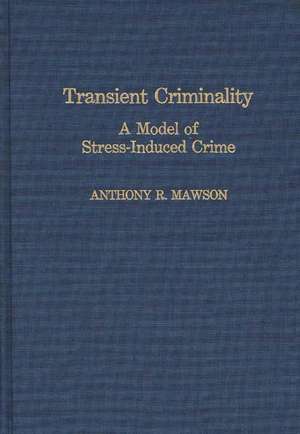
Transient Criminality
Autor Anthony Mawsonen Limba Engleză Hardback – 30 oct 1987
"Police & Security Bulletin"
Mawson proposes that transient criminality results from acute environmental stress and/or physiological disturbances in a context of diminished social supports. He posits a synthesis of situational factors and social and life-sciences concepts to explain stress-induced crime, and illustrates how the resulting model can explain theft, burglary, vandalism, homicide, assault, and rape. This new text includes discussions on the existing literature on the link between stress and criminality; the existing models of stress-induced crime; a new model of motivational behavior; a critique of the concept of conscience; the application of a new model to specific types of crime; and the various cognitive transformations in relation to crime.
Preț: 492.71 lei
Preț vechi: 805.63 lei
-39%
Puncte Express: 739
Carte tipărită la comandă
Livrare economică 23 decembrie 26 - 06 ianuarie 27
Livrare prin curier în România Termenul estimat este afișat lângă disponibilitate.
Transport gratuit pentru acest produs Plată online sau ramburs, în funcție de opțiunile comenzii.
Retur gratuit în 14 zile Comandă securizată și suport în română.
Specificații
ISBN-13: 9780275925529
ISBN-10: 0275925528
Pagini: 348
Dimensiuni: 161 x 240 x 23 mm
Greutate: 0.64 kg
Editura: Praeger
ISBN-10: 0275925528
Pagini: 348
Dimensiuni: 161 x 240 x 23 mm
Greutate: 0.64 kg
Editura: Praeger
V-ar putea interesa
-
 Dance for your DaddyKatherine ShellduckPreț: 114.27 lei
-
 The City That Became Safe: New York's Lessons for Urban Crime and Its ControlFranklin E. Zimring-23%Preț: 219.16 lei286.19 lei
-
 -19%Preț: 363.35 lei445.94 lei
-
 Counter-TerrorismB. Spalek-15%Preț: 668.58 lei786.56 lei
-
 The Anatomy of MotiveJohn E DouglasPreț: 56.15 lei
-
 The Psychopath WhispererKent KiehlPreț: 72.82 lei
-
 Dead or AliveGeoff ThompsonPreț: 128.66 lei
-
 Crime PreventionNick TilleyPreț: 335.86 lei
-
 AS LawMary CharmanPreț: 401.10 lei
-
 ChopperMark Brandon Read-19%Preț: 52.76 lei64.77 lei
-
 The DevilGraham Johnson-18%Preț: 92.90 lei113.96 lei
-
 -26%Preț: 199.88 lei269.32 lei
Descriere
Mawson proposes that transient criminality results from acute environmental stress and/or physiological disturbances in a context of diminished social supports. He posits a synthesis of situational factors and social and life-sciences concepts to explain stress-induced crime, and illustrates how the resulting model can explain theft, burglary, vandalism, homicide, assault, and rape. . . . will be helpful to any who wants to understand more about single or spasmodic violent crime perpetrators.
Police & Security Bulletin
Mawson proposes that transient criminality results from acute environmental stress and/or physiological disturbances in a context of diminished social supports. He posits a synthesis of situational factors and social and life-sciences concepts to explain stress-induced crime, and illustrates how the resulting model can explain theft, burglary, vandalism, homicide, assault, and rape. This new text includes discussions on the existing literature on the link between stress and criminality; the existing models of stress-induced crime; a new model of motivational behavior; a critique of the concept of conscience; the application of a new model to specific types of crime; and the various cognitive transformations in relation to crime.
Notă biografică
ANTHONY R. MAWSON is Research Epidemiologist, Section of Rheumatology and Rehabilitation, Department of Medicine at the Louisiana State University Medical Center.