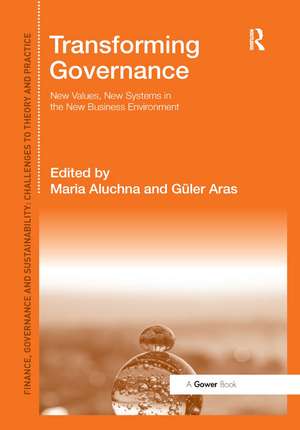
Transforming Governance: New Values, New Systems in the New Business Environment: Finance, Governance and Sustainability
Autor Maria Aluchna, Güler Arasen Limba Engleză Paperback – 12 dec 2019
Din seria Finance, Governance and Sustainability
-
 Preț: 444.29 lei
 - 18%
 Preț: 1111.48 lei
 -
 Preț: 406.47 lei
 -
 Preț: 444.29 lei
 -
 Preț: 332.80 lei
 -
 Preț: 352.06 lei
 -
 Preț: 417.25 lei
 -
 Preț: 408.31 lei
 -
 Preț: 441.84 lei
 -
 Preț: 407.59 lei
 - 18%
 Preț: 1060.21 lei
 - 11%
 Preț: 367.20 lei
 - 18%
 Preț: 1009.08 lei
 - 15%
 Preț: 279.86 lei
 - 11%
 Preț: 360.54 lei
 - 11%
 Preț: 376.12 lei
Preț: 360.98 lei
Preț vechi: 407.27 lei
-11%
Puncte Express: 541
Carte indisponibilă temporar
Doresc să fiu notificat când acest titlu va fi disponibil:
Se trimite...
Specificații
ISBN-13: 9780367880545
ISBN-10: 0367880547
Pagini: 248
Dimensiuni: 174 x 246 mm
Greutate: 0.46 kg
Ediția:1
Editura: Taylor & Francis
Colecția Routledge
Seria Finance, Governance and Sustainability
Locul publicării:Oxford, United Kingdom
ISBN-10: 0367880547
Pagini: 248
Dimensiuni: 174 x 246 mm
Greutate: 0.46 kg
Ediția:1
Editura: Taylor & Francis
Colecția Routledge
Seria Finance, Governance and Sustainability
Locul publicării:Oxford, United Kingdom
Cuprins
1. Preface
2. Introduction
3. Corporate governance theories: a synthesis
4. Corporate governance failures: an international perspective
5. The need for a new paradigm for corporate governance
6. The evolution of corporate governance mechanisms in emerging economies: the case of Turkey
7. Corporate governance and new tasks of the board
8. Corporate governance and the growing role of women in the boardroom
9. Family business governance: a review of the first experiences of Polish family firms
10. Private equity governance
11. Key features of the Russian model of corporate governance
12. Conclusion
2. Introduction
3. Corporate governance theories: a synthesis
4. Corporate governance failures: an international perspective
5. The need for a new paradigm for corporate governance
6. The evolution of corporate governance mechanisms in emerging economies: the case of Turkey
7. Corporate governance and new tasks of the board
8. Corporate governance and the growing role of women in the boardroom
9. Family business governance: a review of the first experiences of Polish family firms
10. Private equity governance
11. Key features of the Russian model of corporate governance
12. Conclusion
Notă biografică
Maria Aluchna is an associate professor at the Department of Management Theory, Warsaw School of Economics, Poland. She specializes in corporate governance, strategic management and corporate social responsibility. She teaches ’Corporate governance’, ’Transition in Central and Eastern Europe’ and ’Strategic management’. She was awarded the Deutscher Akademischer Austauchdienst (DAAD, 2001/2002) scholarship for a research stay at Universität Passau and the Polish-American Fulbright Commission scholarship at Columbia University (2002/2003). Güler Aras is a professor of Finance and Accounting at Yildiz Technical University, Istanbul, Turkey, and a Visiting Professor at Georgetown University McDonough School of Business. She is the founding director of the Center for Finance, Governance and Sustainability (CFGS) at YTU. She is the former Dean of the Faculty of Administrative and Economic Sciences and of the Graduate School. Her research focus is on financial economy and financial markets with particular emphasis on the relationship between sustainability, corporate governance, corporate social responsibility, and corporate financial performance. Professor Aras has published more than 20 books and has contributed over 250 articles to academic, business and professional journals and edited several book collections. Her most recent book, titled Sustainable Markets for Sustainable Business: A Global Perspective for Business and Financial Markets, was published by Gower in 2015.
Recenzii
'Overall, the book provides a comprehensive overview of corporate governance and its evolution in developing countries; it is clearly written and avoids academic style, keeping references to a minimum. This makes it especially well-suited for finance or management master's students who are approaching corporate governance for the first time. In this setting, the instructor can use the book to introduce students to specific topics and also to provoke interesting class discussions. It can be also used by PhD students to gain a broad perspective of how the corporate governance issues are approached by different academic fields and to identify interesting problems and discrepancies that call for further research.'
María Gutiérrez Urtiaga, Universidad Carlos III de Madrid, Madrid, Spain
María Gutiérrez Urtiaga, Universidad Carlos III de Madrid, Madrid, Spain
Descriere
In Transforming Governance the contributors, guided by Maria Aluchna and Güler Aras, address the current state, as well as the development of corporate governance and its perceived tasks and functions, in response to the changing market and regulatory environment. The book addresses the inefficiencies, scandals and crises as well as the signific