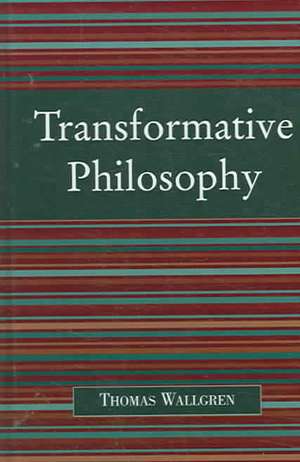
Transformative Philosophy: Socrates, Wittgenstein, and the Democratic Spirit of Philosophy
Autor Thomas Wallgrenen Limba Engleză Hardback – 11 mai 2006
Preț: 918.84 lei
Preț vechi: 1436.62 lei
-36%
Puncte Express: 1378
Carte tipărită la comandă
Livrare economică 30 noiembrie-14 decembrie
Livrare prin curier în România Termenul estimat este afișat lângă disponibilitate.
Transport gratuit pentru acest produs Plată online sau ramburs, în funcție de opțiunile comenzii.
Retur gratuit în 14 zile Comandă securizată și suport în română.
Specificații
ISBN-13: 9780739113615
ISBN-10: 0739113615
Pagini: 501
Dimensiuni: 171 x 234 x 46 mm
Greutate: 0.92 kg
Editura: Bloomsbury Publishing
Colecția Lexington Books
Locul publicării:New York, United States
ISBN-10: 0739113615
Pagini: 501
Dimensiuni: 171 x 234 x 46 mm
Greutate: 0.92 kg
Editura: Bloomsbury Publishing
Colecția Lexington Books
Locul publicării:New York, United States
V-ar putea interesa
-
 The World in the HeadRobert Cummins-12%Preț: 304.52 lei347.89 lei
 -
 Essays on SkepticismAnthony Brueckner-21%Preț: 349.88 lei441.70 lei
 -
 -6%Preț: 364.36 lei387.69 lei
 -
 Oxford Studies in Epistemology Volume 4Tamar Szabó Gendler-31%Preț: 776.19 lei1125.00 lei
 -
 Oxford Studies in Epistemology Volume 4Tamar Szabó Gendler-11%Preț: 377.88 lei424.54 lei
 -
 Anti-ExternalismJoseph Mendola-12%Preț: 253.77 lei289.30 lei
 -
 Philosophy of Science: A Unified ApproachGerhard Schurz-15%Preț: 461.35 lei542.77 lei
 -
 The Values FactorJohn F DemartiniPreț: 114.43 lei
 -
 -16%Preț: 131.91 lei157.81 lei
 -
 Finite and Infinite GamesJames Carse-57%Preț: 57.65 lei132.86 lei
 -
 Systema RevelationsBrad ScornavaccoPreț: 155.09 lei
 -
 Benjamin, Barthes and the Singularity of PhotographyDr. Kathrin Yacavone-26%Preț: 200.71 lei269.56 lei
 -
 The Politics of AestheticsGabriel Rockhill-24%Preț: 145.01 lei191.64 lei
 -
 Truth and MethodHans-Georg Gadamer-23%Preț: 196.66 lei256.29 lei
Cuprins
Chapter 1 Introduction
Chapter 2 Locating the Itch
Chapter 3 The Genealogy of "Philosophy"
Chapter 4 Paradigms of Analytical Philosophy as First Philosophy and Their Problems
Chapter 5 Wittgenstein'sPhilosophical Investigations: Overcoming the Overcoming of First Philosophy
Chapter 6 Mapping a Neglected Terrain: Philosophy in Relation to Its Times
Chapter 7 Working on Oneself, Caring for Us: Toward a Transformative Philosophy
Chapter 2 Locating the Itch
Chapter 3 The Genealogy of "Philosophy"
Chapter 4 Paradigms of Analytical Philosophy as First Philosophy and Their Problems
Chapter 5 Wittgenstein'sPhilosophical Investigations: Overcoming the Overcoming of First Philosophy
Chapter 6 Mapping a Neglected Terrain: Philosophy in Relation to Its Times
Chapter 7 Working on Oneself, Caring for Us: Toward a Transformative Philosophy
Recenzii
Thomas Wallgren's book Transformative Philosophy is a remarkable, important achievement in modern philosophy.. The importance of the book is that it manages to portray significant positions and debates in modern philosophy both in their own modern terms and as examples of how to deal with some deep and basic problems that have always characterized serious philosophy since Socrates. There is hardly any other book available that analyses "what philosophy is about today" with such profundity as this book. It reveals a fine and valuable insight into important parts of both modern analytic and modern continental philosophy.. It is a book that one can recommend to not only to students of philosophy but to learned scholars, since few living philosophers have managed, with excellence, to present the aspirations of modern philosophy as still answering to the historical roots and original ambitions of the enterprise.
With great mastery, Wallgren navigates through much of the best in recent Wittgenstein scholarship, introducing us to many lines of interpretation found therein: transcendental, relativistic, naturalistic, corrective therapeutic.... Yet, in the end they are all left behind in favor of a different and new line: "polyphonic grammatical" interpretation, and, more generally, "transformative philosophy". By presenting Wittgenstein to us as a follower of Socrates, the author succeeds in demonstrating one way in which Wittgenstein may offer us an alternative to choosing between theory and corrective therapy on the one hand and anarchy and irrationalism on the other. And, needless to say, along the way Wittgenstein himself is also scrupulously scanned for faults.
Transformative Philosophy is a courageous, profoundly searching examination of the character and value of philosophical theory and practice.. Philosophers as diverse as the pre-Socratics, Socrates, Heidegger, Quine, Dummett, Davidson, Habermas, Apel, Foucault, Deleuze, Guattari, Rorty, and Wittgenstein himself, along with his recent expositors and critics, are scrutinized to determine the extent to which their basic contentions make sense and make a genuine difference to-or instead raise basic difficulties for-our philosophical procedures. Wallgren develops a compelling alternative to first-philosophical pretensions, deflationist quietism, and relativism in the form a "polyphonic" grammatical interpretation of Wittgenstein's later philosophy. He shows how we can be seriously committed philosophically both to rational justification and to the moral relevance of philosophy to our own times.. Wallgren's book is replete with subtle and important insights, above all about Socrates and Wittgenstein; it is a "must read" for philosophers of all persuasions.
I found [Transformative Philosophy] a charming [book], philosophically quite astute and wide-ranging, and decidedly bold and inventive in the direction it proposes.
Wallgren's detailed account of the transformative potential of philosophy - of the way in which, by working to resolve conceptual confusions or to rid oneself of delusions, one can end up transforming one's entire life and even the world itself - has been long-awaited and is most welcome. Wallgren's development of the therapeutic interpretation of philosophy.builds on all that is best in the great voices of philosophy from Socrates to the present day, and focuses most intently around Wittgenstein's thought.. Those who think that admiring Wittgenstein entails conservative political views will be shaken by this book, for Wallgren's philosophy is a deeply-contemporarily-relevant philosophy of emancipation: from the tutelage of scientism and individualism, and from our governance by mentalities such as that of knowledge-fetishism or free-market-ideology.
With great mastery, Wallgren navigates through much of the best in recent Wittgenstein scholarship, introducing us to many lines of interpretation found therein: transcendental, relativistic, naturalistic, corrective therapeutic.... Yet, in the end they are all left behind in favor of a different and new line: "polyphonic grammatical" interpretation, and, more generally, "transformative philosophy". By presenting Wittgenstein to us as a follower of Socrates, the author succeeds in demonstrating one way in which Wittgenstein may offer us an alternative to choosing between theory and corrective therapy on the one hand and anarchy and irrationalism on the other. And, needless to say, along the way Wittgenstein himself is also scrupulously scanned for faults.
Transformative Philosophy is a courageous, profoundly searching examination of the character and value of philosophical theory and practice.. Philosophers as diverse as the pre-Socratics, Socrates, Heidegger, Quine, Dummett, Davidson, Habermas, Apel, Foucault, Deleuze, Guattari, Rorty, and Wittgenstein himself, along with his recent expositors and critics, are scrutinized to determine the extent to which their basic contentions make sense and make a genuine difference to-or instead raise basic difficulties for-our philosophical procedures. Wallgren develops a compelling alternative to first-philosophical pretensions, deflationist quietism, and relativism in the form a "polyphonic" grammatical interpretation of Wittgenstein's later philosophy. He shows how we can be seriously committed philosophically both to rational justification and to the moral relevance of philosophy to our own times.. Wallgren's book is replete with subtle and important insights, above all about Socrates and Wittgenstein; it is a "must read" for philosophers of all persuasions.
I found [Transformative Philosophy] a charming [book], philosophically quite astute and wide-ranging, and decidedly bold and inventive in the direction it proposes.
Wallgren's detailed account of the transformative potential of philosophy - of the way in which, by working to resolve conceptual confusions or to rid oneself of delusions, one can end up transforming one's entire life and even the world itself - has been long-awaited and is most welcome. Wallgren's development of the therapeutic interpretation of philosophy.builds on all that is best in the great voices of philosophy from Socrates to the present day, and focuses most intently around Wittgenstein's thought.. Those who think that admiring Wittgenstein entails conservative political views will be shaken by this book, for Wallgren's philosophy is a deeply-contemporarily-relevant philosophy of emancipation: from the tutelage of scientism and individualism, and from our governance by mentalities such as that of knowledge-fetishism or free-market-ideology.