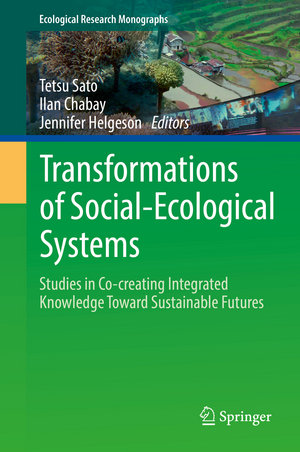
Transformations of Social-Ecological Systems
Editat de Tetsu Sato, Ilan Chabay, Jennifer Helgesonen Limba Engleză Hardback – 19 dec 2018
Sub coordonarea editorială a cercetătorilor Tetsu Sato, Ilan Chabay și Jennifer Helgeson, acest volum de referință publicat de Springer fundamentează teoretic și practic conceptul de co-producție a cunoașterii în context local. Ne-a atras atenția rigoarea cu care editorii analizează tranziția de la inițiativele autonome ale comunităților către transformări sociale la scară largă, necesare pentru sustenabilitatea globală. Apreciem în mod deosebit introducerea conceptului de Integrated Local Environmental Knowledge (ILEK), o formă de cunoaștere hibridă care integrează expertiza științifică cu experiența practică a actorilor locali.
Structura lucrării este una progresivă, facilitând înțelegerea unui domeniu complex. Prima parte se concentrează pe mecanismele de generare a cunoașterii, oferind exemple fascinante precum managementul apelor subterane în Turcia sau silvicultura de auto-recoltare din Japonia. A doua parte trece spre dimensiunea axiologică, explorând valorile locale prin studii despre reintroducerea berzei albe orientale, în timp ce ultima secțiune analizează procesele de mobilizare și învățare socială. Cititorii familiarizați cu Transdisciplinary Research, Sustainability, and Social Transformation de Tom Dedeurwaerdere vor aprecia modul în care acest volum trece dincolo de guvernanța parteneriatelor de cercetare, punând un accent mai puternic pe studiile de caz empirice și pe aplicabilitatea ILEK în deciziile de zi cu zi.
De asemenea, lucrarea completează viziunea prezentată în Satoumi Science de Shinichiro Kakuma, extinzând analiza de la zonele de coastă către diverse ecosisteme terestre și lacustre, precum Lacul Malawi. Este o resursă densă, de 444 de pagini, care evită generalizările teoretice în favoarea unor soluții colaborative concrete pentru probleme de mediu critice.
Preț: 1084.63 lei
Preț vechi: 1322.71 lei
-18%
Carte disponibilă
Livrare economică 18 mai-01 iunie
Specificații
ISBN-10: 9811323267
Pagini: 444
Ilustrații: XI, 430 p. 113 illus., 98 illus. in color.
Dimensiuni: 160 x 241 x 28 mm
Greutate: 0.91 kg
Ediția:1st ed. 2018
Editura: Springer
Locul publicării:Singapore, Singapore
De ce să citești această carte
Această ediție este esențială pentru cercetătorii și studenții din domeniul ecologiei și științelor sociale care doresc să înțeleagă cum cunoștințele locale pot deveni instrumente politice și administrative. Veți câștiga o perspectivă clară asupra metodologiei ILEK și a modului în care colaborarea transdisciplinară poate genera soluții reale pentru sustenabilitate, dincolo de mediul academic, fiind un ghid valoros și pentru agențiile guvernamentale.
Despre autor
Tetsu Sato este un expert recunoscut în ecologie și sustenabilitate, activând în cadrul unor rețele internaționale de cercetare care promovează interacțiunea dintre știință și societate. Alături de Ilan Chabay și Jennifer Helgeson, acesta a coordonat numeroase proiecte axate pe managementul resurselor naturale și adaptarea comunităților locale la schimbările antropice. Expertiza lor combinată acoperă domenii variate, de la economia mediului la sociologie rurală, oferind volumului Transformations of Social-Ecological Systems o autoritate academică indiscutabilă în spațiul cercetării transdisciplinare contemporane.
Descriere scurtă
In the midst of global anthropogenic impacts that affect various environments, over the past few decades we have observed autonomous initiatives in local communities around the world to tackle these environmental challenges. It is vital that such local actions be scaled up to achieve sustainable societies, which requires societal transformation on larger scales. Thanks to numerous collaborative actions in local communities, transdisciplinary knowledge co-production among diverse stakeholders has successfully been mobilized,resulting in the development of Integrated Local Environmental Knowledge (ILEK); knowledge that can inform and support decisions and actions promoting the sustainable transformation of society.
This book uses comparative case studies in communities around the world to illuminate and clarify processes and factors promoting the co-production and utilization of ILEK to facilitate decision-making. In addition, readers will gain deeper insights into the science-society interactions that can contribute to finding collaborative solutions to a wide range of critical environmental problems. Though the book is ideally suited for researchers and students, it also offers a valuable resource for practitioners, government agencies, and stakeholder agencies.
Cuprins
Recenzii
Notă biografică
Prof. Sato studied the ecology of cichlid fishes of African lakes for 20 years, and expanded his research into adaptive governance of complex social-ecological systems. Throughout his career, including as conservation director of the WWF Japan and professor of Nagano University, he focused on creating knowledge bases for community-based management of natural resources. As the project leader of the ILEK project (from 2012 to 2017), he has explored a transdisciplinary approach to co-produce integrated local environmental knowledge (ILEK) as the knowledge basis for decision making and actions of diverse stakeholders for societal transformations toward sustainability. Since 2017, he has been leading a 3-year research project at Ehime University titled “Transdisciplinary Study of Natural Resource Management Under Poverty Conditions Collaborating with Vulnerable Sectors (TD-VULS project)”, funded by the Research Institute of Science and Technology for Society (RISTEX), Japan Science and Technology Agency.
Ilan Chabay is head of Strategic Science Initiatives and Programs and the KLASICA (Knowledge, Learning, and Societal Change International Research Alliance - www.KLASICA.org) project at the Institute for Advanced Sustainability Studies (IASS) in Potsdam, Germany; and adjunct professor in the School of Sustainability, Arizona State University at the ASU Barrett & O’Connor Center, Washington DC, USA. His major research fields are understanding social dynamics in complexsocial-ecological systems, collective behaviour change, affective expression of narratives of vision and identity for sustainable futures, and creativity and innovation for societal needs.
At IASS, where he has been since 2012, Prof. Chabay was co-leader of interdisciplinary research on ecological, social, and economic transformations in the Eurasian Arctic (2013–2016). He has published more than 60 peer-reviewed articles in major journals in social and natural science and holds three patents. He serves on international advisory boards on affordable energy for humanity, environmental systems research, social dimensions of creativity and innovation, and integrated risk governance. He was Helmholtz Alliance ENERGY-TRANS professor at the University of Stuttgart Institute for Social Science (2012–2014), elected honorary member of the Swiss Academy of Humanities and Social Sciences, and appointed Hasselblad Professor in sociology and applied IT in Gothenburg and Chalmers Universities, Sweden (2006–2011). He founded the New Curiosity Shop, a workshop in Silicon Valley (1984–2001), where he led design and production of interactive science exhibitions for 230 museums, science centres, and corporations worldwide, including Disney and NASA. He was associate director of the Exploratorium Science Museum, San Francisco (1982–1983), consulting professor of chemistry at Stanford University (1984–1988), and led research on non-linear optical spectroscopy at US NIST (1974–1982) after receiving his Ph.D. in chemical physics from the University of Chicago.
Jennifer Helgeson is a research economist in the Applied Economics Office, Engineering Laboratory, National Institute of Standards and Technology (NIST) in Maryland, USA. Her major research fields are sustainability and resilience science, collective behavioural change, modeling for valuing and understanding co-benefits of resilience planning, community resilience planning, and socioeconomic survey work.
Dr. Helgeson leads the Applied Economics Office at NIST’s work on the economics of community resilience planning. She is primarily interested in economic analyses that consider behavioural aspects and approaches to dealing with environmental issues. In the past, she was a researcher at the Centre for International Climate and Environmental Research, Norway, and a climate adaptation specialist at the Organisation for Economic Co-operation and Development (OECD), France.She holds an M.Sc. degree in environmental change and management from the University of Oxford. She received her Ph.D. from the London School of Economics. She was the recipient of a Fulbright grant to Norway, where she studied the socioeconomics of transboundary reindeer herding. Dr. Helgeson has authored articles, reports, and book chapters related to the importance of recognizing perceptions and heuristics in studying economic and social decisions. She has also designed experiments related to risk perception and resilience that have been applied from rural Uganda to the Northeast USA. Additionally, she has co-edited a previous book on land restoration practices.