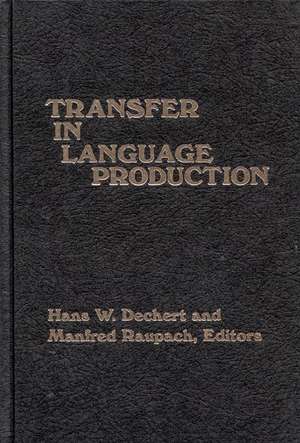
Transfer in Language Production
Autor Hans W. Dechert, Manfred Raupachen Limba Engleză Hardback – 1989
Preț: 518.28 lei
Preț vechi: 804.74 lei
-36%
Puncte Express: 777
Carte tipărită la comandă
Livrare economică 26 decembrie 26 - 09 ianuarie 27
Livrare prin curier în România Termenul estimat este afișat lângă disponibilitate.
Transport gratuit pentru acest produs Plată online sau ramburs, în funcție de opțiunile comenzii.
Retur gratuit în 14 zile Comandă securizată și suport în română.
Specificații
ISBN-13: 9780893913991
ISBN-10: 0893913995
Pagini: 298
Dimensiuni: 161 x 240 x 21 mm
Greutate: 0.56 kg
Editura: Praeger
ISBN-10: 0893913995
Pagini: 298
Dimensiuni: 161 x 240 x 21 mm
Greutate: 0.56 kg
Editura: Praeger
V-ar putea interesa
-
 Metaphor: A Practical IntroductionZoltan Kövescses-13%Preț: 279.01 lei318.89 lei
-
 -20%Preț: 437.48 lei543.77 lei
-
 Rhetoric: A Very Short IntroductionRichard Toye-19%Preț: 57.36 lei70.82 lei
-
 The Code BookSimon SinghPreț: 115.86 lei
-
 Toward a History of American LinguisticsE.F.K. KoernerPreț: 489.24 lei
-
 On DialogueDavid BohmPreț: 230.67 lei
-
 Psycholinguistic Models of ProductionHans W. Dechert-28%Preț: 492.57 lei687.81 lei
-
 Classrooms and LiteracyDavid Bloome-39%Preț: 495.26 lei807.10 lei
-
 -40%Preț: 484.03 lei803.74 lei
-
 Becoming Literate in English as a Second LanguageSusan R. Goldman-30%Preț: 322.48 lei462.46 lei
-
 Communication and Student SocializationAnn Q. Staton-Spicer-30%Preț: 321.56 lei461.98 lei
-
 Learning to Write Differently: Beginning Writers and Word ProcessingMarilyn Cochran-Smith-30%Preț: 324.22 lei463.36 lei
-
 Mapping Hegemony: Television News and Industrial ConflictRobert Goldman-37%Preț: 292.91 lei462.53 lei
-
 Second Language Reading and Vocabulary LearningThomas Huckin-21%Preț: 332.57 lei418.64 lei
-
 -21%Preț: 323.09 lei408.02 lei
-
 Multilingualism OnlineCarmen LeePreț: 404.47 lei
-
 -25%Preț: 278.87 lei371.36 lei
-
 Understanding SemanticsSebastian LöbnerPreț: 450.03 lei
-
 Deutsch-französische Übersetzungsübungen für das GrundstudiumCatherine RampfPreț: 143.92 lei
Descriere
The chapters in this volume represent an approach to the notion of language transfer which reflects the paradigm shift originating from cognitive science. The perception and expression of ideas and events in one language in terms of another language is considered only a special case of one of the fundamental processes in human problem solving-reasoning by analogy. Transfer in language production is seen as a basic metaphorical concept denoting language interaction that must be discussed in connection with other metaphorical concepts denoting language interaction as well. If this is true, the assessment of language transfer in light of the production paradigm has hardly begun. It will continue to be a topic of far-reaching consequences for a theory of language processing and language acquisition.