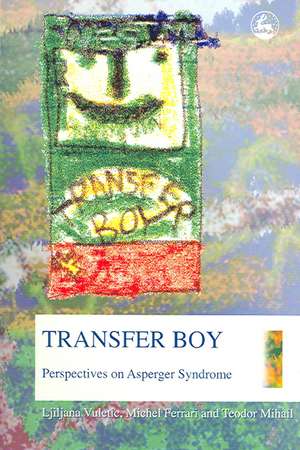
Transfer Boy: Perspectives on Asperger Syndrome
Autor Teodor Mihail, Michel Ferrari, Ljiljana Vuleticen Limba Engleză Paperback – 15 mar 2005
The authors evaluate the merits and pitfalls of different interpretations of autism and address the broad psychological issues related to Asperger Syndrome - intelligence, social skills, memory, the transitional period from childhood to adolescence. The study includes results and interpretations of standard measures of self-concept, an IQ test and a psychiatric exam, contributing to the hitherto under-researched area of autistic self-knowledge.
Preț: 150.22 lei
Preț vechi: 199.39 lei
-25%
Puncte Express: 225
Carte indisponibilă temporar
Doresc să fiu notificat când acest titlu va fi disponibil:
Se trimite...
Specificații
ISBN-13: 9781843102137
ISBN-10: 1843102137
Pagini: 208
Dimensiuni: 161 x 232 x 13 mm
Greutate: 0.32 kg
Editura: JESSICA KINGSLEY PUBLISHERS
Colecția Jessica Kingsley Publishers
Locul publicării:London, United Kingdom
ISBN-10: 1843102137
Pagini: 208
Dimensiuni: 161 x 232 x 13 mm
Greutate: 0.32 kg
Editura: JESSICA KINGSLEY PUBLISHERS
Colecția Jessica Kingsley Publishers
Locul publicării:London, United Kingdom
Recenzii
Transfer Boy: Perspectives on Asperger Syndrome is a detailed look at a fascinating and complex human being. The authors method involved polling multiple perspectives, including Teodor Milhail's own first-person perspective, to build a collage that explores complexity.The view of the disability from the inside is compelling and often challenging.
This book uses a portrait of Teodor, a teenager with Asperger syndrome (AS), to examine aspects of living with AS, and by extension, ideas about AS.Transfer Boy goes well beyond the basic case study format and is one of the first books for professionals to integrate the desire for self-determination expressed by autistic adults with scientific perspectives on 'difference'.
Teodor is physically present in his classroom, but mentally elsewhere. In an effort to learn about him, and other students like him, therapist Vuletic and academic Ferrari (applied cognitive science, u. of Toronto) teamed up with Teodor to write his analysis of Asperger's syndrome based on his autobiography. Their commentary, which includes elements of psychiatric, psychological, and neurobiological research, is combined with commentary on the various interpretations of Asperger's syndrome and notes by those who know and love Teodor.
This is a very detailed and well-constructed volume relating to contemporary issues in Asperger Syndrome. The authors are to be complimented on the inclusive nature of this work... this book's greatest achievement is the manner in which the authors simultaneously integrate existing research on autism with a biographical narrative. Probably the best part of this book, for the reader, is the intricately woven story of the Asperger experience from a very human perspective. The authors are to be congratulated for the manner in which they tackle the many various and flawed assessment methodologies which may lead to a diagnosis with Asperger Syndrome. The lack of agreement in research circles regarding the causal nature of the syndrome is well evidenced. This argument is well made and enhanced as scientific theories regarding Asperger Syndrome's aetiology are given new and real meaning, as they are applied to Teodor's lived experience of the condition. In summary, this a timely volume as the incidence of the diagnosis Autistic Spectrum Disorders are ever increasing. I would recommend this volume as an ideal reference text for all those working with and caring for people with Autistic Spectrum Disorders, wherever they may be. The many issues raised in this volume demonstrate the international transferability of issues relating to families experiencing Asperger Syndrome. A must-have volume for all educational establishments training professional groups to work with people with Autistic Spectrum Disorders.
This book uses a portrait of Teodor, a teenager with Asperger syndrome (AS), to examine aspects of living with AS, and by extension, ideas about AS.Transfer Boy goes well beyond the basic case study format and is one of the first books for professionals to integrate the desire for self-determination expressed by autistic adults with scientific perspectives on 'difference'.
Teodor is physically present in his classroom, but mentally elsewhere. In an effort to learn about him, and other students like him, therapist Vuletic and academic Ferrari (applied cognitive science, u. of Toronto) teamed up with Teodor to write his analysis of Asperger's syndrome based on his autobiography. Their commentary, which includes elements of psychiatric, psychological, and neurobiological research, is combined with commentary on the various interpretations of Asperger's syndrome and notes by those who know and love Teodor.
This is a very detailed and well-constructed volume relating to contemporary issues in Asperger Syndrome. The authors are to be complimented on the inclusive nature of this work... this book's greatest achievement is the manner in which the authors simultaneously integrate existing research on autism with a biographical narrative. Probably the best part of this book, for the reader, is the intricately woven story of the Asperger experience from a very human perspective. The authors are to be congratulated for the manner in which they tackle the many various and flawed assessment methodologies which may lead to a diagnosis with Asperger Syndrome. The lack of agreement in research circles regarding the causal nature of the syndrome is well evidenced. This argument is well made and enhanced as scientific theories regarding Asperger Syndrome's aetiology are given new and real meaning, as they are applied to Teodor's lived experience of the condition. In summary, this a timely volume as the incidence of the diagnosis Autistic Spectrum Disorders are ever increasing. I would recommend this volume as an ideal reference text for all those working with and caring for people with Autistic Spectrum Disorders, wherever they may be. The many issues raised in this volume demonstrate the international transferability of issues relating to families experiencing Asperger Syndrome. A must-have volume for all educational establishments training professional groups to work with people with Autistic Spectrum Disorders.
Cuprins
1. A Transfer Boy. 2. A Good and Loving Child: The Family Perspective. 3. A Good and Well-Behaved Student: The School Perspective. 4. An Autistic or Asperger Syndrome Child: The Scientific Perspective. 5. A Transfer Boy: The First-Person Perspective. 6. Conclusion. Where Do We Go From Here? 7. Epilogue: Transfer Boy No More. Appendix A: Method of this Study. Appendix B: Diagnostic Criteria for Autistic Disorder. Appendix C: Diagnostic Criteria for Asperger's Disorder. References. Index