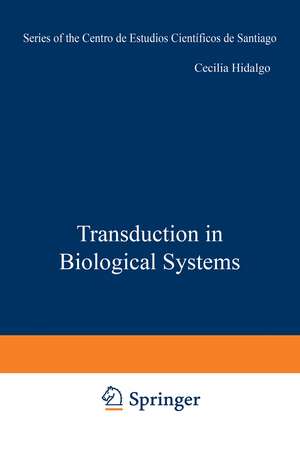
Transduction in Biological Systems: Series of the Centro De Estudios Científicos
Editat de Cecilia Hidalgo, Juan Bacigalupo, Enrique Jaimovich, Julio Vergaraen Limba Engleză Paperback – 19 mar 2012



Preț: 385.26 lei
Puncte Express: 578
Carte tipărită la comandă
Livrare economică 08-22 decembrie
Livrare prin curier în România Termenul estimat este afișat lângă disponibilitate.
Transport gratuit de la 400.00 lei Plată online sau ramburs, în funcție de opțiunile comenzii.
Retur gratuit în 14 zile Comandă securizată și suport în română.
Specificații
ISBN-13: 9781468457384
ISBN-10: 1468457381
Pagini: 536
Ilustrații: 530 p.
Dimensiuni: 152 x 229 x 28 mm
Greutate: 0.71 kg
Ediția:Softcover reprint of the original 1st ed. 1990
Editura: Springer Us
Colecția Springer
Seria Series of the Centro De Estudios Científicos
Locul publicării:New York, NY, United States
ISBN-10: 1468457381
Pagini: 536
Ilustrații: 530 p.
Dimensiuni: 152 x 229 x 28 mm
Greutate: 0.71 kg
Ediția:Softcover reprint of the original 1st ed. 1990
Editura: Springer Us
Colecția Springer
Seria Series of the Centro De Estudios Científicos
Locul publicării:New York, NY, United States
V-ar putea interesa
-
 Energy for Animal LifeR. McNeill Alexander-29%Preț: 376.73 lei527.52 lei
 -
 Electricity and Magnetism in Biological SystemsDonald Edmonds-28%Preț: 439.40 lei613.09 lei
 -
 Molecular Theory of SolutionsArieh Ben-Naim-31%Preț: 690.45 lei1003.35 lei
 -
 Introducing Biological Energetics: How Energy and Information Control the Living WorldNorman W. H. Cheetham-20%Preț: 454.38 lei570.73 lei
 -
 -30%Preț: 963.71 lei1379.37 lei
 -
 Chemical BiophysicsDaniel A. BeardPreț: 511.37 lei
 -
 BiophysicsPatrick F. Dillon-19%Preț: 547.25 lei675.62 lei
 -
 Biological Physics of the Developing EmbryoGabor Forgacs-23%Preț: 784.75 lei1019.15 lei
 -
 Physics in Molecular BiologyKim Sneppen-23%Preț: 779.32 lei1012.11 lei
 -
 Statistical Mechanics of Cellular Systems and ProcessesMuhammad H. Zaman-11%Preț: 609.30 lei684.60 lei
 -
 Random Walks in BiologyHoward C BergPreț: 356.85 lei
 -
 Biophysics For DummiesKen VosPreț: 126.26 lei
 -
 Single-Channel RecordingBert Sakmann-18%Preț: 2069.92 lei2524.28 lei
Public țintă
ResearchCuprins
I. Stimulus-Response Coupling.- A. Transduction in Sensory Cells.- 1 Dynamics of the Release of Calcium by Light and Inositol 1,4,5-Trisphosphate in Limulus Ventral Photoreceptors.- 2 Second Messengers in Invertebrate Phototransduction.- 3 The cGMP-Gated Channels of Rod and Cone Photoreceptors.- 4 Functional Aspects of the cGMP-Activated Channel from Bovine Rod Outer Segments.- 5 A Complex Regulation of the cGMP-Dependent Channels of Retinal Rod Membranes by the cGMP Phosphodiesterase.- 6 Transduction, Signal Transference, and Encoding in Composite Chemoreceptors: A Comparison between Gustatory and Arterial Chemoreceptors.- B. Excitation-Secretion Coupling.- 7 Role of Membrane Receptors in Stimulus-Secretion Coupling.- 8 Glucose Dose Response of Pancreatic ?-Cells: Experimental and Theoretical Results.- 9 Electrical and Secretory Response to Cholinergic Stimulation in Mouse and Human Adrenal Medullary Chromaffin Cells.- 10 Calcium Currents and Hormone Secretion in the Rat Pituitary Gonadotroph.- 11 Synexin-Driven Membrane Fusion: Molecular Basis for Exocytosis.- 12 Signal Transduction and Ion Permeability in Adrenal Glomerulosa Cells.- C. Other Transduction Mechanisms.- 13 The Target of Inositol 1,4,5-Trisphosphate in Nonmuscle Cells: Calciosome or Endoplasmic Reticulum?.- 14 Stimulus-Response Coupling in Mammalian Ciliated Cells: The Role of Ca2+ in Prostaglandin Stimulation.- 15 Hepatocyte Gap Junctions: Metabolic Regulation and Possible Role in Liver Metabolism.- 16 Mechanisms of Frequency Tuning in the Internal Ear.- II. Excitation-Contraction Coupling in Striated Muscle.- A. Sodium Channels and Sodium Pump.- 17 Coexistence of Different Types of Sodium Channels in Striated Muscle and Nerve.- 18 Sodium Pump in T-Tubules of Frog Muscle Fibers.- B. Calcium Channels inT-Tubule.- 19 Excitation-Contraction Coupling in Barnacle Muscle Fibers: Does Calcium Entry Trigger Contraction Directly?.- 20 Biochemical Structure of the Dihydropyridine Receptor.- 21 Role of Slow Inward Calcium Current in Excitation-Contraction Coupling.- C. Molecular Architecture of the Triad.- 22 Molecular Architecture of T-SR Junctions: Evidence for a Junctional Complex That Directly Connects the Two Membrane Systems.- 23 Proteins of the Triad Junction of Skeletal Muscle.- 24 Monoclonal Antibodies as Probes of Triad Structure and Excitation-Contraction Coupling in Skeletal Muscle.- D. Transduction at the Triad.- 25 A Third Role for Calcium in Excitation-Contraction Coupling.- 26 A Pharmacological Approach to the Physiological Mechanism of Excitation-Contraction Coupling.- 27 A Chemical Mechanism for Excitation-Contraction Coupling in Skeletal Muscle.- 28 What We Know and What We Would Like to Know about the Role of Inositol 1,4,5-Trisphosphate in Skeletal Muscle.- 29 Calcium Release in Skinned Muscle Fibers: Effect of Inositol 1,4,5-Trisphosphate.- 30 Metabolism of Phosphoinositides in Skeletal Muscle Membranes.- E. Calcium Release.- 31 Pharmacology of the Ryania Alkaloids: The Ester A, a Ryanodine Analog That Only Increases Sarcoplasmic Reticulum Calcium Permeability.- 32 Ca2+ Release Channel of Sarcoplasmic Reticulum: Characterization of the Regulatory Sites.- 33 Calcium Channels in Sarcoplasmic Reticulum Membranes Isolated from Skeletal Muscle.