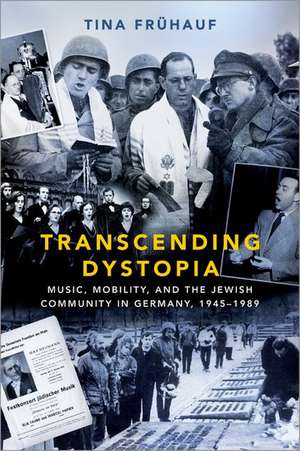
Transcending Dystopia: Music, Mobility, and the Jewish Community in Germany, 1945-1989
Autor Tina Frühaufen Limba Engleză Hardback – 31 mar 2021
Preț: 461.30 lei
Preț vechi: 538.51 lei
-14%
Puncte Express: 692
Carte disponibilă
Livrare economică 19-24 noiembrie
Livrare prin curier în România Termenul estimat este afișat lângă disponibilitate.
Transport gratuit pentru acest produs Plată online sau ramburs, în funcție de opțiunile comenzii.
Retur gratuit în 14 zile Comandă securizată și suport în română.
Specificații
ISBN-13: 9780197532973
ISBN-10: 0197532977
Pagini: 644
Ilustrații: 29
Dimensiuni: 236 x 157 x 46 mm
Greutate: 1.04 kg
Editura: Oxford University Press
Colecția OUP USA
Locul publicării:New York, United States
ISBN-10: 0197532977
Pagini: 644
Ilustrații: 29
Dimensiuni: 236 x 157 x 46 mm
Greutate: 1.04 kg
Editura: Oxford University Press
Colecția OUP USA
Locul publicării:New York, United States
Recenzii
Transcending Dystopia is a detailed historiography of Jewish music history based on extensive research into sources and, more recently, on interviews, particularly with regard to the aspects of mobility (in the spatial and cultural sense and that of cultural self-image) and identity. The book also touches on what could be called a musical histoire des mentalités.
Transcending Dystopia is a meticulously researched and articulately written work that analyzes music as a modality of transition for Jewish communities in postwar Germany.
Frühauf gives a picture of a community grappling with how to transition in a post-Holocaust world, and the role music plays in this transition. It is a masterful interdisciplinary work on a little-studied time period in Jewish musical history, and provides an important framework for looking at the musical life of other postwar Jewish communities in the future.
Though the book's title uses community in the singular, Frühauf draws attention to the heterogeneity of Germany's postwar Jewish communities by consistently attending to vectors of difference such as class, generation, regional identity, and religious tradition. Transcending Dystopia paints a complex portrait of Jewish musical life in the postwar period, and demonstrates the importance of attending to local dynamics when crafting historical narratives.
Tina Frühauf is a leading scholar of German-Jewish music culture, its composers and performers, its institutions, instruments, and practices. Her latest monograph, Transcending Dystopia: Music Mobility, and the Jewish Community in Germany, 1945-1989, is a tour-de-force of research and reconstruction. Her archival virtuosity has yielded mountains of detail about the people who reconstituted Jewish musical practices in Germany after the Holocaust.
Encyclopedic in scope and rich with facsimiles of photographs and performance posters, the apparatus includes extensive scholarly notes, a bibliography of the most relevant sources, and a helpful index. The first ever scholarly compendium of Jewish musical events in Germany from 1945 to 1989, this volume will be valuable for students of music, postwar European history, and Judaic studies worldwide.
By examining the musical world of Holocaust survivors in Germany, Tina Frühauf has found an original way to look at Jewish life in Europe after the war...Frühauf's research is comprehensive, down to the level of describing individual concerts with their performers, the pieces that were heard, the location, and the date. She includes details about radio broadcasts and newspaper reviews, career moves of individual cantors and other musicians, and the musical fate of local congregations. There is no other book on this subject, with or without this level of detail. It's an astonishing achievement and an essential addition to the history of Jewish music.
Frühauf builds a detailed picture of the issues facing this confusing era and music's vital role in it. For those concerend with this area of history, this factfilled book is essential reading
By analyzing the development of Jewish life in Germany through its music, Frühauf gives us a fresh perspective on the cultures of East and West Germany after the Holocaust.
An astonishing achievement and an essential addition to the history of Jewish music.
Comprehensive, authoritative, highly readable, insightful, and ground-breaking, Tina Frühauf's book enriches our understanding of the varied fate of postwar German Jews — east and west — through music, a powerful expression of Jewish resilience, identity, and belief.
As deftly traced by Tina Frühauf, the post-World War Two renewal of German Jewry's uniquely creative liturgical musical tradition is a testimony to the spiritual resilience of the surviving remnant of the Shoah.
It is a masterful interdisciplinary work on a little-studied time period in Jewish musical history, and provides an important framework for looking at the musical life of other postwar Jewish communities in the future.
Transcending Dystopia is a meticulously researched and articulately written work that analyzes music as a modality of transition for Jewish communities in postwar Germany.
Frühauf gives a picture of a community grappling with how to transition in a post-Holocaust world, and the role music plays in this transition. It is a masterful interdisciplinary work on a little-studied time period in Jewish musical history, and provides an important framework for looking at the musical life of other postwar Jewish communities in the future.
Though the book's title uses community in the singular, Frühauf draws attention to the heterogeneity of Germany's postwar Jewish communities by consistently attending to vectors of difference such as class, generation, regional identity, and religious tradition. Transcending Dystopia paints a complex portrait of Jewish musical life in the postwar period, and demonstrates the importance of attending to local dynamics when crafting historical narratives.
Tina Frühauf is a leading scholar of German-Jewish music culture, its composers and performers, its institutions, instruments, and practices. Her latest monograph, Transcending Dystopia: Music Mobility, and the Jewish Community in Germany, 1945-1989, is a tour-de-force of research and reconstruction. Her archival virtuosity has yielded mountains of detail about the people who reconstituted Jewish musical practices in Germany after the Holocaust.
Encyclopedic in scope and rich with facsimiles of photographs and performance posters, the apparatus includes extensive scholarly notes, a bibliography of the most relevant sources, and a helpful index. The first ever scholarly compendium of Jewish musical events in Germany from 1945 to 1989, this volume will be valuable for students of music, postwar European history, and Judaic studies worldwide.
By examining the musical world of Holocaust survivors in Germany, Tina Frühauf has found an original way to look at Jewish life in Europe after the war...Frühauf's research is comprehensive, down to the level of describing individual concerts with their performers, the pieces that were heard, the location, and the date. She includes details about radio broadcasts and newspaper reviews, career moves of individual cantors and other musicians, and the musical fate of local congregations. There is no other book on this subject, with or without this level of detail. It's an astonishing achievement and an essential addition to the history of Jewish music.
Frühauf builds a detailed picture of the issues facing this confusing era and music's vital role in it. For those concerend with this area of history, this factfilled book is essential reading
By analyzing the development of Jewish life in Germany through its music, Frühauf gives us a fresh perspective on the cultures of East and West Germany after the Holocaust.
An astonishing achievement and an essential addition to the history of Jewish music.
Comprehensive, authoritative, highly readable, insightful, and ground-breaking, Tina Frühauf's book enriches our understanding of the varied fate of postwar German Jews — east and west — through music, a powerful expression of Jewish resilience, identity, and belief.
As deftly traced by Tina Frühauf, the post-World War Two renewal of German Jewry's uniquely creative liturgical musical tradition is a testimony to the spiritual resilience of the surviving remnant of the Shoah.
It is a masterful interdisciplinary work on a little-studied time period in Jewish musical history, and provides an important framework for looking at the musical life of other postwar Jewish communities in the future.
Notă biografică
Tina Frühauf is Adjunct Associate Professor at Columbia University and serves on the doctoral faculty of The Graduate Center of the City University of New York. She is the editor of the award-winning Dislocated Memories: Jews, Music, and Postwar German Culture (OUP, 2014) and has published widely on German Jewish music culture and twentieth-century music.