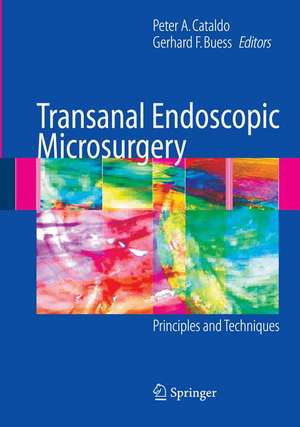
Transanal Endoscopic Microsurgery
Editat de Peter Cataldo, Gerhard F Buessen Limba Engleză Paperback – 7 apr 2009
Preț: 1104.87 lei
Preț vechi: 1163.02 lei
-5%
Puncte Express: 1657
Carte disponibilă
Livrare economică 09-23 noiembrie
Livrare prin curier în România Termenul estimat este afișat lângă disponibilitate.
Transport gratuit pentru acest produs Plată online sau ramburs, în funcție de opțiunile comenzii.
Retur gratuit în 14 zile Comandă securizată și suport în română.
Specificații
ISBN-13: 9780387763972
ISBN-10: 038776397X
Pagini: 147
Ilustrații: XIV, 147 p. With CD-ROM.
Dimensiuni: 187 x 262 x 15 mm
Greutate: 0.5 kg
Ediția:2009 edition
Editura: Springer
Locul publicării:New York, NY, United States
ISBN-10: 038776397X
Pagini: 147
Ilustrații: XIV, 147 p. With CD-ROM.
Dimensiuni: 187 x 262 x 15 mm
Greutate: 0.5 kg
Ediția:2009 edition
Editura: Springer
Locul publicării:New York, NY, United States
V-ar putea interesa
-
 Appendix, Colon, and RectumParul J. Shukla-23%Preț: 1161.03 lei1499.02 lei
 -
 Colorectal SurgeryRichard G Molloy-21%Preț: 620.31 lei789.96 lei
 -
 Principles of Gynecologic Oncology SurgeryPedro T. Ramirez-26%Preț: 1519.58 lei2058.42 lei
 -
 Atlas of Abdominal Wall ReconstructionMichael J. Rosen-28%Preț: 1479.87 lei2056.55 leiRecomandat
 -
 TULUA Abdominoplasty: Transverse Plication TechniqueFrancisco Javier Villegas-Alza-29%Preț: 1173.89 lei1656.56 lei
 -
 Sabiston Textbook of Surgery: The Biological Basis of Modern Surgical PracticeDouglas Scott Tyler-29%Preț: 1169.15 lei1645.26 leiRecomandat
 -
 Advances in Surgery, 2024John L. Cameron-5%Preț: 1225.02 lei1289.49 lei
 -
 Surgery of the Anus, Rectum and Colon, 2- Volume SetMichael R. B. Keighley-26%Preț: 2962.79 lei4012.54 lei
 -
 -5%Preț: 1165.29 lei1226.62 lei
 -
 Master Techniques in Surgery: Thoracic Surgery: Lung Resections, BronchoplastyDouglas J. Mathisen MD-24%Preț: 1640.59 lei2165.79 lei
 -
 Colon and Rectal Surgery: Anorectal OperationsSteven D. Wexner-18%Preț: 1701.42 lei2080.97 lei
 -
 Frontiers in Colorectal SurgeryRobin K S Phillips-19%Preț: 290.86 lei361.18 lei
 -
 Advanced Techniques in Minimally Invasive and Robotic Colorectal SurgeryOvunc Bardakcioglu-5%Preț: 477.14 lei502.25 lei
 -
 -5%Preț: 1170.98 lei1232.61 lei
 -
 Rectal CancerGeorge J. Chang-5%Preț: 912.88 lei960.92 lei
 -
 Minimally Invasive Surgery for Upper Abdominal CancerMiguel A. Cuesta-5%Preț: 1339.67 lei1410.18 lei
 -
 Current Common Dilemmas in Colorectal SurgeryChristopher M. Schlachta-5%Preț: 839.93 lei884.14 lei
 -
 -5%Preț: 1580.23 lei1663.40 lei
 -
 Exocrine Pancreatic CancerHughes Baumel-5%Preț: 595.23 lei626.55 lei
Public țintă
Professional/practitionerCuprins
Indications.- Preoperative Preparation.- Equipment and Operative Set-up.- Pelvic Anatomic Considerations for Transanal Endoscopic Microsurgery.- Getting Started.- Partial-Thickness Excision.- Full-Thickness Excision.- Advanced Surgical Techniques.- Complications.- Comparison with Traditional Techniques.- Full-Thickness Local Excision.- Oncologic Outcomes.- Clinical Trials.- Future Directions.
Textul de pe ultima copertă
Transanal Endoscopic Microsurgery: Principles and Techniques is the first book to present a complete review of an exciting developing technology. Cancer of the rectum remains a significant health problem, despite the increasing improvement of survival rates. The improvement in patient care comes from many sources: more accurate preoperative staging, aggressive neoadjuvant therapy and improved surgical techniques. Surgical extirpation continues to be the cornerstone of curative treatment of this potentially lethal disease. Transanal endoscopic microsurgery (TEM) is a technique for the performance of local excision by way of a binocular magnified operating system. Comparative trials demonstrate significantly better oncologic results for rectal cancer treated by TEM compared to conventional local excision. TEM provides a technically superior method for excision of rectal polyps and select early rectal cancers, with lower costs and fewer complications when compared to conventional approaches.
The editors and chapter authors of Transanal Endoscopic Microsurgery: Principles and Techniques are the world’s leading experts on TEM and their collective clinical experience is reflected in the practically oriented approach in every chapter. The text will prove to be an asset to any colorectal or general surgeon’s library.
The editors and chapter authors of Transanal Endoscopic Microsurgery: Principles and Techniques are the world’s leading experts on TEM and their collective clinical experience is reflected in the practically oriented approach in every chapter. The text will prove to be an asset to any colorectal or general surgeon’s library.
Caracteristici
Written by the specialists who innovated these techniques in the lab and performed the first procedures on humans for early clinical trials