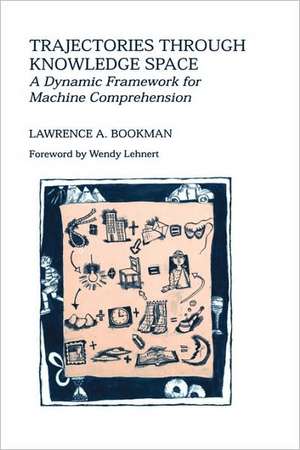
Trajectories Through Knowledge Space
Autor Lawrence A Bookmanen Limba Engleză Hardback – 30 sep 1994
Preț: 1325.50 lei
Preț vechi: 1656.87 lei
-20%
Puncte Express: 1988
Carte tipărită la comandă
Livrare economică 08-22 decembrie
Livrare prin curier în România Termenul estimat este afișat lângă disponibilitate.
Transport gratuit pentru acest produs Plată online sau ramburs, în funcție de opțiunile comenzii.
Retur gratuit în 14 zile Comandă securizată și suport în română.
Specificații
ISBN-13: 9780792394877
ISBN-10: 0792394879
Pagini: 271
Ilustrații: XXI, 271 p.
Dimensiuni: 156 x 234 x 18 mm
Greutate: 0.59 kg
Ediția:1994 edition
Editura: Springer Us
Locul publicării:New York, NY, United States
ISBN-10: 0792394879
Pagini: 271
Ilustrații: XXI, 271 p.
Dimensiuni: 156 x 234 x 18 mm
Greutate: 0.59 kg
Ediția:1994 edition
Editura: Springer Us
Locul publicării:New York, NY, United States
V-ar putea interesa
-
 -20%Preț: 1328.81 lei1661.02 lei
 -
 Linguistic Issues in Machine TranslationFrank Van Eydne-33%Preț: 899.33 lei1337.75 lei
 -
 Hybrid Approaches to Machine TranslationMarta R. Costa-Jussà-20%Preț: 847.61 lei1059.51 lei
 -
 Systems and Frameworks for Computational MorphologyCerstin Mahlow-20%Preț: 318.56 lei398.20 lei
 -
 Adaptive Semantics VisualizationKawa Nazemi-20%Preț: 1037.12 lei1296.39 lei
 -
 Semantic TechnologyGuilin Qi-20%Preț: 337.58 lei421.98 lei
 -
 -20%Preț: 667.15 lei833.94 lei
 -
 Linguistic Linked Open DataDiana Trandab¿¿-20%Preț: 322.70 lei403.37 lei
 -
 Advances in Artificial IntelligenceRichard Khoury-20%Preț: 325.44 lei406.80 lei
 -
 Natural Language Understanding in a Semantic Web ContextCaroline Barrière-20%Preț: 500.01 lei625.01 lei
 -
 Controlled Natural LanguageBrian Davis-20%Preț: 269.62 lei337.03 lei
 -
 Information RetrievalPavel Braslavski-20%Preț: 339.94 lei424.92 lei
 -
 -20%Preț: 321.36 lei401.70 lei
 -
 -20%Preț: 329.35 lei411.69 lei
 -
 Sanskrit Computational LinguisticsAmba Kulkarni-20%Preț: 327.99 lei409.99 lei
 -
 Building and Using Comparable CorporaSerge Sharoff-20%Preț: 645.86 lei807.34 lei
 -
 Developments in Language TheorySre¿ko Brlek-20%Preț: 328.72 lei410.89 lei
 -
 The WordNet in Indian LanguagesNiladri Sekhar Dash-20%Preț: 689.72 lei862.15 lei
 -
 -20%Preț: 1267.39 lei1584.24 lei
Public țintă
ResearchCuprins
1 Introduction.- 1.1 Motivation.- 1.2 A View of Text Comprehension.- 1.3 Overview of the LeMICON System.- 1.4 Implementation.- 1.5 Points of Interest.- 1.6 The Impact of this Work on Four Related Fields.- 1.7 Development of the Two-Tier Model.- 1.8 A Guide to the Reader.- 2 An Overview of Connectionist and Probabilistic Approaches to Language Processing.- 2.1 A Computational Linguistics Perspective.- 2.2 A Connectionist Perspective.- 2.3 A Comparison of Connectionist and Probabilistic NLP Methods.- 2.4 Bridging the Gap — Integrating Connectionist and Computational Linguistic Approaches.- 3 Memory Architecture.- 3.1 The Relational Tier.- 3.2 The Associational or ASF Tier.- 3.3 Connecting the Two Tiers.- 3.4 Working Memory.- 3.5 How New Knowledge Is Integrated.- 4 The Basic Computation.- 4.1 A Functional Description of the Algorithm.- 4.2 Representing the Input.- 4.3 Computational Details and Program Output at each Step.- 4.4 General Discussion of the Algorithm.- 4.5 How LeMICON Handles Binding.- 4.6 The Links to Psychology and Neurophysiology Revisited.- 4.7 Some Comparisons to Other Text Understanding Systems.- 5 Analysis of the Interpretation at the Relational and ASF Level.- 5.1 Introduction.- 5.2 Analyzing the Interpretation at the Relational Level.- 5.3 Analyzing the Interpretation at the ASF Level.- 5.4 Analyzing Time-Dependent Interactions at the ASF Level.- 5.5 Comparing Interpretations — A Quantitative Analysis.- 5.6 An Ablation Study.- 6 Reasoning from the Relational Level of the Representation.- 6.1 Introduction.- 6.2 Identifying the Conceptual Roots.- 6.3 Explaining the Connections Between Events.- 6.4 Determining Important Concepts in the Interpretation Graph.- 6.5 Conceptual Roots and their Role in Summarization.- 7 Experiments in Acquiring Knowledgefrom On-line Corpora.- 7.1 Introduction.- 7.2 The Automatic Acquisition of Knowledge from On-line Sources.- 7.3 The Automatic Construction of the Relational Tier.- 7.4 The Automatic Construction of the Associational Tier.- 7.5 How Semantic Memory Evolves in Response to New Input.- 7.6 Changing the Link Weights.- 7.7 Implementation Details.- 8 An Analysis of the Acquired Knowledge.- 8.1 An Alternative View of the Underlying Knowledge Representation.- 8.2 Discussion of Soundness of Approach.- 8.3 An Evaluation of LeMICON’s Representation.- 8.4 Previous Text Systems Revisited.- 8.5 The Knowledge Acquisition Continuum.- 9 Conclusions.- 9.1 Some Consequences of the Two-Tier Model of Memory.- 9.2 Associational Representations.- 9.3 The Universality of ASFs.- 9.4 Scalability.- 9.5 Automatic Acquisition of Knowledge.- 9.6 Building Large-Scale Knowledge Bases.- 9.7 A Link to Corpus Linguistics.- 9.8 The Interplay between Computation and Representation.- 9.9 Limitations.- 10 Future Directions.- 10.1 Expanding The Knowledge Base.- 10.2 Finding Deeper Semantic Relationships via Corpus Analysis.- 10.3 Handling Contradictory Input.- 10.4 Learning New Relationships.- 10.5 A Basic Level Semantic Encoding.- 10.6 Child Versus Adult Comprehension.- References.- Author Index.