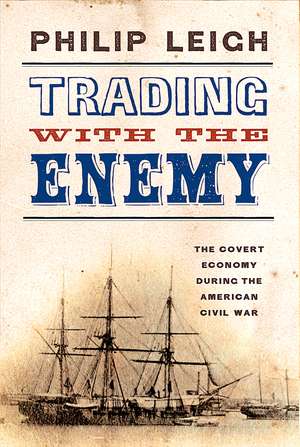
Trading with the Enemy: The Covert Economy During the American Civil War
Autor Philip Leighen Limba Engleză Paperback – 30 mai 2022
The Impact of Illicit Trade Between the North and South During the Civil War
While Confederate blockade runners famously carried the seaborne trade for the South during the American Civil War, the amount of Southern cotton exported to Europe was only half of that shipped illicitly to the North. Most went to New England textile mills where business “was better than ever,” according to textile mogul Amos Lawrence. Rhode Island senator William Sprague, a mill owner and son-in-law to Treasury Secretary Salmon P. Chase, was a member of a partnership supplying weapons to the Confederacy in exchange for cotton. The trade in contraband was not confined to New England. Union General William T. Sherman claimed Confederates were supplied with weapons from Cincinnati, while General Ulysses S. Grant captured Rebel cavalry armed with carbines purchased in Union-occupied Memphis. During the last months of the war, supplies entering the Union-controlled port of Norfolk, Virginia, were one of the principal factors enabling Robert E. Lee’s Confederate army to avoid starvation. Indeed, many of the supplies that passed through the Union blockade into the Confederacy originated in Northern states, instead of Europe as is commonly supposed. Merchants were not the only ones who profited; Union officers General Benjamin Butler and Admiral David Dixon Porter benefited from this black market. President Lincoln admitted that numerous military leaders and public officials were involved, but refused to stop the trade.
In Trading with the Enemy: The Covert Economy During the American Civil War, New York Times Disunion contributor Philip Leigh recounts the little-known story of clandestine commerce between the North and South. Cotton was so important to the Northern economy that Yankees began growing it on the captured Sea Islands of South Carolina. Soon the neutral port of Matamoras, Mexico, became a major trading center, where nearly all the munitions shipped to the port—much of it from Northern armories—went to the Confederacy. After the fall of New Orleans and Vicksburg, a frenzy of contraband-for-cotton swept across the vast trans-Mississippi Confederacy, with Northerners sometimes buying the cotton directly from the Confederate government. A fascinating study, Trading with the Enemy adds another layer to our understanding of the Civil War.
While Confederate blockade runners famously carried the seaborne trade for the South during the American Civil War, the amount of Southern cotton exported to Europe was only half of that shipped illicitly to the North. Most went to New England textile mills where business “was better than ever,” according to textile mogul Amos Lawrence. Rhode Island senator William Sprague, a mill owner and son-in-law to Treasury Secretary Salmon P. Chase, was a member of a partnership supplying weapons to the Confederacy in exchange for cotton. The trade in contraband was not confined to New England. Union General William T. Sherman claimed Confederates were supplied with weapons from Cincinnati, while General Ulysses S. Grant captured Rebel cavalry armed with carbines purchased in Union-occupied Memphis. During the last months of the war, supplies entering the Union-controlled port of Norfolk, Virginia, were one of the principal factors enabling Robert E. Lee’s Confederate army to avoid starvation. Indeed, many of the supplies that passed through the Union blockade into the Confederacy originated in Northern states, instead of Europe as is commonly supposed. Merchants were not the only ones who profited; Union officers General Benjamin Butler and Admiral David Dixon Porter benefited from this black market. President Lincoln admitted that numerous military leaders and public officials were involved, but refused to stop the trade.
In Trading with the Enemy: The Covert Economy During the American Civil War, New York Times Disunion contributor Philip Leigh recounts the little-known story of clandestine commerce between the North and South. Cotton was so important to the Northern economy that Yankees began growing it on the captured Sea Islands of South Carolina. Soon the neutral port of Matamoras, Mexico, became a major trading center, where nearly all the munitions shipped to the port—much of it from Northern armories—went to the Confederacy. After the fall of New Orleans and Vicksburg, a frenzy of contraband-for-cotton swept across the vast trans-Mississippi Confederacy, with Northerners sometimes buying the cotton directly from the Confederate government. A fascinating study, Trading with the Enemy adds another layer to our understanding of the Civil War.
Preț: 162.10 lei
Puncte Express: 243
Carte disponibilă
Livrare economică 16-30 noiembrie
Livrare prin curier în România Termenul estimat este afișat lângă disponibilitate.
Transport gratuit de la 400.00 lei Plată online sau ramburs, în funcție de opțiunile comenzii.
Retur gratuit în 14 zile Comandă securizată și suport în română.
Specificații
ISBN-13: 9781594163876
ISBN-10: 1594163871
Pagini: 200
Ilustrații: 18
Dimensiuni: 152 x 229 x 18 mm
Greutate: 0.31 kg
Editura: Westholme Publishing, U.S.
Colecția Westholme Publishing
ISBN-10: 1594163871
Pagini: 200
Ilustrații: 18
Dimensiuni: 152 x 229 x 18 mm
Greutate: 0.31 kg
Editura: Westholme Publishing, U.S.
Colecția Westholme Publishing
Recenzii
"[The] story is all the more shocking because of the persons involved. One primary villain was US Senator William Sprague of Rhode Island."—Washington Times
"Trading With the Enemy is a welcome addition to the literature of the Civil War for providing a concise and readable account of the illicit trade between the lines."—Civil War Book Review
"Leigh’s revelations about who encouraged and allowed for this kind of illegal trade is sometimes shocking."—Publisher’s Weekly
Notă biografică
PHILIP LEIGH is a regular contributor to the New York Times Disunion Civil War series and the Civil War Monitor. A professional writer, he holds an engineering degree from the Florida Institute of Technology and an MBA from the Kellogg School at Northwestern University. He most recently edited a new edition of Co. Aytch, or a Side Show of the Big Show by Sam Watkins, also available from Westholme Publishing.
Descriere
In Trading with the Enemy: The Covert Economy During the American Civil War, New York Times Disunion contributor Philip Leigh recounts the little-known story of clandestine commerce between the North and South. Cotton was so important to the Northern economy that Yankees began growing it on the captured Sea Islands of South Carolina. Soon the neutral port of Matamoras, Mexico, became a major trading center, where nearly all the munitions shipped to the port—much of it from Northern armories—went to the Confederacy. After the fall of New Orleans and Vicksburg, a frenzy of contraband-for-cotton swept across the vast trans-Mississippi Confederacy, with Northerners sometimes buying the cotton directly from the Confederate government. A fascinating study, Trading with the Enemy adds another layer to our understanding of the Civil War.