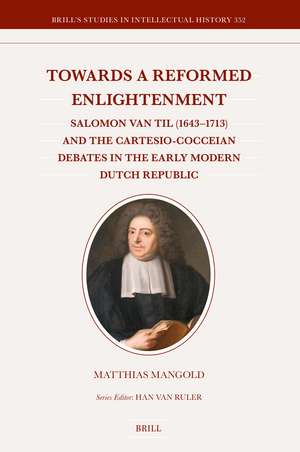
Towards a Reformed Enlightenment: Salomon van Til (1643–1713) and the Cartesio-Cocceian Debates in the Early Modern Dutch Republic: Brill's Studies in Intellectual History, cartea 352
Autor Matthias Mangolden Limba Engleză Hardback – 15 mai 2024
Bazându-ne pe documentația oferită de Brill în seria Brill's Studies in Intellectual History, notăm cu interes apariția volumului Towards a Reformed Enlightenment, semnat de Matthias Mangold. Această lucrare monografică oferă prima examinare aprofundată a lui Salomon van Til, un teolog olandez a cărui operă marchează tranziția intelectuală de la sfârșitul secolului al XVII-lea. Considerăm că forța acestui studiu rezidă în abordarea contextuală riguroasă, care plasează gândirea lui Van Til la intersecția dintre ortodoxia reformată și influențele filozofiei moderne.
Autorul structurează volumul în două părți distincte: prima secțiune reconstituie mediul intelectual al Republicii Olandeze, incluzând tensiunile dintre curentele Voetien și Cocceian, în timp ce a doua parte analizează specificul cartezianismului lui Van Til. Credem că această organizare permite cititorului să urmărească progresia de la fundamentele biografice și ministeriale către conceptele complexe de „filozofie rațională” și armonia dintre teologia revelată și rațiune. Cartea extinde cadrul propus de The Early Enlightenment in the Dutch Republic, 1650-1750 de Wiep Van Bunge cu date noi din perioada de tranziție spre secolul al XVIII-lea, oferind o perspectivă mai nuanțată asupra modului în care teologii reformați au asimilat metoda lui Descartes pentru a contracara radicalismul lui Spinoza. Totodată, lucrarea completează analiza din Reformed Orthodoxy and Philosophy, 1625-1750 de Aza Goudriaan, focalizându-se pe o figură centrală, dar neglijată până acum de istoriografia modernă, demonstrând că Iluminismul olandez nu a fost doar o mișcare seculară, ci și una profund ancorată în dezbateri ecleziastice.
Din seria Brill's Studies in Intellectual History
- 18%
 Preț: 947.52 lei
 - 18%
 Preț: 1314.73 lei
 - 18%
 Preț: 604.55 lei
 - 18%
 Preț: 885.25 lei
 - 18%
 Preț: 730.48 lei
 - 18%
 Preț: 778.94 lei
 - 18%
 Preț: 628.28 lei
 - 15%
 Preț: 592.13 lei
 - 18%
 Preț: 629.57 lei
 - 18%
 Preț: 607.03 lei
 - 18%
 Preț: 739.46 lei
 - 15%
 Preț: 507.96 lei
 - 18%
 Preț: 594.79 lei
 - 18%
 Preț: 713.29 lei
 - 18%
 Preț: 608.61 lei
 - 23%
 Preț: 930.22 lei
 - 18%
 Preț: 737.04 lei
Preț: 736.05 lei
Preț vechi: 897.62 lei
-18%
Carte disponibilă
Livrare economică 13-18 noiembrie
Specificații
ISBN-10: 9004697241
Pagini: 548
Dimensiuni: 155 x 235 x 36 mm
Greutate: 1.04 kg
Editura: Brill
Colecția Brill
Seria Brill's Studies in Intellectual History
De ce să citești această carte
Această lucrare este esențială pentru cercetătorii istoriei ideilor și ai teologiei reformate. Cititorul va obține o înțelegere clară a modului în care filozofia carteziană a fost integrată în gândirea religioasă pentru a naviga între tradiționalismul rigid și radicalismul iluminist. Este un volum academic de referință care recuperează contribuția intelectuală a lui Salomon van Til într-un format riguros, publicat de o editură de prestigiu.
Despre autor
Matthias Mangold este un cercetător specializat în istoria intelectuală și teologică a perioadei moderne timpurii. Prin volumul Towards a Reformed Enlightenment, el își demonstrează expertiza în analiza surselor primare din secolul al XVII-lea olandez. Deși palmaresul său include și lucrări cu tematică diversă, precum Schwaben. Meine kulinarische Heimat, Mangold se distinge în mediul academic prin capacitatea de a sintetiza dezbateri filozofice complexe și de a le ancora în contextul politic și social al epocii, oferind noi perspective asupra evoluției Iluminismului european.
Notă biografică
Descriere
With its strong contextual approach, this analysis of Van Til’s thought sheds new light on various intellectual dynamics at the time, most notably the long-standing conflict between the Voetian and Cocceian factions within the Dutch Reformed Church and the reception of Cartesian philosophy in the face of emerging Radical Enlightenment ideas.
Cuprins
Abbreviations
Introduction
1 Literature Review
2 Objectives of This Study
3 Methodological Considerations
4 Sources
5 Overview
Part 1: Van Til in Context
1 Intellectual Developments at Van Til’s Time
1.1 Introduction
1.2 Currents within Early Modern Dutch Protestantism
1.3 Descartes and Cartesianism in the Dutch Republic
1.4 Spinoza, Spinozism and the ‘Radical Enlightenment’
1.5 Summary and Conclusion
2 Van Til’s Life and Work
2.1 Van Til’s Early Life and Education
2.2 Pastoral Ministry in North-Holland (1666–1683)
2.3 Minister and Professor in Dordrecht (1683–1702)
2.4 Professor in Leiden (1702–1713)
2.5 Summary and Conclusion
Part 2: Van Til’s Cartesianism
3 Theology and Philosophy
3.1 Introduction
3.2 Early Modern Discussions on Theology and Philosophy
3.3 Van Til’s Concept of Rational Philosophy
3.4 Philosophical Knowledge
3.5 Theology and Philosophy Separated
3.6 Harmony and Tension
3.7 The Nature of Revealed Theology
3.8 Establishing the Authority of Scripture
3.9 Summary and Conclusion
4 Natural Theology
4.1 Introduction
4.2 Van Til’s Compendium on Natural Theology
4.3 Natural Theology: Knowing God
4.4 Natural Ethics: Serving God
4.5 Preparation for the Gospel
4.6 Summary and Conclusion
5 Reason and Scriptural Interpretation
5.1 Introduction
5.2 Scripture, Clarity, and the Task of Interpretation
5.3 Tradition and Church Authority
5.4 The Proper Use of Reason
5.5 Interpretation “Befitting of God” and the Unity of Truth
5.6 The Bible, Divine Accommodation, and the Copernican Worldview
5.7 Dualism and the Devil
5.8 Summary and Conclusion
6 Engagement with Spinoza
6.1 Introduction
6.2 Historical Considerations
6.3 Anti-Spinozan Polemics in the Voor-hof and the Vervolg
6.4 The Voor-hof (1694) and the Challenge to Biblical Authority
6.5 The Vervolg (1696) and Spinoza’s Radical Theology
6.6 Van Til’s Academic Engagement with Spinoza in His Compendium
6.7 Summary and Conclusion
Part 3: Van Til’s Cocceianism
7 A Call for Moderation
7.1 Introduction
7.2 The “Leiden Prohibition” and the Voetian Polemics of 1676
7.3 Cocceian Irenicism in the Aftermath of 1676
7.4 Van Til’s Plea for Concord: Salems vrede (1678)
7.5 Van Til’s Fundamental Reflections on Ecclesiastical Peace
7.6 Van Til’s Assessment of the Cocceian Issues
7.7 Summary and Conclusion
8 Prophetic Theology
8.1 Introduction
8.2 Cocceius and the Roots of Cocceian Prophetic Theology
8.3 Further Developments and the Friesland Crisis of the Early 1680s
8.4 Van Til’s Inleydinge tot de prophetische schriften
8.5 Van Til’s Prophetic Exegesis and Emblematics
8.6 The De Joncourt Controversy
8.7 Summary and Conclusions
9 Federal Theology
9.1 Introduction
9.2 Van Til’s Concept of Covenant
9.3 The Covenant of Works (foedus operum)
9.4 The Covenant of Grace (foedus gratiae)
9.5 Salvation-Historical Differentiations in the Covenant of Grace
9.6 The “Counsel of Peace” between the Father and the Son
9.7 Summary and Conclusion
Conclusion
1 Van Til’s Appropriation of Cartesian Philosophy
2 Van Til’s Appropriation of the Cocceian Heritage
3 Van Til’s Cartesio-Cocceian Synthesis and the Reformed Enlightenment in the Dutch Republic
Appendix: Van Til’s Works in Chronological Order
Bibliography
Index