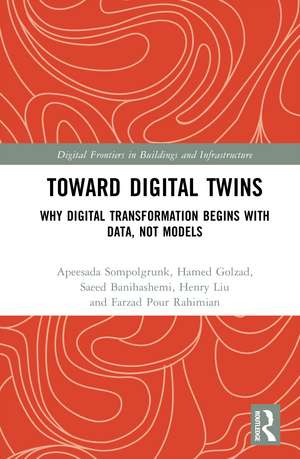
Toward Digital Twins: Why Digital Transformation begins with Data, not Models: Digital Frontiers in Buildings and Infrastructure
Autor Apeesada Sompolgrunk, Hamed Golzad, Saeed Banihashemi, Henry Liu, Farzad Pour Rahimianen Limba Engleză Hardback – 16 mar 2027
Drawing on a systematic literature review, 20 expert interviews, and a survey of 102 practitioners, the book develops the AEC Organisational–Big BIM Data Strategic Alignment Model. It defines four domains including Organisational strategy, Organisational infrastructure and processes, Big BIM Data strategy, and Big BIM Data infrastructure and processes and shows that alignment operates across three domains at a time, rather than between any two in isolation. Of the four pathways tested, the strongest evidence supports building data capability first. A case analysis of Autodesk, based on audited filings, then shows why alignment alone is insufficient: platform concentration establishes terms that individual firms, particularly smaller ones, do not control.
Written for executives, policymakers, and researchers, the book reframes the digital twin as an organisational capability to be developed and governed, rather than a technology to be purchased.

Preț: 1231.25 lei
Preț vechi: 1621.60 lei
-24% Precomandă
Puncte Express: 1847
Carte nepublicată încă
Livrare prin curier în România Precomanda se expediază când titlul devine disponibil.
Transport gratuit pentru acest produs Plată online sau ramburs, în funcție de opțiunile comenzii.
Retur gratuit în 14 zile Comandă securizată și suport în română.
Doresc să fiu notificat când acest titlu va fi disponibil:
Se trimite...
Specificații
ISBN-13: 9781041328841
ISBN-10: 1041328842
Pagini: 206
Ilustrații: 32
Dimensiuni: 156 x 234 mm
Ediția:1
Editura: CRC Press
Colecția Routledge
Seria Digital Frontiers in Buildings and Infrastructure
ISBN-10: 1041328842
Pagini: 206
Ilustrații: 32
Dimensiuni: 156 x 234 mm
Ediția:1
Editura: CRC Press
Colecția Routledge
Seria Digital Frontiers in Buildings and Infrastructure
Public țintă
Academic, Postgraduate, and Professional ReferenceCuprins
1. Revisiting BIM: Unfulfilled Promises and Conceptual Drift in the built environment 2. Beyond BIM Thinking: Organisational Preconditions for Digital Twins 3. Information as a Strategic Asset: Foundations for Data-Driven Alignment 4. Aligning Strategy, Organisation, and Data Capabilities 5. Platforms, Ecosystems, and Control: Lessons from Autodesk 6. Toward Data-Driven Digital Twins: Strategic Imperatives for AEC SMEs Appendix A A Note on Sources and Methods
Notă biografică
Apeesada Sompolgrunk is a construction management researcher and academic specialising in digital transformation across the Architecture, Engineering, and Construction (AEC) sector. He recently completed a PhD in Building and Construction Management at the University of Canberra, where his research focuses on the strategic integration of big data with AEC organisational operation. His work aims to address longstanding productivity challenges in the construction industry by aligning digital technologies with organisational strategy, particularly for small and medium-sized enterprises (SMEs).
Hamed Golzad is a senior lecturer in Building & Construction Management at the School of Design and Built Environment, University of Canberra (UC). Prior to joining academia, Hamed worked as a site engineer and project manager for more than six years, successfully handling projects of varying scales and complexities. His research focus is on addressing the critical challenges in the industry as well as current global issues. The significance of his research can be evidenced by attracting A$725,958.00 in external funding, publication in high-quality journals, extensive collaboration with a senior researcher at national and international levels, and supervision of several PhD students.
Saeed Banihashemi is an Associate Professor at the School of Built Environment, University of Technology Sydney, where he spearheads teaching and research in digital construction. With a PhD in Built Environment and over a decade of experience spanning academia, research, and industry collaboration, Dr. Banihashemi's work lies at the forefront of digital transformation, construction technology, and sustainability in the built environment. Dr Banihashemi brings a unique interdisciplinary background, combining deep expertise in both architecture and construction. This fusion allows him to effectively bridge the design and execution phases of the built environment, ensuring that emerging technologies are seamlessly integrated across the lifecycle of construction projects. An expert in the adoption of advanced technologies such as Artificial Intelligence (AI), Virtual Reality (VR), and Augmented Reality (AR), Dr Banihashemi actively applies these innovations in his teaching, research, and industry development projects. His work is driving transformative change in the design, construction, and infrastructure sectors, enhancing productivity, sustainability, and resilience. Dr Banihashemi's pioneering research contributes to academic scholarship and has a tangible impact on industry practices, positioning him as a thought leader in digital and sustainable construction. Through his leadership at UTS, he continues to influence the next generation of construction professionals, equipping them with the skills and knowledge to navigate and shape the future of the built environment.
Henry Liu is an Associate Professor and Postgraduate Programme Director at the University of Canberra (UC). Prior to joining UC, Henry was a Senior Lecturer at Northumbria University, United Kingdom (UK). Henry completed a Doctor of Philosophy (PhD) from Curtin University in 2015, and he also holds two master's degrees related to management studies. Henry is research-active and has contributed to personally and collaboratively securing approximately AU$1.09m external grants since 2017/18. His research aims to ensure relevance to management practice of the engineering sector. He has multiple research interests with a focus on decision-making, organisational performance measurement, infrastructure financing, workforce planning, management of transport resilience and managing projects. Henry is currently sitting in the editorial boards of three (3) international journals including a leading journal of engineering management, IEEE Transactions on Engineering Management. His research works (as the principal author) have appeared in high-ranked management journals, e.g., International Journal of Production Research, Production Planning & Control, Transportation Research Part D, ASCE's Journal of Management in Engineering, International Journal of Project Management etc.
Farzad Pour Rahimian is a Professor of Digital Engineering and Manufacturing at Loughborough University with exceptional expertise in digital construction, sustainable built environment practices, AI-enabled technologies, and circular economy solutions. As former Lead of the Centre for Sustainable Engineering at Teesside University, they directed over 100 researchers delivering internationally recognized sustainability and Net Zero research. Their work integrates digital twins, BIM, artificial intelligence, and Industry 4.0/5.0 technologies to enhance productivity, resilience, and low-carbon infrastructure delivery across construction and manufacturing sectors. With over £3 million in direct research funding secured and £20+ million in collaborative project leadership, their research impact is evidenced by 7,000+ citations and an H-index of 45, placing them in the top 0.3% globally in Civil and Environmental Engineering.
Hamed Golzad is a senior lecturer in Building & Construction Management at the School of Design and Built Environment, University of Canberra (UC). Prior to joining academia, Hamed worked as a site engineer and project manager for more than six years, successfully handling projects of varying scales and complexities. His research focus is on addressing the critical challenges in the industry as well as current global issues. The significance of his research can be evidenced by attracting A$725,958.00 in external funding, publication in high-quality journals, extensive collaboration with a senior researcher at national and international levels, and supervision of several PhD students.
Saeed Banihashemi is an Associate Professor at the School of Built Environment, University of Technology Sydney, where he spearheads teaching and research in digital construction. With a PhD in Built Environment and over a decade of experience spanning academia, research, and industry collaboration, Dr. Banihashemi's work lies at the forefront of digital transformation, construction technology, and sustainability in the built environment. Dr Banihashemi brings a unique interdisciplinary background, combining deep expertise in both architecture and construction. This fusion allows him to effectively bridge the design and execution phases of the built environment, ensuring that emerging technologies are seamlessly integrated across the lifecycle of construction projects. An expert in the adoption of advanced technologies such as Artificial Intelligence (AI), Virtual Reality (VR), and Augmented Reality (AR), Dr Banihashemi actively applies these innovations in his teaching, research, and industry development projects. His work is driving transformative change in the design, construction, and infrastructure sectors, enhancing productivity, sustainability, and resilience. Dr Banihashemi's pioneering research contributes to academic scholarship and has a tangible impact on industry practices, positioning him as a thought leader in digital and sustainable construction. Through his leadership at UTS, he continues to influence the next generation of construction professionals, equipping them with the skills and knowledge to navigate and shape the future of the built environment.
Henry Liu is an Associate Professor and Postgraduate Programme Director at the University of Canberra (UC). Prior to joining UC, Henry was a Senior Lecturer at Northumbria University, United Kingdom (UK). Henry completed a Doctor of Philosophy (PhD) from Curtin University in 2015, and he also holds two master's degrees related to management studies. Henry is research-active and has contributed to personally and collaboratively securing approximately AU$1.09m external grants since 2017/18. His research aims to ensure relevance to management practice of the engineering sector. He has multiple research interests with a focus on decision-making, organisational performance measurement, infrastructure financing, workforce planning, management of transport resilience and managing projects. Henry is currently sitting in the editorial boards of three (3) international journals including a leading journal of engineering management, IEEE Transactions on Engineering Management. His research works (as the principal author) have appeared in high-ranked management journals, e.g., International Journal of Production Research, Production Planning & Control, Transportation Research Part D, ASCE's Journal of Management in Engineering, International Journal of Project Management etc.
Farzad Pour Rahimian is a Professor of Digital Engineering and Manufacturing at Loughborough University with exceptional expertise in digital construction, sustainable built environment practices, AI-enabled technologies, and circular economy solutions. As former Lead of the Centre for Sustainable Engineering at Teesside University, they directed over 100 researchers delivering internationally recognized sustainability and Net Zero research. Their work integrates digital twins, BIM, artificial intelligence, and Industry 4.0/5.0 technologies to enhance productivity, resilience, and low-carbon infrastructure delivery across construction and manufacturing sectors. With over £3 million in direct research funding secured and £20+ million in collaborative project leadership, their research impact is evidenced by 7,000+ citations and an H-index of 45, placing them in the top 0.3% globally in Civil and Environmental Engineering.
Descriere
Written for executives, policymakers, and researchers, the book reframes the digital twin as an organisational capability to be developed and governed, rather than a technology to be purchased.