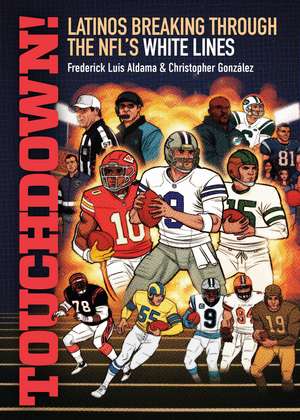
Touchdown!: Latinos Breaking Through the NFL's White Lines: Latinx Shorts
Autor Frederick Luis Aldama, Christopher Gonzálezen Limba Engleză Paperback – 10 noi 2026
An accessible, lively, and concise study of Latino participation in the NFL that is part sports history, part cultural analysis, and part love letter to those who break through color lines.
The NFL doesn’t want you to know: Latinos have been playing in the league since 1927. In Touchdown!, Frederick Luis Aldama and Christopher González tap interviews, archival research, and statistics to tell the story that generations of sports journalists have missed. They celebrate Cuban-born Lou Molinet’s leather-helmet debut, Steve Van Buren’s Hall of Fame rise, Tom Flores’s Lombardi trophies, and Jim Plunkett threading impossible passes. And they address those convergences of race, class, and athletic opportunity—such as pay-to-play youth leagues, housing segregation, legal exclusions to early citizenship, and racist stereotypes pushing Latino players away from “thinking” positions—that keep brown players on the sidelines. Part sports history, part cultural analysis, and part love letter to the those who break through color lines, Touchdown! fills a critical gap in sports literature and Latino studies and makes clear what the scoreboard has tried to erase: La cultura has been on the field the whole time.
The NFL doesn’t want you to know: Latinos have been playing in the league since 1927. In Touchdown!, Frederick Luis Aldama and Christopher González tap interviews, archival research, and statistics to tell the story that generations of sports journalists have missed. They celebrate Cuban-born Lou Molinet’s leather-helmet debut, Steve Van Buren’s Hall of Fame rise, Tom Flores’s Lombardi trophies, and Jim Plunkett threading impossible passes. And they address those convergences of race, class, and athletic opportunity—such as pay-to-play youth leagues, housing segregation, legal exclusions to early citizenship, and racist stereotypes pushing Latino players away from “thinking” positions—that keep brown players on the sidelines. Part sports history, part cultural analysis, and part love letter to the those who break through color lines, Touchdown! fills a critical gap in sports literature and Latino studies and makes clear what the scoreboard has tried to erase: La cultura has been on the field the whole time.
Preț: 165.93 lei
Precomandă
Puncte Express: 249
Carte nepublicată încă
Livrare prin curier în România Precomanda se expediază când titlul devine disponibil.
Transport gratuit de la 400.00 lei Plată online sau ramburs, în funcție de opțiunile comenzii.
Retur gratuit în 14 zile Comandă securizată și suport în română.
Doresc să fiu notificat când acest titlu va fi disponibil:
Se trimite...
Specificații
ISBN-13: 9780814259948
ISBN-10: 0814259944
Pagini: 224
Ilustrații: 22 color images
Dimensiuni: 127 x 178 mm
Greutate: 0.45 kg
Editura: Ohio State University Press
Colecția Ohio State University Press
Seria Latinx Shorts
ISBN-10: 0814259944
Pagini: 224
Ilustrații: 22 color images
Dimensiuni: 127 x 178 mm
Greutate: 0.45 kg
Editura: Ohio State University Press
Colecția Ohio State University Press
Seria Latinx Shorts
Recenzii
“Touchdown! goes beyond merely recounting the many ‘firsts’ of Latinos in the NFL to take a critical look at how Latino inclusion is often tied more to NFL market expansion rather than genuine acceptance of another group into the fold.”—Jorge Iber, author of The Sanchez Family: Mexican American High School and Collegiate Wrestlers from Cheyenne, Wyoming
“Touchdown! blitzes through history the NFL fumbled for decades. Aldama and González drive from pioneers like Tom Flores, Joe Kapp, and Jim Plunkett to the systemic barriers still keeping Latinos on the sidelines. For those of us who lived it, this book scores big. For everyone else, it’s a fourth-quarter wake-up call.” —Hank Olguin, Cal leading rusher, Rose Bowl ’59, and author of Who Let the Mexicans Play in the Rose Bowl?
“Rigorously researched yet accessible, Touchdown! centers the historically silenced presence of Latino players in the NFL, tracing their invisibility from the mid-twentieth century to our present-day social and legal institutions.” —Jennifer Domino Rudolph, author of Baseball as Mediated Latinidad: Race, Masculinity, Nationalism, and Performances of Identity
Notă biografică
Frederick Luis Aldama is the Jacob and Frances Sanger Mossiker Chair in the Humanities at the University of Texas at Austin, where he founded and directs the Latinx Pop Lab. He is the author or editor of many books, including Talking #browntv: Latinas and Latinos on the Screen and the Eisner-winning Latinx Superheroes in Mainstream Comics.Christopher González is Professor and Jacob and Frances Sanger Mossiker Endowed Chair in the Department of English at Southern Methodist University. He is the author or editor of numerous books, including Reel Latinxs: Representation in U.S. Film and TV and Permissible Narratives: The Promise of Latino/a Literature.
Extras
Ancient Ballgames to Modern Gridirons
Long before Jerry Jones built his billion-dollar stadium, our ancestors were constructing ballcourts that would make AT&T Stadium look like a Pop Warner field. The grand plazas of Mesoamerican cities hosted sophisticated ball games that combined athletic excellence, tactical genius, and cosmic significance. We’re talking about sporting venues at Chichen Itza and Teotihuacan that seated more people than some current NFL stadiums. From Chichen Itza and Copán to Monte Albán and El Tajín, 1,300 ballcourts have been identified across Mesoamerica, a density of sporting infrastructure that would put the modern NFL to shame. Except, instead of overpriced nachos, spectators witnessed rituals that could determine everything from rainfall to royal succession.
The Mesoamerican ballgame (known as pok ta’ pok, ōllamaliztli, or pitz depending on where you played) required athletes to keep a solid rubber ball in motion using primarily their hips, though some versions allowed forearms and elbows. Sound easy? Try doing it while wearing 40 pounds of protective gear (some carved from stone) and knowing that losing might literally cost you your head; though scholars still debate whether it was the winners or the losers who faced that particular consequence. These players demonstrated the same combination of individual brilliance and team coordination that separates Patrick Mahomes from your cousin who still talks about his high school glory days.
The game’s complexity went way beyond physical prowess. Players maneuvered for position, executed complex strategies, and aimed for stone rings mounted impossibly high on the court walls, basically threading a needle while getting body-slammed. This was sophisticated athletic competition that established templates still visible in modern football: specialized playing spaces, the ball as sacred object, the balance between individual heroics and collective effort, and most crucially, athletics as cultural performance that creates community meaning.
When Pedro Pascal raises a frosty Corona and channels “La Vida Más Fina,” he’s channeling thousands of years of cultural pride and athletic tradition. When Latino players strap on helmets and pads, they’re wearing the modern equivalent of the elaborate costumes and protective gear worn by ballplayers who were simultaneously athletes, warriors, and cosmic actors. Their performances could elevate them to godlike status or send them to the afterlife. Talk about playing with consequences.
Our historical perspective demolishes the racist nonsense about Latinos being newcomers to American sports. We brought to this continent a cultural appreciation for athletic competition that predates the Mayflower by about 3,000 years. We brought distinct approaches to teamwork rooted in familismo, community involvement that extends beyond helicopter parents, and the integration of sport into the fabric of daily life. Latino players have enriched a game that, without them, would be as bland as unseasoned ground beef.
Scrimmage Lines
In football, the line of scrimmage marks where the action starts, that contested space where opposing forces clash and possibilities emerge. For Latinos in professional football, this metaphor extends beyond hash marks and yard lines. It represents every barrier thrown up by a system designed to keep brown kids watching from the sidelines while white kids get handed scholarships and starting positions.
Nobody wants to talk about how football isn’t like pickup soccer in the barrio or basketball at the local court. You can’t just grab a ball and play. Football demands institutional support: Equipment that costs more than some families’ monthly rent, coaches who know the difference between a 3-4 and a 4-3 defense, organized leagues with referees and insurance policies. This dependence on educational institutions means that any honest discussion of Latino underrepresentation in the NFL has to reckon with how schools have systematically screwed over Latino youth for generations.
Victoria-María MacDonald drops truth bombs in Latino Education in the United States when she writes: “The history of the education of Latinos in the United States is a story of exclusion and inclusion, of marginalization and integration, of struggle and success.” That’s academic speak for: We’ve been getting screwed, fighting back, getting screwed some more, and occasionally breaking through despite the odds. MacDonald shows how “state governments, higher educational institutions, and local school boards have either created spaces for Latino participation or actively excluded them from educational opportunities." Translation: The same institutions that should have been developing the next generation of Latino NFL stars were too busy pushing our kids toward vocational training and English-only policies.
Long before Jerry Jones built his billion-dollar stadium, our ancestors were constructing ballcourts that would make AT&T Stadium look like a Pop Warner field. The grand plazas of Mesoamerican cities hosted sophisticated ball games that combined athletic excellence, tactical genius, and cosmic significance. We’re talking about sporting venues at Chichen Itza and Teotihuacan that seated more people than some current NFL stadiums. From Chichen Itza and Copán to Monte Albán and El Tajín, 1,300 ballcourts have been identified across Mesoamerica, a density of sporting infrastructure that would put the modern NFL to shame. Except, instead of overpriced nachos, spectators witnessed rituals that could determine everything from rainfall to royal succession.
The Mesoamerican ballgame (known as pok ta’ pok, ōllamaliztli, or pitz depending on where you played) required athletes to keep a solid rubber ball in motion using primarily their hips, though some versions allowed forearms and elbows. Sound easy? Try doing it while wearing 40 pounds of protective gear (some carved from stone) and knowing that losing might literally cost you your head; though scholars still debate whether it was the winners or the losers who faced that particular consequence. These players demonstrated the same combination of individual brilliance and team coordination that separates Patrick Mahomes from your cousin who still talks about his high school glory days.
The game’s complexity went way beyond physical prowess. Players maneuvered for position, executed complex strategies, and aimed for stone rings mounted impossibly high on the court walls, basically threading a needle while getting body-slammed. This was sophisticated athletic competition that established templates still visible in modern football: specialized playing spaces, the ball as sacred object, the balance between individual heroics and collective effort, and most crucially, athletics as cultural performance that creates community meaning.
When Pedro Pascal raises a frosty Corona and channels “La Vida Más Fina,” he’s channeling thousands of years of cultural pride and athletic tradition. When Latino players strap on helmets and pads, they’re wearing the modern equivalent of the elaborate costumes and protective gear worn by ballplayers who were simultaneously athletes, warriors, and cosmic actors. Their performances could elevate them to godlike status or send them to the afterlife. Talk about playing with consequences.
Our historical perspective demolishes the racist nonsense about Latinos being newcomers to American sports. We brought to this continent a cultural appreciation for athletic competition that predates the Mayflower by about 3,000 years. We brought distinct approaches to teamwork rooted in familismo, community involvement that extends beyond helicopter parents, and the integration of sport into the fabric of daily life. Latino players have enriched a game that, without them, would be as bland as unseasoned ground beef.
Scrimmage Lines
In football, the line of scrimmage marks where the action starts, that contested space where opposing forces clash and possibilities emerge. For Latinos in professional football, this metaphor extends beyond hash marks and yard lines. It represents every barrier thrown up by a system designed to keep brown kids watching from the sidelines while white kids get handed scholarships and starting positions.
Nobody wants to talk about how football isn’t like pickup soccer in the barrio or basketball at the local court. You can’t just grab a ball and play. Football demands institutional support: Equipment that costs more than some families’ monthly rent, coaches who know the difference between a 3-4 and a 4-3 defense, organized leagues with referees and insurance policies. This dependence on educational institutions means that any honest discussion of Latino underrepresentation in the NFL has to reckon with how schools have systematically screwed over Latino youth for generations.
Victoria-María MacDonald drops truth bombs in Latino Education in the United States when she writes: “The history of the education of Latinos in the United States is a story of exclusion and inclusion, of marginalization and integration, of struggle and success.” That’s academic speak for: We’ve been getting screwed, fighting back, getting screwed some more, and occasionally breaking through despite the odds. MacDonald shows how “state governments, higher educational institutions, and local school boards have either created spaces for Latino participation or actively excluded them from educational opportunities." Translation: The same institutions that should have been developing the next generation of Latino NFL stars were too busy pushing our kids toward vocational training and English-only policies.
Cuprins
Contents
List of Illustrations
Acknowledgments
Chapter 1 Kick Off: A Century of Erasure
Chapter 2 Gains to Time-Outs: The Myth of Meritocracy
Chapter 3 Huddles to Blitzes: The Bonds That Break
Chapter 4 Offense/Defense: The White Racial Frame
Chapter 5 False Starts to Face Masks: The Illusion of Progress
Chapter 6 Turnovers to Pass Interference: War, Opportunity, and Exile
Chapter 7 Red Zones to Touchdowns: The Politics of Inclusion
Chapter 8 Safety and Gridirons: Survival and Its Costs
Chapter 9 Instant Replays to Halftimes: The Spectacle of Otherness
Chapter 10 Sacks to Moving Chains: Grinding Forward
Timeline
Works Cited and Further Reading
About the Autores
Index
List of Illustrations
Acknowledgments
Chapter 1 Kick Off: A Century of Erasure
Chapter 2 Gains to Time-Outs: The Myth of Meritocracy
Chapter 3 Huddles to Blitzes: The Bonds That Break
Chapter 4 Offense/Defense: The White Racial Frame
Chapter 5 False Starts to Face Masks: The Illusion of Progress
Chapter 6 Turnovers to Pass Interference: War, Opportunity, and Exile
Chapter 7 Red Zones to Touchdowns: The Politics of Inclusion
Chapter 8 Safety and Gridirons: Survival and Its Costs
Chapter 9 Instant Replays to Halftimes: The Spectacle of Otherness
Chapter 10 Sacks to Moving Chains: Grinding Forward
Timeline
Works Cited and Further Reading
About the Autores
Index
Descriere
Tells the long and lively history of Latinos in the NFL, celebrating successes and explaining institutional barriers to fill a critical gap in sports literature and Latina/o/e studies.