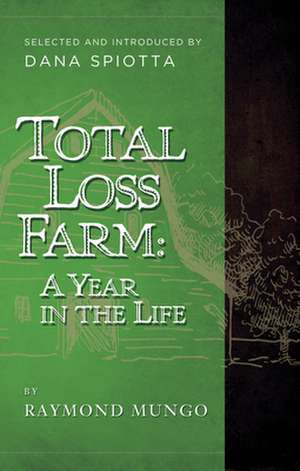
Total Loss Farm
Autor Raymond Mungoen Limba Engleză Paperback – 11 noi 2014
In making her selection for Pharos Editions, Dana Spiotta tells us how drawn she was by the work of Raymond Mungo. “[He] writes . . . about his own joy and his own pain, he is particularly good when he describes the land around him and how it feels on his body.”
Indeed, if Henry David Thoreau had downed a handful of liberty caps before penning Walden it would have read much like Mungo’s Total Loss Farm, a rollicking memoir of the late 1960’s back-to-the-earth movement. Written in a limber prose style formed by the tempo of the times, Mungo takes us into the cultural tsunami of a failed radical politics as it broke on the shoals of a drug-fueled personal freedom and washed inland across the farmlands of Vermont, leaving a trail of damage and redemption in its wake.
Total Loss Farm attracted widespread critical and commercial attention in 1970, when the "back-to-the-land" hippie commune movement first emerged. The book's first section, "Another Week on the Concord and Merrimack Rivers," appeared as the cover article in the May 1970 issue of Atlantic Monthly. The hardcover first edition from Dutton was quickly followed by paperback editions from Bantam, Avon, and Madrona Publishers, keeping the book in print for several decades. Very recently, Dwight Garner in the New York Times Book Review cited Total Loss Farm as "the best and also the loopiest of the commune books."
Indeed, if Henry David Thoreau had downed a handful of liberty caps before penning Walden it would have read much like Mungo’s Total Loss Farm, a rollicking memoir of the late 1960’s back-to-the-earth movement. Written in a limber prose style formed by the tempo of the times, Mungo takes us into the cultural tsunami of a failed radical politics as it broke on the shoals of a drug-fueled personal freedom and washed inland across the farmlands of Vermont, leaving a trail of damage and redemption in its wake.
Total Loss Farm attracted widespread critical and commercial attention in 1970, when the "back-to-the-land" hippie commune movement first emerged. The book's first section, "Another Week on the Concord and Merrimack Rivers," appeared as the cover article in the May 1970 issue of Atlantic Monthly. The hardcover first edition from Dutton was quickly followed by paperback editions from Bantam, Avon, and Madrona Publishers, keeping the book in print for several decades. Very recently, Dwight Garner in the New York Times Book Review cited Total Loss Farm as "the best and also the loopiest of the commune books."
Preț: 68.23 lei
Puncte Express: 102
Carte indisponibilă temporar
Livrare prin curier în România Termenul estimat este afișat lângă disponibilitate.
Transport gratuit de la 400.00 lei Plată online sau ramburs, în funcție de opțiunile comenzii.
Retur gratuit în 14 zile Comandă securizată și suport în română.
Specificații
ISBN-13: 9781940436036
ISBN-10: 1940436036
Pagini: 176
Dimensiuni: 140 x 210 x 10 mm
Greutate: 0.22 kg
Editura: CATAPULT
ISBN-10: 1940436036
Pagini: 176
Dimensiuni: 140 x 210 x 10 mm
Greutate: 0.22 kg
Editura: CATAPULT
V-ar putea interesa
-
 Slaves in the FamilyEdward BallPreț: 149.46 lei
 -
 On Two FrontsSgt Adam FennerPreț: 139.17 lei
 -
 Lightning FieldDana SpiottaPreț: 87.05 lei
 -
 Eat the DocumentDana SpiottaPreț: 99.21 lei
 -
 Funeral in a Feminine DressMj Burke SrPreț: 85.34 lei
 -
 -27%Preț: 67.92 lei92.87 lei
 -
 Stone ArabiaDana SpiottaPreț: 93.52 lei
 -
 PragueCharles Ota HellerPreț: 123.20 lei
 -
 My Memoir WorkbookMarcia RosenPreț: 84.18 lei
 -
 Enter Miss ThangBrian EdwardsPreț: 309.82 lei
 -
 CleanChris Beckman-21%Preț: 86.07 lei108.95 lei
 -
 Small PiecesJoanne Limburg-18%Preț: 53.65 lei65.17 lei
 -
 -20%Preț: 62.48 lei77.79 lei
Notă biografică
Raymond Mungo is a prolific author of many books and journalism dating from the late 1960s, when he was a radical leader and founder of the underground press’ Liberation News Service and “Total Loss Farm,” one of the first hippie communes in the US. He has been a social worker for the mentally ill in Long Beach, California, where he lives and writes.
Dana Spiotta is the author of the novels Stone Arabia, Eat the Document, and The Lightning Field. She as a final for the 2006 National Book Award and a recipient of the Rosenthal Foundation Award from the American Academy of Arts and Letters. She teaches in the Syracuse University MFA program and lives in Central New York with her daughter and husband.
Dana Spiotta is the author of the novels Stone Arabia, Eat the Document, and The Lightning Field. She as a final for the 2006 National Book Award and a recipient of the Rosenthal Foundation Award from the American Academy of Arts and Letters. She teaches in the Syracuse University MFA program and lives in Central New York with her daughter and husband.
Extras
Introduction by Dana Spiotta
I first came across Raymond Mungo’s books when I was doing research for my 2006 novel Eat the Document. Raymond Mungo’s two consecutive memoirs,Famous Long Ago, My Life and Times in the Liberation News Service (1969) and Total Loss Farm: A Year in the Life (1970), were written contemporaneous with the times by someone who was deeply involved in the youth movement. For me the entry point in writing about something—a moment in history, for instance--is always language. Mungo’s books stood out right away with the rhythms and sound of what it was like to be young in America in the late 1960s. So much about the generation that came of age in the 1960s has become overlaid with cliché and easy reductions. Even in the dry wit of his titles, Mungo gives us the raw moment in all its complexity, and I believe these powerful books are a significant part of the American memory of how we got to where we find ourselves now.
Raymond Mungo wrote his first book, Famous Long Ago, in 1969 when he was 23 years old. It tells his version of the history of the Liberation New Service, which he co-founded with Martin Bloom when he was an undergraduate at Boston College. Liberation News Service (LNS, I love the name—militant and easily made into a nice intialism, which the New Left was so fond of, like SDS) was like the Associated Press for the underground. It brought the unreported news about the war and the details of the movement to campuses and communities that didn’t have access to a local underground paper. In the Internet age again and again we have seen the radicalizing effect access to information can have for a grassroots political movement. Mungo and the LNS were savvy about the power of information, and the underground press was vital in getting turnout to protests and bringing radical groups together. More broadly they were able to suggest an alternative to the mainstream, not just in content but in method. The LNS (and the underground) was looser, freer and more subjective. The proliferation of underground presses helped create the identity and sensibility of the counterculture. In their proto-DIY way, they were creating a space independent of the establishment complete with different values, different newspapers, different language, different music, and different lives.
Famous Long Ago also documents the crashing and splitting of LNS. As the war and the draft raged on despite the growing and nearly mainstream anti-war movement, the disillusionment grew. The Movement and in particular the New Left, the leaders of the Movement, fell into some famous and complex sectarian disputes. LNS was split between what Mungo calls, with his usual wit, the “Vulgar Marxists” and the more artistic and poetic ambitions of Mungo and Bloom. The book ends with Mungo and Bloom absconding to Vermont with the printing press and the LNS money. They retreat to rural and pastoral places, as many young people did in the wake of Nixon’s election and the trauma of 1968. This “back to the land” movement took the form of communes and rural enclaves all across the United States. Some were elaborate living experiments, like the (amazing) Diggers’ and Free Family commune Black Bear Ranch in California, The Farm in Tennessee, and Drop City in New Mexico, and some were smaller scale, like Total Loss Farm in Vermont. Most lasted only a few years. But in un appreciated ways they inaugurated waves of the counterculture that would be felt even longer than the antiwar movement (which in many ways was a failure). From the rural experiments of the late 1960s and early 1970s, we get an early critique of consumer and corporate culture. But Mungo was also aware that this impulse has a long history in America, and he refers to Thoreau (often just “Henry”) throughout the book. Mungo sees the pollution everywhere, and he passionately bemoans the development and industry that cause it. Mungo is disdainful—as many were—of the new cars that must be bought every three years, of the suburbs, and of what he calls “booger” living. The profound feeling one gets from these experiments is a desire to restart, to shake off the conventions of received ideas of what it means to be citizen. In that way, it helped mainstream the identity movements of the 1970s. These were thought experiments as much as living experiments: what if we were not stuck? What if we were truly liberated? As impossible as it is to actually discard the limits you were raised with, the reverberations of their efforts changed us forever.
Interestingly, Mungo doesn’t idealize or sentimentalize his experience. Total Loss Farm is intent on being honest. He even admits that this book was written to get money for the farm in what he calls a “burn scheme” in which you use legit money for radical purposes, like his book advance. His honesty is also right there in the title: Total Loss Farm. He says “It is called Total Loss Farm because it produces nothing visible to the mature eye—all the livestock, machinery, seeds, and such tools and not even one peach or can of maple syrup makes it as far as the Market. And nobody who goes in there to stay has been seen alive again.” But Total Loss Farm is also the place you go to lose yourself—your corrupt, ego-driven self—and become close to the earth where you can live an authentic, humble life. The communes are animated by a refusal, and Mungo makes this clear. He, the former journalist, doesn’t even read the paper anymore. He, the despairing radical, pointedly avoids attending the Moratorium to stop the war on November 15. But however much “back to the land” is a retreat, it is not a giving up. You drop out to leave something, but you also drop out to make something new. This is harder than the city and suburban youth ever imagined. Winter is long, and living off the grid with no money tests everyone’s resolve. But Mungo captures how needed the discomfort was. To feel cold was to feel something real and it made the very complicated world feel simpler. Total Loss Farm is essentially a diary of a very bad year: bad for Mungo and bad for America. The book begins in the fall of 1969 with the suicide of LNS’s co-founder. The pastoral fantasy of going back to the land is already fraught. Some time has passed living on the farm. He leaves and wanders across the country. He gets drive-a-way cars and relies on the largesse of groovy people everywhere. He returns to Vermont until the book comes full circle in the fall of 1970. All along he records his intensely felt impressions in his characteristic deeply subjective style. But he writes very well about his own joy and his own pain, and he is particularly good when he describes the land around him and how it feels it on his body:
“The road keeps twisting and climbing, so the limits of our vision extend no more than 20 feet. Sitting on the fieldstone, we suddenly realize the din and thunder of our very feet had been drowning out the birds. Sitting still, we can hear them come back to life—unceasing and chatty, they are playing in harmony with the delicate swosh of a waterfall just up ahead...Lying on the fieldstone, we must shelter our eyes from the blinking sun among the needles overhead.”
He is equally good on the despair of winter:
“The late winter, more than any other season, locks us in and ensures our privacy, mud season in March forbids autos within miles of our cottage, bitter winds and the accumulated snows of yesteryear make the universe outside forbidding and dreary, wood supplies run low and wet until we huddle all in one over the same stove, foodstuffs preserved and frozen from summer run out altogether, automobiles die clanking and unregistered, all the money’s gone, we burst into a full year’s close saving of tears.”
Total Loss Farm is a first-hand account of a decisive moment when the intense idealism of the anti-war movement scattered. At its best the book achieves a genuine poignancy. The young bruised idealists have a brutal comedown (“a colossal bummer”) while Nixon and the establishment rule the land. The desire to change the world gets downgraded to just trying to change yourself, and even that was difficult. It is moving to see how much Mungo and so many others were willing to put on the line, and how reluctant they were to give up their dream of a New Age. The communes of the 70s are often characterized as failures, but only because their ambition was so large. We feel the success of their legacy all through Mungo’s book, and how prescient they were about the environment, local and organic food, consumer culture and the dangers to the American future that lay in the unfettered power and influence of corporate entities.
Raymond Mungo’s books are essential reading for anyone who wants to understand the young people who came of age during the Vietnam War era, that deeply influential and idealistic generation. Despite Mungo’s insistence that we must erase the past (1970 is Year Zero) and to begin anew (which is an American perfectionist’s conceit, or a young radical’s required disposition), I think we must remember and understand the past, particularly the beautiful, scarcely documented moments of subversive joy that have occurred over and over in the history of these United States. The past fortifies us for the future. We can only know where we are if we understand what led us to this palce. Total Loss Farm is a significant part of the story of how we got from there to here.
-Dana Spiotta, November 2013
I first came across Raymond Mungo’s books when I was doing research for my 2006 novel Eat the Document. Raymond Mungo’s two consecutive memoirs,Famous Long Ago, My Life and Times in the Liberation News Service (1969) and Total Loss Farm: A Year in the Life (1970), were written contemporaneous with the times by someone who was deeply involved in the youth movement. For me the entry point in writing about something—a moment in history, for instance--is always language. Mungo’s books stood out right away with the rhythms and sound of what it was like to be young in America in the late 1960s. So much about the generation that came of age in the 1960s has become overlaid with cliché and easy reductions. Even in the dry wit of his titles, Mungo gives us the raw moment in all its complexity, and I believe these powerful books are a significant part of the American memory of how we got to where we find ourselves now.
Raymond Mungo wrote his first book, Famous Long Ago, in 1969 when he was 23 years old. It tells his version of the history of the Liberation New Service, which he co-founded with Martin Bloom when he was an undergraduate at Boston College. Liberation News Service (LNS, I love the name—militant and easily made into a nice intialism, which the New Left was so fond of, like SDS) was like the Associated Press for the underground. It brought the unreported news about the war and the details of the movement to campuses and communities that didn’t have access to a local underground paper. In the Internet age again and again we have seen the radicalizing effect access to information can have for a grassroots political movement. Mungo and the LNS were savvy about the power of information, and the underground press was vital in getting turnout to protests and bringing radical groups together. More broadly they were able to suggest an alternative to the mainstream, not just in content but in method. The LNS (and the underground) was looser, freer and more subjective. The proliferation of underground presses helped create the identity and sensibility of the counterculture. In their proto-DIY way, they were creating a space independent of the establishment complete with different values, different newspapers, different language, different music, and different lives.
Famous Long Ago also documents the crashing and splitting of LNS. As the war and the draft raged on despite the growing and nearly mainstream anti-war movement, the disillusionment grew. The Movement and in particular the New Left, the leaders of the Movement, fell into some famous and complex sectarian disputes. LNS was split between what Mungo calls, with his usual wit, the “Vulgar Marxists” and the more artistic and poetic ambitions of Mungo and Bloom. The book ends with Mungo and Bloom absconding to Vermont with the printing press and the LNS money. They retreat to rural and pastoral places, as many young people did in the wake of Nixon’s election and the trauma of 1968. This “back to the land” movement took the form of communes and rural enclaves all across the United States. Some were elaborate living experiments, like the (amazing) Diggers’ and Free Family commune Black Bear Ranch in California, The Farm in Tennessee, and Drop City in New Mexico, and some were smaller scale, like Total Loss Farm in Vermont. Most lasted only a few years. But in un appreciated ways they inaugurated waves of the counterculture that would be felt even longer than the antiwar movement (which in many ways was a failure). From the rural experiments of the late 1960s and early 1970s, we get an early critique of consumer and corporate culture. But Mungo was also aware that this impulse has a long history in America, and he refers to Thoreau (often just “Henry”) throughout the book. Mungo sees the pollution everywhere, and he passionately bemoans the development and industry that cause it. Mungo is disdainful—as many were—of the new cars that must be bought every three years, of the suburbs, and of what he calls “booger” living. The profound feeling one gets from these experiments is a desire to restart, to shake off the conventions of received ideas of what it means to be citizen. In that way, it helped mainstream the identity movements of the 1970s. These were thought experiments as much as living experiments: what if we were not stuck? What if we were truly liberated? As impossible as it is to actually discard the limits you were raised with, the reverberations of their efforts changed us forever.
Interestingly, Mungo doesn’t idealize or sentimentalize his experience. Total Loss Farm is intent on being honest. He even admits that this book was written to get money for the farm in what he calls a “burn scheme” in which you use legit money for radical purposes, like his book advance. His honesty is also right there in the title: Total Loss Farm. He says “It is called Total Loss Farm because it produces nothing visible to the mature eye—all the livestock, machinery, seeds, and such tools and not even one peach or can of maple syrup makes it as far as the Market. And nobody who goes in there to stay has been seen alive again.” But Total Loss Farm is also the place you go to lose yourself—your corrupt, ego-driven self—and become close to the earth where you can live an authentic, humble life. The communes are animated by a refusal, and Mungo makes this clear. He, the former journalist, doesn’t even read the paper anymore. He, the despairing radical, pointedly avoids attending the Moratorium to stop the war on November 15. But however much “back to the land” is a retreat, it is not a giving up. You drop out to leave something, but you also drop out to make something new. This is harder than the city and suburban youth ever imagined. Winter is long, and living off the grid with no money tests everyone’s resolve. But Mungo captures how needed the discomfort was. To feel cold was to feel something real and it made the very complicated world feel simpler. Total Loss Farm is essentially a diary of a very bad year: bad for Mungo and bad for America. The book begins in the fall of 1969 with the suicide of LNS’s co-founder. The pastoral fantasy of going back to the land is already fraught. Some time has passed living on the farm. He leaves and wanders across the country. He gets drive-a-way cars and relies on the largesse of groovy people everywhere. He returns to Vermont until the book comes full circle in the fall of 1970. All along he records his intensely felt impressions in his characteristic deeply subjective style. But he writes very well about his own joy and his own pain, and he is particularly good when he describes the land around him and how it feels it on his body:
“The road keeps twisting and climbing, so the limits of our vision extend no more than 20 feet. Sitting on the fieldstone, we suddenly realize the din and thunder of our very feet had been drowning out the birds. Sitting still, we can hear them come back to life—unceasing and chatty, they are playing in harmony with the delicate swosh of a waterfall just up ahead...Lying on the fieldstone, we must shelter our eyes from the blinking sun among the needles overhead.”
He is equally good on the despair of winter:
“The late winter, more than any other season, locks us in and ensures our privacy, mud season in March forbids autos within miles of our cottage, bitter winds and the accumulated snows of yesteryear make the universe outside forbidding and dreary, wood supplies run low and wet until we huddle all in one over the same stove, foodstuffs preserved and frozen from summer run out altogether, automobiles die clanking and unregistered, all the money’s gone, we burst into a full year’s close saving of tears.”
Total Loss Farm is a first-hand account of a decisive moment when the intense idealism of the anti-war movement scattered. At its best the book achieves a genuine poignancy. The young bruised idealists have a brutal comedown (“a colossal bummer”) while Nixon and the establishment rule the land. The desire to change the world gets downgraded to just trying to change yourself, and even that was difficult. It is moving to see how much Mungo and so many others were willing to put on the line, and how reluctant they were to give up their dream of a New Age. The communes of the 70s are often characterized as failures, but only because their ambition was so large. We feel the success of their legacy all through Mungo’s book, and how prescient they were about the environment, local and organic food, consumer culture and the dangers to the American future that lay in the unfettered power and influence of corporate entities.
Raymond Mungo’s books are essential reading for anyone who wants to understand the young people who came of age during the Vietnam War era, that deeply influential and idealistic generation. Despite Mungo’s insistence that we must erase the past (1970 is Year Zero) and to begin anew (which is an American perfectionist’s conceit, or a young radical’s required disposition), I think we must remember and understand the past, particularly the beautiful, scarcely documented moments of subversive joy that have occurred over and over in the history of these United States. The past fortifies us for the future. We can only know where we are if we understand what led us to this palce. Total Loss Farm is a significant part of the story of how we got from there to here.
-Dana Spiotta, November 2013